


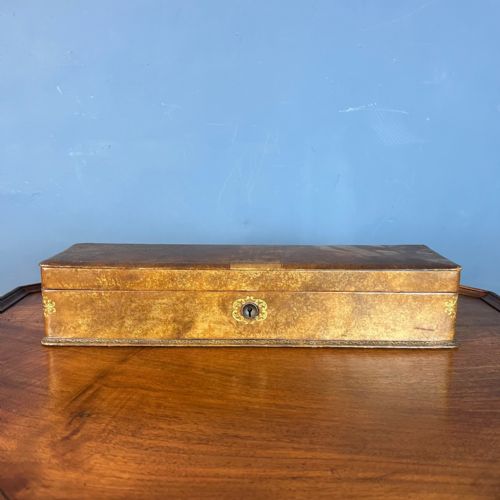


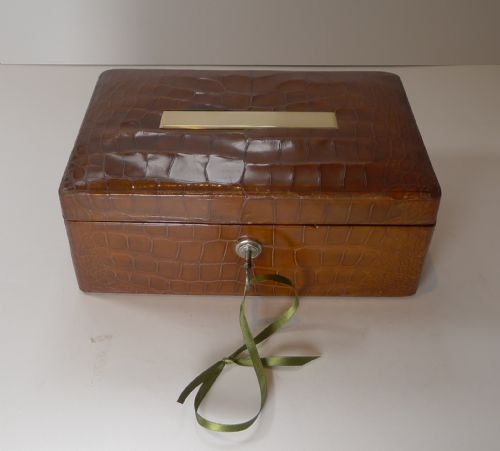

Leather Document Casket
A leather document casket is a sturdy storage box designed to hold papers securely, offering both period utility and rich texture.
Leather Document Casket
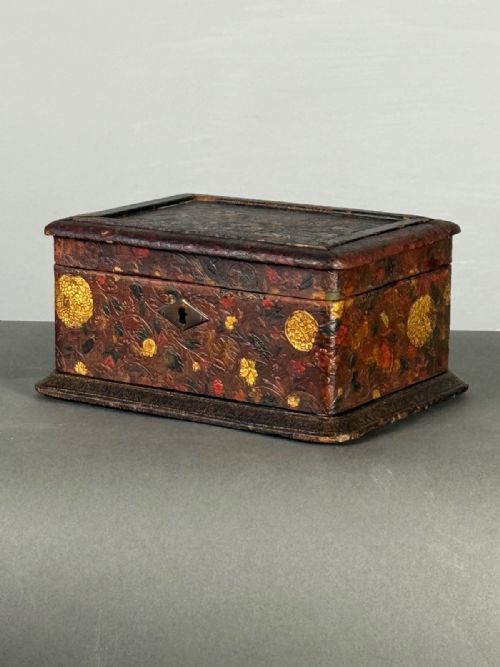
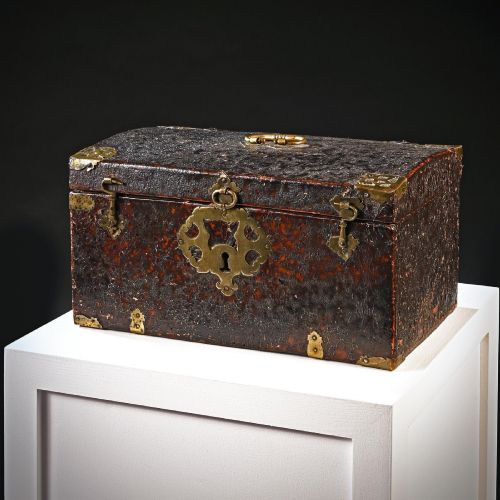
When you search for a leather document casket, you encounter sturdy storage boxes designed to hold valuable papers and precious items securely. The versions met on this page span several centuries, including 17th Century examples, Georgian caskets, Regency writing slopes, and Victorian tooled boxes.
These pieces function as both desk accessories and decorative boxes, often taking the form of rectangular caskets, faux books, or travelling chests. Materials range from traditional leather and pigskin to exotic crocodile skin, paired with timber frames and metal hardware.
Origins stretch across English, French, and Chinese workshops, showing how different makers adapted the basic form for travel, study, or parlour use. You find both restrained early designs and more elaborate 19th Century French polychrome creations.
How they were made
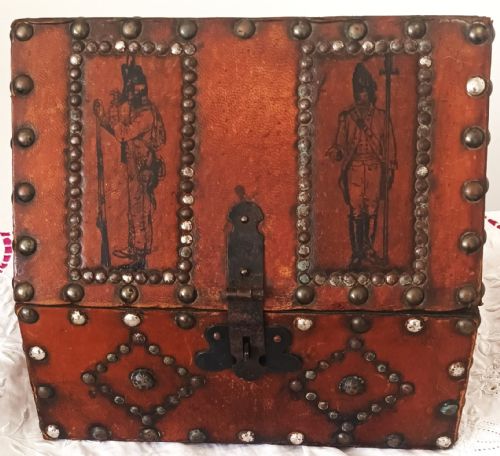
Construction relies on a core of wood or metal covered in cattle hide, pigskin, or reptile skin, secured with brass studs, mounts, or hinges. Artisans applied gold leaf tooling and pigment to ornament the surfaces of finer boxes.
Hardware such as rosette shaped brass mounts, claw and ball feet, and iron locks provided structural reinforcement as well as decoration. Interiors frequently featured fabric linings tailored to hold jewellery, writing equipment, or documents safely.
The listings span from the 17th century through the Victorian era to the mid-20th century, incorporating wood, brass, iron, and gold leaf.
What varies in quality
Quality shows in the precision of the leatherwork, from the depth and clarity of gold leaf tooling to the seamless wrapping of corners and edges. Superior boxes use heavier wood foundations and durable hides such as pigskin or thick cattle leather.
The sophistication of the metalwork also separates tiers, with cast brass mounts, engraved lockplates, and stable hinges indicating higher workshop standards. Original interior fabric linings and functioning locks with matching keys elevate a piece.
Susse Freres Paris
The Leather Document Casket Glossary
- Casket
- A decorative box used for holding valuables, documents, or jewellery. These pieces often feature hinged lids and secure locking mechanisms.
- Chasse
- A box or reliquary shaped like a house with a pitched roof. This form appears in antique leather-bound examples.
- Writing slope
- A desk accessory with a slanted writing surface that opens to reveal storage compartments for paper and ink. Some examples combine this function with jewellery storage.
- Tooled leather
- Leather decorated by pressing heated metal tools into the surface to create patterns or imagery. Gold leaf is frequently applied within these impressions.
- Regency
- An English stylistic period spanning the early 19th century. Pieces from this era often feature classical restraint and refined brass mounts.
Leather Document Casket: Frequently Asked Questions
What is a leather document casket?
A leather document casket is a rigid container wrapped in hide, built to protect important papers and valuables from dust and handling.
Historically used by merchants, travellers, and officials, these boxes combined secure storage with portable elegance.
How were these boxes used?
Owners stored deeds, letters, currency, and sometimes jewellery inside them, often keeping them on desks or taking them on journeys.
Travel versions featured robust brass hardware and secure locks to withstand the rigours of movement.
How do I date a leather box?
Dating relies on observing the structural materials, the style of the brass mounts, and the nature of the leather tooling.
Earlier examples from the 17th century display simpler, heavier construction, while Victorian and later pieces show more varied ornamentation.
Can I use one for modern storage?
These caskets accommodate modern letters, photographs, and small keepsakes effectively while adding period character to a room.
Placing them on a desk or shelf preserves their decorative presence in a contemporary interior.
What hides were used?
Makers utilised standard cattle leather, pigskin, and exotic skins such as crocodile or alligator depending on the period and budget.
Each hide aged differently, developing distinct patinas over decades of handling.