
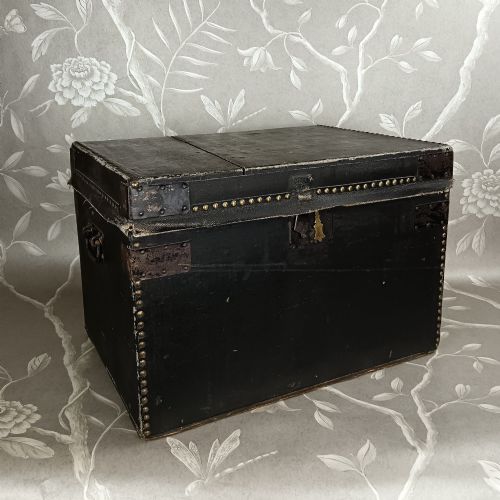
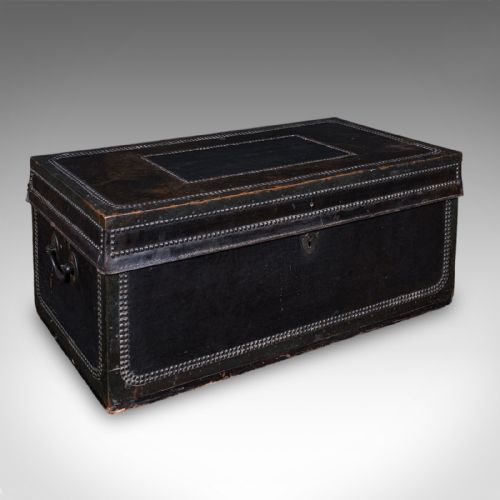


Leather Campaign Luggage
Leather campaign luggage brings durable travel history into modern rooms, offering robust brass-bound protection built for distant journeys.
Leather Campaign Luggage
Leather campaign luggage encompasses sturdy travel chests, trunks, and cases designed for portability and endurance during military and civilian expeditions. These pieces originate from periods ranging from the Georgian and Regency eras through the Victorian and Edwardian decades, up to the 1920s.
Buyers most frequently encounter Victorian and 19th-century examples on this page, often constructed with reinforced corners and designated for officers or travellers. Forms include coaching trunks, double hat cases, and strong boxes, reflecting the diverse storage needs of past travellers.
Makers and retailers marked their creations, leaving names stamped into hide or inscribed on brass plates. The materials span traditional leathers, hides, and canvas paired with structural timber and metal mountings.
How leather campaign luggage was made
Makers built these trunks around robust wooden frames, often utilising timbers such as camphorwood alongside iron and brass reinforcement. Heavy leather or hide covers the exterior, secured by metal bands, studs, and protective corner plates.
Brass corners, handles, and locks provided structural strength and shielded vulnerable edges during rough transit. Skilled craftsmen stitched thick hide and applied black canvas or lacquered finishes to withstand moisture and heavy handling on the road.
Several travel trunks retain their original interior hat compartments and initial plates, hinting at the specific wardrobes of Victorian gentlemen on the move.
What varies in quality
The standard of construction distinguishes utilitarian trunks from bespoke pieces commissioned from notable makers. Superior examples feature fitted interiors, robust brass hardware, and premium hide that retains its supple strength.
Original maker signatures, such as those by Wm. Insall, Chapple & Sons, or Drew & Sons, elevate a piece. The precision of the brass-bound joinery and the intact nature of internal compartments indicate the level of craftsmanship involved.
Wm. Insall of Bristol·Chapple & Sons·JW Allen·Seabrook of St.Pauls·Drew & Sons
The Leather Campaign Luggage Glossary
- Campaign case
- A portable container designed for military officers or travellers on the move. These pieces usually feature recessed brass handles and reinforced corners for durability.
- Coaching trunk
- A sturdy chest shaped to fit atop a horse-drawn coach or carriage. They are built with heavy leather or hide over wood to endure exterior travel conditions.
- Camphorwood
- An aromatic timber frequently utilised for the internal structure of travel chests. Its natural scent helped deter insects from stored garments during long voyages.
- Hide
- A heavy animal skin used to cover and protect travelling trunks. It provides a durable exterior layer that resists wear and moisture.
- Brass-bound
- A method of reinforcing edges and corners with strips and brackets of brass. This technique prevents structural damage during rough transit.
Leather Campaign Luggage: Frequently Asked Questions
What materials were used for these trunks?
Makers combined heavy leather, hide, and black canvas with structural wood frames. Metals such as brass, iron, and steel provided protective binding, corner plates, and secure locks.
Internal compartments sometimes incorporated fragrant woods like camphorwood to protect stored items.
How can I clean vintage leather luggage?
Dust the surface gently with a soft brush and apply a suitable conservation-grade leather dressing to maintain flexibility. Avoid harsh modern cleaning chemicals that can strip original finishes.
Keep the leather away from direct sunlight and damp environments to preserve the material over time.
Where were these pieces used?
These trunks accompanied military officers, colonial administrators, and civilian travellers across distant territories. They were built to endure rough handling on ships, trains, and horse-drawn carriages.
Today, collectors place them in living spaces as coffee tables or storage chests that reflect travel history.