

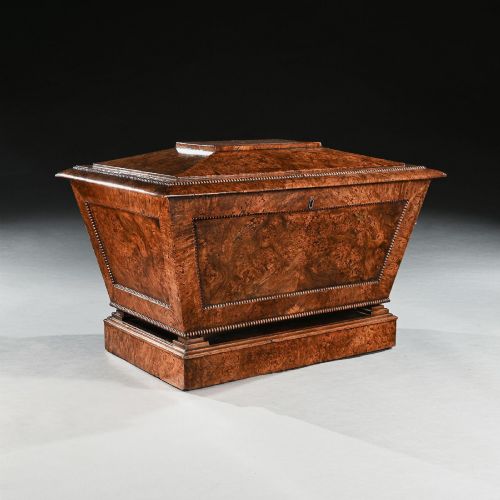
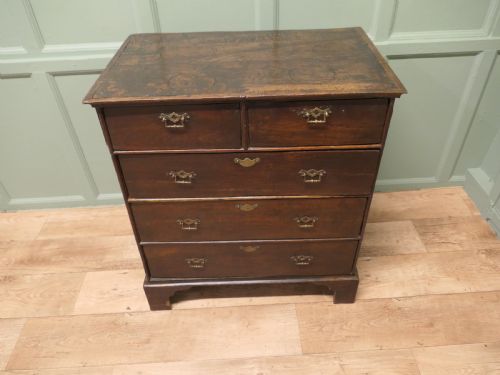


Late Georgian Oak Chest
A late georgian oak chest brings honest grain, heavy timber, and utilitarian grace into a modern bedroom.
Late Georgian Oak Chest
When you search for a late georgian oak chest, you find substantial storage furniture built from resilient native timber during the late eighteenth and early nineteenth centuries. These pieces encompass standard chests of drawers, mule chests with lower drawers, and taller formats like tallboys and press cupboards.
The version you are most likely to meet on this page is the classic rectangular chest of drawers or mule chest showing deep patination and simple brass hardware. Regional variations, such as Lancashire examples, appear alongside straightforward domestic pieces made for everyday storage.
Makers of this era constructed these carcases to endure decades of hard household use, relying on sturdy pegged joints and thick timber rather than delicate veneers. Today, collectors value this durability and the rich warmth that unpainted oak acquires over centuries.
What varies in quality
The upper tier of these pieces displays timber selection with strong medullary rays and deep, untouched patination acquired through generations of polishing. Poorer examples suffer from abrasive stripping that removes the soft amber tones of the original surface.
Structural integrity separates a fine survival from a heavily rebuilt piece, particularly where feet, top boards, and drawer runners have been replaced. Original brasses and clean, unwarped drawer bottoms elevate the standing of any standard chest.
Late Georgian Oak Chest Retail Price Guide 2026
Typical asking prices for late georgian oak chest among the pieces listed under this phrase on Sellingantiques today, from the lower quarter to the upper quarter. They describe what is for sale here now, not the wider market.
One mule chest clearly lived a double life with a slate top bolted on, perhaps doubling as an impromptu kitchen prep station.
The Late Georgian Oak Chest Glossary
- Mule chest
- A storage chest featuring one or more drawers built into the base beneath the main lifting lid compartment. This hybrid form bridges the traditional blanket chest and the chest of drawers.
- Tallboy
- A tall chest of drawers consisting of one chest stacked vertically upon another, maximising vertical storage capacity. These pieces require careful placement in rooms with standard ceiling heights.
- Crossbanding
- A decorative border of veneer laid around the perimeter of a drawer front or top board with the grain running perpendicular to the centre panel. This technique frames the primary oak surface with contrasting timber.
- Patina
- The deep sheen and varied colour built up on wood surfaces through age, handling, and wax polishing. It serves as a primary indicator of historical authenticity.
- Dovetail
- A joint formed by interlocking wedge-shaped fingers, glued and fitted at right angles to secure drawer corners. Hand-cut dovetails indicate cabinetmaking work prior to industrial manufacturing.
Late Georgian Oak Chest: Frequently Asked Questions
How do I clean a late georgian oak chest?
Apply a traditional beeswax polish sparingly with a soft cloth and buff gently to maintain the surface sheen. Avoid modern silicone sprays or harsh chemical cleaners that strip the historic finish.
Keep the timber away from direct heat sources and strong sunlight to prevent the oak from drying out and splitting over time.
Can I use an oak chest for clothing storage?
These chests work exceptionally well for storing heavy garments, linens, and blankets due to their deep drawers and sturdy construction. Ensure the interior remains dry and well-aired to protect natural fibres.
Line the base with acid-free tissue paper if you are storing delicate textiles directly against older timber surfaces.
How do I spot a later replacement top?
Examine the overhang and the grain direction where the top board meets the upper moulding of the carcase. Replacement tops often show mismatched timber colour or modern screw fixings underneath.
Check the inner side of the frieze for plugged holes or unfilled screw channels that indicate an earlier top was removed.
What is the difference between a mule chest and a tallboy?
A mule chest combines a top-opening trunk with one or two lower drawers, sitting low to the floor for general household storage. A tallboy stacks multiple full-width drawers vertically, rising high against the wall.
Both forms emerged from different storage needs, with mule chests favouring bulky bedding and tallboys organising folded garments.