




Large Oval Decorative Mirror
A large oval decorative mirror brings architectural presence and reflected light to a room, drawing the eye with its curved frame.
Large Oval Decorative Mirror
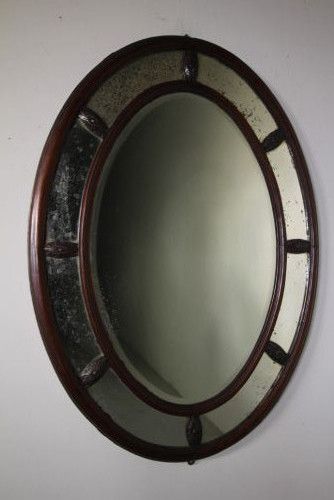
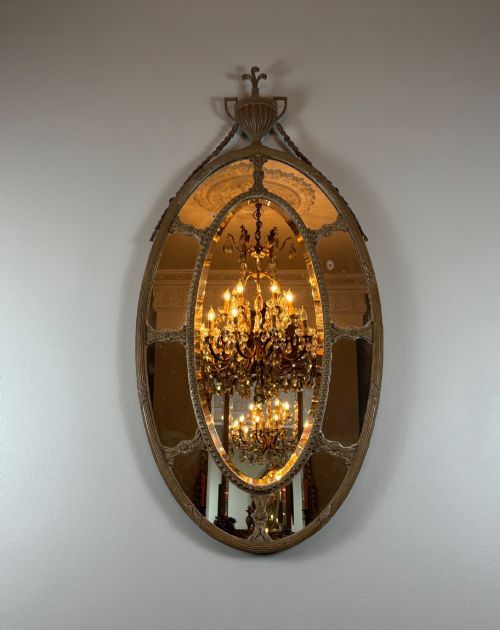
A large oval decorative mirror serves as a commanding wall piece, frequently found in grand country houses and formal reception rooms. These substantial looking-glasses span the nineteenth century, including specific dates like eighteen eighty and nineteen ten, alongside broader Victorian and Georgian eras.
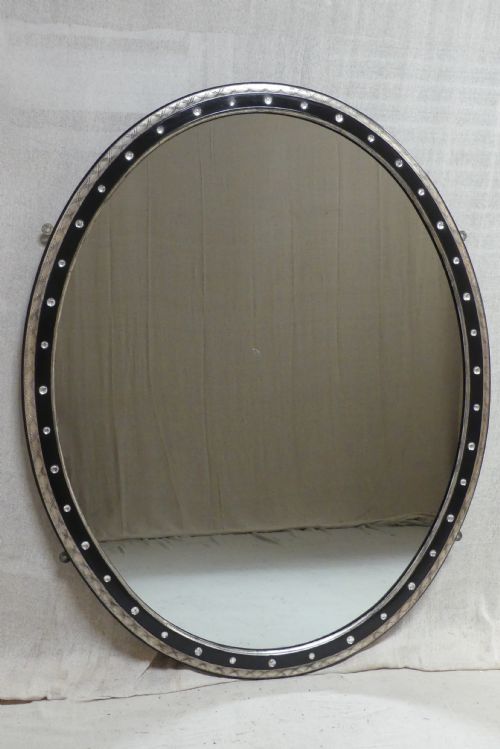
The forms encompass wall mirrors, overmantel mirrors, and cushion mirrors, designed to hang above mantelpieces or along principal hallways. They appear in diverse regional guises, from French chateau styles to Irish ebonised and silver gilt variants.
The silhouettes balance strict geometry with elaborate ornamentation, featuring frames adorned with urns, swags, and carved cartouches. Buyers encounter both single statement pieces and matched pairs that anchor large wall spaces with symmetry.
How they were made
Carved timber and mahogany form the structural backbone of these frames, providing a sturdy base for intricate detailing. Giltwood and gesso are applied over the wood substrate to build up relief decoration, which is then gilded to create a reflective metallic sheen.
Composition ornament, often moulded in relief and fixed to the wooden carcass, allows for repetitive motifs like swags and urns. Silver gilt and parcel gilt treatments highlight specific areas of the carved woodwork against ebonised or painted grounds.
Large Oval Decorative Mirror Retail Price Guide 2026
Typical asking prices for large oval decorative mirror among the pieces listed under this phrase on Sellingantiques today, from the lower quarter to the upper quarter. They describe what is for sale here now, not the wider market.
Listings feature pieces spanning the Georgian, Victorian, and early twentieth-century periods, constructed from mahogany, giltwood, and gesso.
What varies in quality
The depth and crispness of the hand-carved woodwork distinguish finer frames from simpler moulded versions. Crisp detailing in the gesso foliage and sharp definition in applied urns and swags indicate skilled workshop production.
The integrity of the original gilding and the quality of the supporting timber carcass dictate the overall preservation and standing of the piece. Heavier country house scales and substantial timber depths suggest higher grade commissions intended for principal reception rooms.
The Large Oval Decorative Mirror Glossary
- Gesso
- A plaster-like mixture applied to wood frames to create a smooth surface for gilding or carving. It accepts fine detail work for motifs such as scrolls and swags.
- Giltwood
- Timber that has been coated with gold leaf over a prepared base. This finish provides a warm, reflective surface characteristic of formal period mirrors.
- Overmantel
- A large mirror specifically designed to hang above a fireplace mantelpiece. These pieces often feature extended proportions to fill the vertical space of a chimney breast.
- Parcel Gilt
- A decoration method where only specific portions of an object are gilded, leaving the underlying wood or painted surface visible elsewhere. This technique creates contrast within the frame.
- Cushion Mirror
- A looking-glass featuring a convex or sloping outer frame that curves inward toward the central glass plate. The design directs ambient light inward.
Large Oval Decorative Mirror: Frequently Asked Questions
Where should I hang a large oval mirror?
These mirrors suit principal reception rooms, hallways, and above fireplace mantelpieces where their scale creates a focal point. Their curved frames soften rigid architectural lines in traditional interiors.
Ensure the wall construction supports the considerable weight of timber and gesso frames, particularly for large nineteenth-century examples.
How do I identify a Victorian mirror?
Victorian examples often display revival influences such as Rococo scrolls or Neoclassical urns and swags executed in carved wood and gesso. The scale tends to be substantial, matching the generous proportions of nineteenth-century domestic architecture.
Construction methods typically involve heavier timber carcasses and distinct layers of gesso preparation beneath the original gilding.
What is an overmantel mirror?
An overmantel mirror is built to occupy the wall space directly above a fireplace. These pieces reflect room light downwards and visually expand the hearth area.
Their proportions are generally wider or taller to balance the brickwork and mantel shelf below.
Are these mirrors heavy?
Yes, timber, gesso, and thick glass plates create significant weight that requires robust wall fixings. Professional installation into structural wall studs or masonry is essential for safety.
The substantial mass reflects the dense woods and layered ornament used in their construction.