


Large Oak Buffet Cabinet
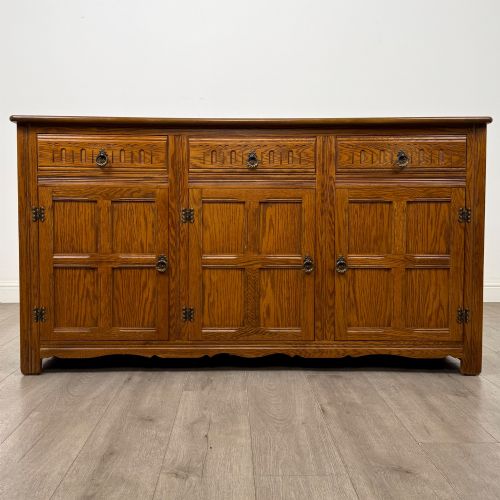
A large oak buffet cabinet brings substantial storage and deep historical character into a room, offering heavy timber construction and imposing proportions.
Large Oak Buffet Cabinet
A large oak buffet cabinet serves as a heavy storage piece for dining rooms and large living spaces, incorporating deep cupboards and serving surfaces. These pieces appear frequently from the Victorian and Edwardian eras, alongside earlier Georgian and 18th century examples.
The versions met most often on this page take the form of substantial sideboards, server units, and mirror-backed credenzas constructed from solid timber. Regional variations include Scottish and French provincial interpretations, alongside English country pieces.
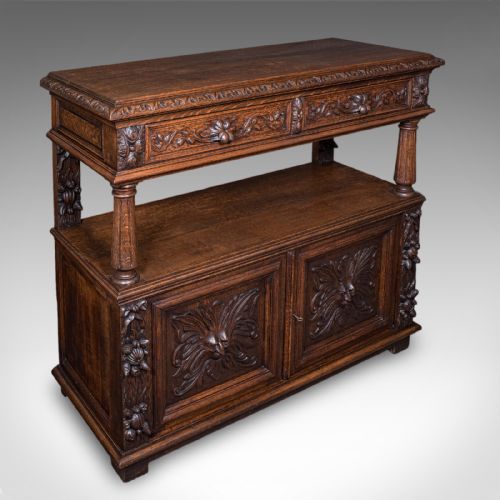
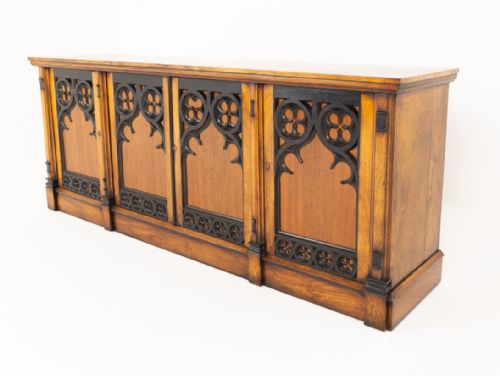
Makers and craftsmen of the 19th century drew heavily upon historical idioms, producing items adorned with Gothic, Jacobean Revival, and Renaissance motifs. Buyers encounter elaborately carved door panels, raised mouldings, and occasional court cupboard configurations.
What varies in quality
The depth and crispness of hand-carving separate standard production items from exceptional commissions, particularly on pieces featuring figural work such as Green Man motifs or intricate Gothic tracery. The choice of timber grain, especially the use of highly figured pollard oak, dictates visual presence.
Structural integrity depends upon the preservation of heavy joinery and original brass mounts without excessive timber shrinkage or replacement hardware. Integrated mirror glass quality and the survival of original bevelled edges influence overall desirability.
Listings span the 18th, 19th, and 20th centuries, featuring Victorian, Edwardian, and Georgian periods alongside oak, pollard oak, brass, and bevelled glass.
The Large Oak Buffet Cabinet Glossary
- Pollard oak
- Oak timber taken from a tree that has been pollarded, producing a dense, highly figured grain pattern. This timber was favoured for high-status Victorian cabinet doors.
- Enfilade
- A suite of rooms aligned with each other, or in this context, a long sideboard or cabinet designed for serving food along a wall. French provincial examples often use this layout.
- Court cupboard
- An antique form of enclosed cabinet featuring a recessed upper section supported by pillars. Edwardian and later revivals adapt this heavy storage format.
- Green Man
- A sculptural architectural ornament depicting a human face entwined with foliage and vines. Carved oak examples appear prominently on late 19th century sideboards.
- Dresser base
- A low wooden sideboard fitted with drawers and cupboards, traditionally used in kitchens and dining spaces. Georgian and Victorian versions provide wide serving surfaces.
Large Oak Buffet Cabinet: Frequently Asked Questions
Where should I place a large oak buffet cabinet?
These imposing pieces require substantial wall space and benefit from placement in dining rooms, large hallways, or spacious living areas where their depth and height do not crowd the room.
Ensure the floor can support significant timber weight and allow adequate clearance for large cabinet doors and drawers to open fully.
How do I care for antique oak furniture?
Maintain the timber by applying traditional beeswax periodically to nourish the grain and preserve the surface sheen without building up heavy synthetic layers.
Keep the cabinet away from direct heat sources and dramatic humidity fluctuations to prevent wood splitting and shrinkage in the large panels.
What is the difference between a buffet and a sideboard?
Buffets and sideboards both function as serving furniture, though buffet cabinets traditionally emphasise enclosed cupboard storage for dining ware and provisions.
Many large Victorian and Edwardian examples blur these distinctions by combining flat serving tops with extensive lower cupboards and upper mirror backs.
How can I date a carved oak cabinet?
Examine the carving style, hardware types, and construction methods alongside any regional design traits visible in the woodwork and timber finishing.
Revival pieces from the late 19th century often adopt 17th century Jacobean or Gothic motifs, but timber patination and internal secondary woods help clarify the true period.