









Large Imari Dish
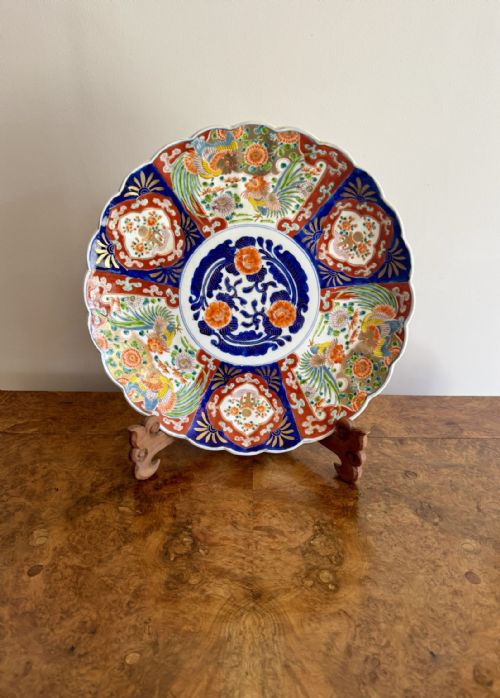
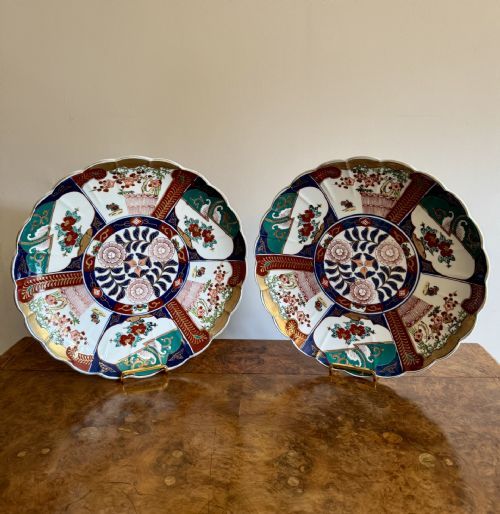
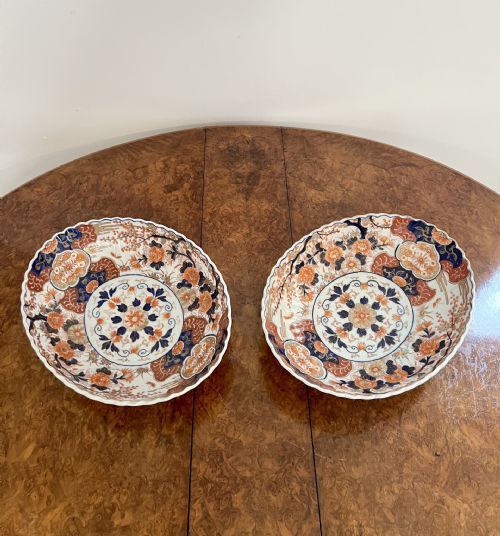
A large imari dish commands attention on a wall or table with its saturated cobalt blue and iron-red palette.
Large Imari Dish
A large imari dish represents a major form of decorative ceramic output, appearing predominantly as chargers, bowls, and serving plates originating from Japanese production centres like Arita during periods spanning the Edo and Meiji eras, alongside nineteenth-century European adaptations.
Buyers seeking this phrase most frequently encounter late nineteenth-century and turn-of-the-century Japanese chargers and plates featuring scalloped edges or broad circular surfaces, though occasional English ironstone interpretations from the Georgian and Victorian eras also emerge.
These substantial vessels function primarily as wall plates or display centerpieces, combining deep blue underglaze with vibrant enamel detailing and gilding to fill domestic spaces with intense pattern and colour.
How they were made
Potters formed these substantial pieces from dense porcelain or ceramic bodies, shaping them into large circular chargers or deep bowls before applying cobalt blue pigments under the glaze.
Artisans then added secondary layers of iron-red enamel and gold leaf or gilt highlights by hand, firing the wares multiple times to fuse the vibrant surface colours onto the vitrified base.
Listings feature porcelain, ironstone, and earthenware bodies decorated with glaze, enamel, and gold leaf across multiple periods.
What varies in quality
The sophistication of the hand-painted motifs dictates the upper tier of the range, separating hurried production from meticulous brushwork that renders complex scenes such as the Seven Lucky Gods or koi carp with sharp definition.
The crispness of the underglaze blue and the richness of the applied enamel and gold leaf determine visual depth, while the structural integrity of heavy porcelain bodies influences overall permanence.
Mason·Minton
The Large Imari Dish Glossary
- Imari
- A style of Japanese porcelain featuring a distinct palette of underglaze blue, iron-red, and gold. This decorative tradition originated in Arita and was heavily exported to European markets.
- Charger
- A large decorative plate or platter used traditionally for ceremonial display rather than dining. These pieces anchor tables or hang securely on walls.
- Underglaze
- A method of decorating pottery before applying a glassy coating and firing the piece at high temperatures. Pigments applied this way endure beneath a protective glossy finish.
- Enameled
- Decorated with opaque or translucent glass-like paints fused to the fired ceramic surface. This technique allows for bright reds, greens, and yellows above the glaze.
- Ironstone
- A heavy, durable type of earthenware patented in the nineteenth century to imitate Chinese porcelain. It provides a robust body for large serving platters and bowls.
Large Imari Dish: Frequently Asked Questions
How do I hang a large imari dish?
Secure display requires a coated spring hanger sized specifically to the diameter and rim depth of the plate. Ensure the wall fixing supports the substantial weight of porcelain or ironstone safely.
Avoid wire alone against the glazed foot ring. Check the tension regularly to keep the charger firm against the wall.
Were these dishes used for food?
Many large charger formats served primarily for display or ceremonial presentation rather than daily dining. Nineteenth-century examples often functioned as fruit display plates or meat platters.
Examine the surface glaze for knife scratches to gauge whether a particular piece saw active dining service or purely decorative use.
How do I tell Edo and Meiji pieces apart?
Edo period pieces date from earlier centuries and display specific potting characteristics and simpler cobalt tones. Meiji period items often show denser, busier compositions with highly vibrant enamel colours.
Inspect the foot ring and glaze pooling on the reverse to understand the manufacturing age.