




Large Hallway Runner
A large hallway runner brings generous length and grounded warmth to an entrance, turning narrow transit spaces into rich textile galleries.
Large Hallway Runner
A large hallway runner provides substantial floor coverage for long corridors and grand entryways, bridging rooms with continuous pattern. These elongated carpets span various origins from the nineteenth and early twentieth centuries, offering significant dimensions for demanding spaces.
The selections here encompass traditional styles including Persian, Caucasian, and Turkmen weaving traditions. Buyers encounter varied formats such as long Kurdish kelleh carpets, Kazak rug runners, and flatwoven kilims tailored for heavy foot traffic.
Originating from village, tribal, and workshop contexts, these pieces reflect distinct regional aesthetics from the 1850s through the 1920s. Each runner combines practical utility with historical character, suiting period properties and modern interiors alike.
Materials and Construction
These textiles rely principally on wool for pile and structure, chosen for resilience under sustained daily use. Cotton foundation threads frequently provide stability and tensile strength across nineteenth-century and early twentieth-century examples.
Weavers employed traditional knotting and flatweaving techniques to build dense piles or flat structures suited to heavy corridors. Natural dye traditions govern the palette, securing lasting depth across varied regional workshops.
Large Hallway Runner Retail Price Guide 2026
Typical asking prices for large hallway runner among the pieces listed under this phrase on Sellingantiques today, from the lower quarter to the upper quarter. They describe what is for sale here now, not the wider market.
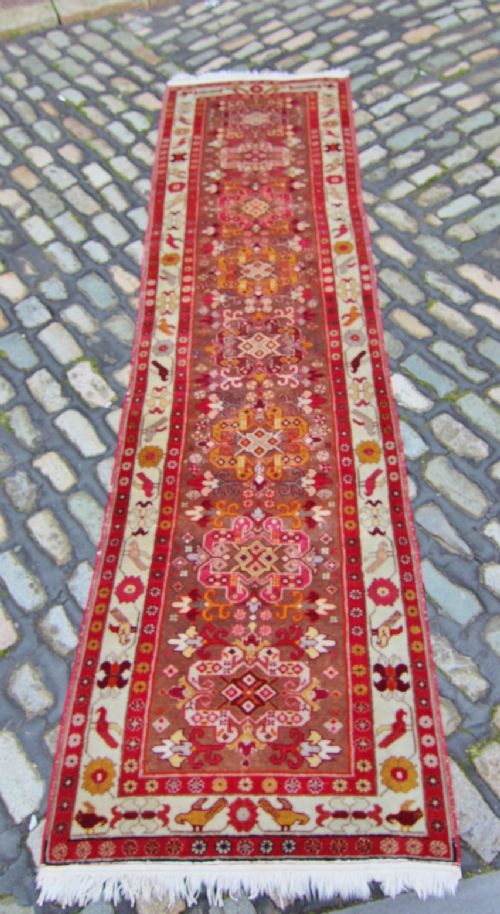
Several runners on this page feature oversized peacocks woven directly into the field, guarding your hallway against unwanted spirits.
Assessing Quality and Execution
Superior examples demonstrate tighter knot density and more confident handling of traditional motifs, resulting in crisp geometric lines or fluid floral arrangements. The handling of natural dyes creates subtle tonal variations that enrich the visual texture over large expanses.
Structural integrity across the foundation threads and secure edge bindings determine how well a long format withstands tension in active hallways. Master weavers achieved exceptional balance in proportions, ensuring symmetrical borders and harmonious medallion placements.
The Large Hallway Runner Glossary
- Runner
- A long, narrow carpet specifically proportioned for corridors, hallways, and staircases. These pieces direct movement through a home while protecting timber or stone flooring.
- Kelleh
- A large format rug or carpet traditionally longer than it is wide, frequently associated with Persian and Kurdish weaving traditions. Such pieces command substantial wall or floor space.
- Kilim
- A flatwoven textile produced without a pile, yielding a lighter weight and reversible format. These pieces rely on slit-weave techniques to create sharp geometric patterns.
- Bidjar
- A renowned weaving centre in western Iran known for producing exceptionally dense, heavy carpets with robust wool foundations. These textiles earned a reputation for formidable durability.
- Boteh
- An ancient almond-shaped motif representing a sprouted seed or floral spray, widely utilised across Persian and Caucasian designs. This enduring symbol appears frequently in varied stylised forms.
Large Hallway Runner: Frequently Asked Questions
How do I choose the right size runner?
Measure your hallway carefully, leaving a consistent border of exposed flooring around the perimeter of the carpet. Ensure doors can swing freely over the pile thickness.
Account for longer formats if your corridor stretches extensively, as continuous coverage maintains visual balance in expansive entranceways.
Are these runners suitable for busy hallways?
Traditional wool construction provides natural resilience and elasticity against heavy foot traffic. Regular underlays help absorb impact and prevent slipping on smooth surfaces.
Vacuum gently without power-brushed heads to preserve the wool pile and historical foundation threads over decades of daily use.
How do I distinguish regional styles?
Caucasian pieces tend to display crisp, geometric medallions and stylised animal or botanical motifs in saturated primary colours. Persian and Kurdish examples often incorporate more complex floral fields, boteh sprays, or structured herati patterns.
Examining the weave density and fringe finishing offers further clues regarding whether a piece originated in a specific village or tribal community.
What is the difference between a kelim and a pile runner?
Kelims are flatwoven without any raised pile, resulting in a thin, flexible textile that lies very flat against the floor. Pile runners feature knotted wool tufts sheared to create a soft, cushioned surface.
Both formats serve hallways effectively, though flatweaves offer a lighter weight and distinct tactile profile compared to deep-piled carpets.