
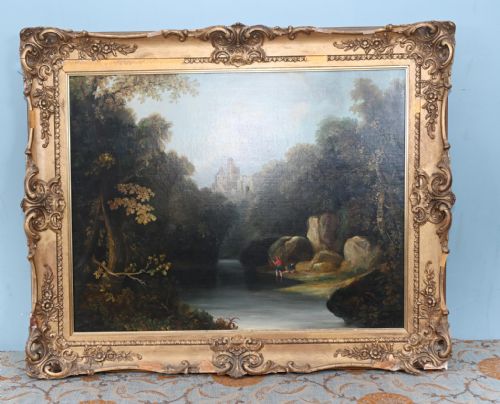


Large Framed River Landscape
A large framed river landscape brings water and open sky into a room, framed to hang straight away.
Large Framed River Landscape
When you search for a large framed river landscape, you encounter substantial works dominated by waterways, spanning periods from the early nineteenth century through to the mid-twentieth century. These pieces record rural rivers, working channels, and tidal estuaries across English, French, and Continental schools.
The most common formats on this page are oil on canvas and watercolour paintings set within giltwood or wood frames. They range from nineteenth-century realism and Victorian watercolours to mid-century impressionism.
Makers and painters represented include named artists such as Alexandre Le Bihan, Stuart Lloyd, William Sydney Cooper, David Cox Jnr, William Mellor, John Wright Oakes, Tom Seymour, Frederick Williamson, Gudrun Sibbons, Harry Pennell, Franz Reder-Broili, Herbert John Finn, Pierre Peltier, and Etty Horton.
How they were made
These works rely primarily on oil on canvas or watercolour applied to paper, mounted within wood frames strengthened with gesso and finished in gilt or plain wood. Artists built up their compositions using layered brushwork for oils or washes for watercolours, capturing light on water and distant banks.
Frames are integral to the pieces, often constructed from carved wood with gesso mouldings that were gilded or painted to complement the canvas or paper within. Glazing is typically used to protect works on paper, while oil paintings remain open to the air on canvas.
Materials recorded across these artworks include oil on canvas, watercolour on paper, gesso, glass, and original gilt wood frames.
What varies in quality
The distinction between works rests on the confidence of the brushwork, the handling of natural light on the water, and the depth of the perspective. Stronger paintings demonstrate a clear command of tone and atmosphere, particularly in how the river integrates with the surrounding landscape.
Frame quality also plays a role, with original giltwood frames showing finer hand-carved gesso detail compared to simpler later replacements. The reputation of the school or the recorded hand of a named artist elevates the significance of the piece.
Alexandre Le Bihan·Stuart Lloyd·William Sydney Cooper·David Cox Jnr·William Mellor·John Wright Oakes·Tom Seymour·Frederick Williamson·Gudrun Sibbons·Harry Pennell·Franz Reder-Broili·Herbert John Finn·Pierre Peltier·Etty Horton
The Large Framed River Landscape Glossary
- Giltwood
- Wood carved and covered with a thin layer of gold leaf or metal gilt. This finish appears frequently on nineteenth-century picture frames.
- Gesso
- A plaster mixture applied to wood frames as a base for gilding or painting. It allows for crisp ornamental moulding around the edge of the artwork.
- Watercolour painting
- Pigment bound in a water-soluble medium applied to paper. These works require glass protection within their frames.
- Continental school
- A broad classification for artists trained and working in mainland Europe rather than Britain. These pieces often bring distinct regional palettes to river scenes.
- Impressionism
- A style focusing on the accurate depiction of light and its shifting qualities. Mid-century and nineteenth-century examples capture the momentary effects of sun upon water.
Large Framed River Landscape: Frequently Asked Questions
How do I hang a large framed river landscape?
These substantial pieces require secure wall fixings, ideally anchored into wall studs or masonry using appropriate picture hooks rated for heavy frames. Because many retain their original heavy wood and gesso frames, check the cord and rings on the reverse before hanging.
Ensure the painting sits at eye level where natural light can catch the surface without causing excessive glare on the varnish or glass.
Are these paintings original works?
The selection consists of original hand-painted oils on canvas and watercolours on paper, alongside a few referenced compositions such as a work after Canaletto. Each piece is an individual creation by the artist named in the listing.
Signatures or attribution notes on the canvas, paper, or frame help identify the hand behind the work, whether from a known Victorian painter or a Continental school.
How should I care for an oil riverscape?
Keep oil paintings away from direct sunlight and sudden temperature changes, which can cause the canvas to slacken or the paint layer to craze. Dust the surface and the frame gently with a soft, dry brush without applying moisture or cleaning solutions.
Watercolours require protection behind glass to shield the paper and pigments from atmospheric moisture and humidity fluctuations.
How do I date a framed landscape?
Dating relies on the style of the brushwork, the stretcher construction behind the canvas, and the materials used in the frame. Victorian and nineteenth-century pieces often feature specific canvas stamps and distinct gilt moulding styles.
Signatures, exhibition labels, and biographical dates of makers like Tom Seymour or William Mellor provide firm brackets for when the art was created.