
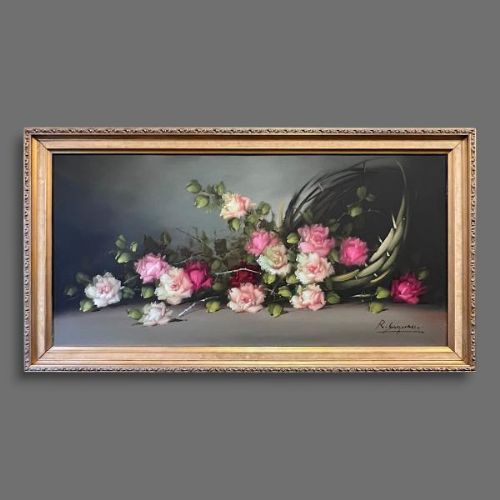


Large Floral Canvas Painting
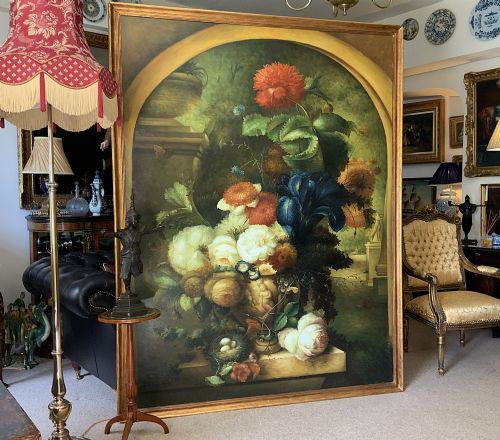
A large floral canvas painting brings intense colour and weight to a room, working best when hung above a low sideboard or mantelpiece.
Large Floral Canvas Painting
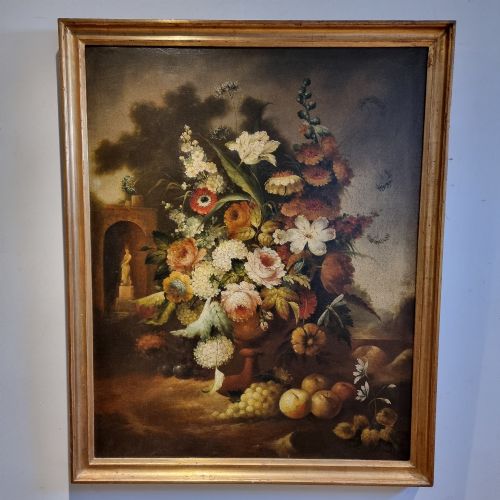
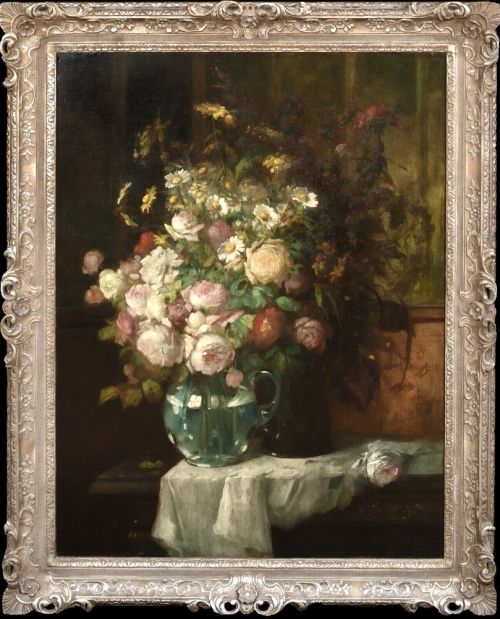
A large floral canvas painting is a substantial oil work depicting blooms, botanical arrangements, or garden scenes, spanning periods from the Victorian era through to mid-century impressionism.
Buyers seeking a large floral canvas painting most frequently encounter mid-century impressionist works, Dutch revival still lifes, and nineteenth-century examples on canvas stretched over wooden frames.
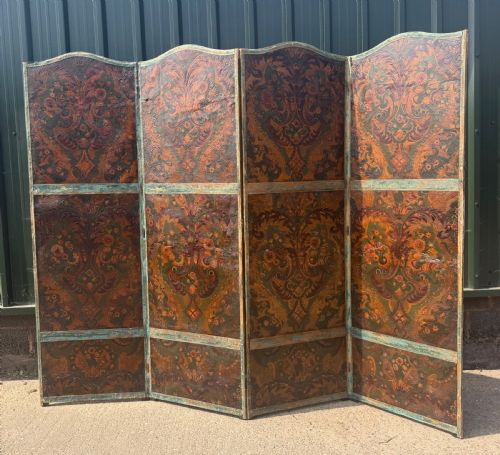
These works scale from monumental architectural panels and folding room dividers down to expansive framed canvas pieces designed to anchor a major wall.
What separates quality
Quality rests in the handling of brushwork and pigment depth, where confident impasto and deliberate colour harmony elevate a piece far above a standard decorative copy.
The integrity of the canvas support, the original tension across the wooden frame, and the presence of period-appropriate gilded wood mouldings heavily influence the standing of the work.
One extraordinary nineteenth-century piece doubles as a four-fold room divider, painted to mimic expensive Dutch tooled leather.
Konstantin Stoitzner·Amile Coppieters·Bela Balogh·Sir George Reid·Julien Stappers
The Large Floral Canvas Painting Glossary
- Canvas
- A heavy woven fabric, typically linen or cotton, stretched tightly across a wooden frame to serve as the foundation for oil paintings.
- Impasto
- A technique where oil paint is laid thickly on the canvas, standing out in relief and catching the light to give texture to petals and leaves.
- Gilded wood
- Timber mouldings coated with a thin layer of gold leaf or metallic gilt, commonly used to frame substantial nineteenth-century paintings.
- Still life
- An artwork depicting inanimate subject matter, typically featuring cut flowers in vases, baskets, or banquet settings.
- Craquelure
- A fine network of microscopic cracks appearing across the surface of aged oil paint and varnish, indicating genuine age.
Large Floral Canvas Painting: Frequently Asked Questions
How do I hang a heavy canvas painting safely?
Substantial oil works require secure wall fixings anchored directly into masonry or structural timber studs using heavy-duty picture wire and brass D-rings.
Position the centre of the canvas at approximate eye level to ensure the composition commands the wall properly.
How should I clean an oil painting on canvas?
Dust the canvas surface gently using a very soft, dry brush to remove airborne particles without disturbing the pigment layer.
Avoid using water, household cleaners, or moisture on aged oil paint, as these can permanently damage the fragile surface.
What rooms suit a large floral canvas painting?
These grand compositions suit principal reception rooms, dining spaces, or hallways with high ceilings where they command sufficient visual space.
Keep them away from direct sunlight and damp environments to protect the canvas support and oil pigments.
How do I tell a mid-century painting from a nineteenth-century one?
Nineteenth-century works typically display heavier varnish discoloration, tighter craquelure, and darker, more restrained tonal palettes than later pieces.
Mid-century impressionist canvases often reveal brighter, looser brushwork and lighter framing materials characteristic of the 1950s and 1960s.