

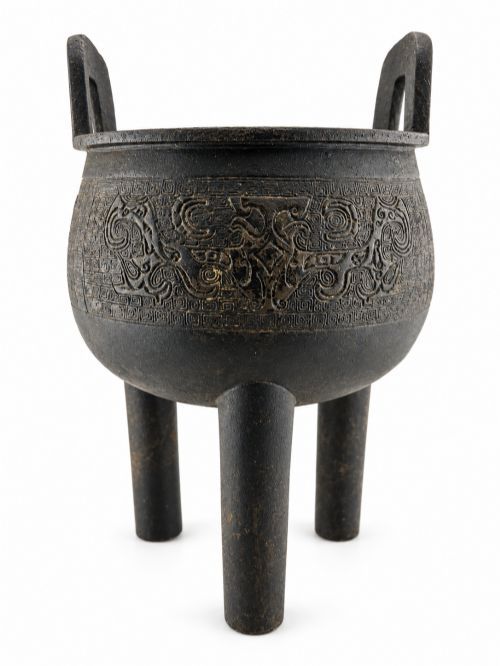


Large Bronze Censer
A large bronze censer brings heavy presence to a room, carrying centuries of ritual form into a modern interior.
Large Bronze Censer
A large bronze censer is a substantial ritual vessel or incense burner designed to anchor a space with considerable weight and presence. The pieces found here span centuries of Asian craftsmanship, reaching from the Ming and Qing dynasties to the Meiji period.
Most examples take the form of tripod vessels, bowls, or lidded koros featuring ritualistic decorations like taotie motifs or dragon and mask handles. Alongside traditional censers, related forms such as jardinières, planters, and ritual food bowls appear frequently in the listings.
Origins heavily favour Chinese workshops adhering to archaic or imperial styles, complemented by Japanese Meiji examples incorporating cloisonné and champlevé enamel. Buyers encounter vessels scaled upwards of thirty centimetres, often weighing several kilograms.
Materials and construction
Makers utilised cast bronze, patinated bronze, and parcel-gilt bronze to achieve durable, heavy bodies capable of withstanding heat and ritual use. Surfaces frequently incorporate intricate cloisonne and champleve enamel work, fusing metallic structures with vibrant coloured glass pastes.
Construction techniques rely on traditional casting methods, often producing thick walls and substantial weights exceeding five kilograms in monumental pieces. Secondary materials like wood appear alongside metal sections, while patination treatments create deep, aged surface tones.
Large Bronze Censer Retail Price Guide 2026
Typical asking prices for large bronze censer among the pieces listed under this phrase on Sellingantiques today, from the lower quarter to the upper quarter. They describe what is for sale here now, not the wider market.
Several heavy censers weigh more than a domestic cat, tipping scales past the five-kilogram mark.
Distinctions in quality
Quality rests in the crispness of the cast decoration, where deep relief work on taotie masks and dragon handles remains sharp and well-defined. Heavier vessels often demonstrate superior wall density and structural stability.
The finesse of surface finishing separates standard production from exceptional work, particularly in the precision of enamel inlay and the subtlety of the bronze patination. Makers marks, when present, add historical depth to the piece.
Wu Bangzuo Mark
The Large Bronze Censer Glossary
- Censer
- A vessel designed for burning incense, typically featuring an open bowl or a pierced lid to release smoke. These pieces often stand on three feet.
- Archaistic
- A design style that consciously imitates ancient ritual bronzes from earlier dynasties, particularly incorporating Shang and Zhou decorative motifs.
- Cloisonne
- An enamelling technique where metal wires are soldered to a bronze base to create compartments filled with coloured paste before firing.
- Koro
- A traditional Japanese incense burner, often lidded and resting on legs, used in domestic and ceremonial settings.
Large Bronze Censer: Frequently Asked Questions
How were large bronze censers used originally?
These vessels served primarily in ritual contexts for burning incense during ceremonies, ancestral worship, and meditative practices. Their substantial size allowed them to occupy central positions in temples, halls, and scholar's chambers.
Over time, many transitioned into decorative objects prized for their sculptural form and association with imperial aesthetics. Their use remained tied to spaces intended for contemplation and formal hospitality.
How do I clean a bronze censer?
Maintenance requires only gentle dusting with a soft, dry cloth to protect the historic surface patination and delicate enamel work. Moisture and chemical cleaners should be avoided entirely, as they strip the aged finish.
Leaving the natural patina undisturbed preserves the visual integrity of the metal. Handling the piece with clean hands prevents oils from settling into the bronze.
Can I still burn incense inside them?
While these vessels were built for burning incense, many owners now display them purely as decorative sculptures due to their age and historical value. If used for incense, placing heat-resistant sand or ash inside the bowl protects the base.
Care must be taken to prevent modern charcoal discs from damaging the interior patination. Most collectors prefer dry use to maintain the interior condition.
How do I distinguish Ming from Qing pieces?
Ming pieces often display robust casting with restrained archaistic decoration and deep, stable patination developed over centuries. Qing examples, particularly those from later reigns, frequently incorporate more elaborate surface details and varied materials like cloisonné enamel.
Form, weight, and stylistic conventions guide attribution alongside any historic marks. Comparing the crispness of the relief work helps clarify the likely period of origin.