
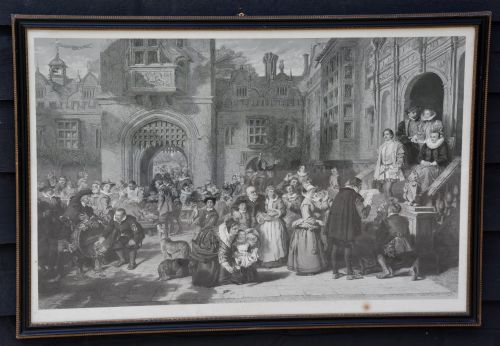


Large Copperplate Print
These large antique copperplate print works bring classical architecture and detailed cartography into a room with genuine eighteenth-century weight.
Large Copperplate Print
A large antique copperplate print delivers the dense line work of eighteenth-century and Victorian plates, focusing heavily on architectural subjects, classical mythology, and regional maps. You will most frequently encounter eighteenth-century sheets depicting the antiquities of Athens or Vatican loggie compositions.
The subjects range from architectural elevations and mythical satyrs to county maps bearing detailed cartography. Most examples arrive framed, frequently in original ebonised wood or Hogarth mouldings under glass.
The origins span the mid-eighteenth century through to the Victorian era, offering substantial wall art with strong neoclassical and Georgian influences. Paper dimensions are generous, designed originally for institutional study or grand domestic display.
Materials and technique
The primary vehicle is ink on heavy handmade paper, pulled from hand-engraved copper plates that allow for extraordinary fineness of line. Selected examples receive hand colouring applied over the monochrome impression.
Framing materials rely on timber, predominantly ebonised wood or traditional Hogarth frames, paired with protective glass to secure the fragile paper surfaces.
Materials recorded across the inventory include heavy paper, ink, wood, glass, gilt, and ebonised wood.
What varies in quality
Quality rests upon the crispness of the plate impression and the depth of the ink within the paper fibres, where worn copper plates yield softer, less articulate lines. The importance of the engraver and the ambition of the original design dictate the standing of each piece.
The integrity of the original framing, such as period ebonised wood or Hogarth mouldings, preserves the historic context of the work. Clean margins and minimal discoloration on the heavy paper substrate further elevate the standing of an individual print.
Eman Bowen·Ottaviani By Raphael·Giovanni Ottaviani·James Basire
The Large Copperplate Print Glossary
- Copperplate
- An intaglio printing process where lines are incised into a copper sheet to hold ink. This technique permits a high degree of fine detail suitable for architectural illustration and maps.
- Engraving
- A printmaking method where an artisan cuts lines directly into the metal plate using a sharp tool called a burin. The resulting impressions display sharp, clean edges.
- Hogarth frame
- A narrow, stepped wooden moulding finished in dark tones or gilding, popular for framing eighteenth-century prints and works on paper. It offers a subtle profile that complements detailed line work.
- Cartography
- The science and art of making maps, heavily represented in eighteenth-century plate work. Eman Bowen examples demonstrate the intricate lettering and decorative cartouches typical of this practice.
Large Copperplate Print: Frequently Asked Questions
How do I hang a large antique copperplate print?
Protect the paper from direct sunlight by choosing an interior wall away from strong windows. Ensure the weight is supported securely using appropriate wall fixings suited to heavy timber frames.
Keep the environment stable regarding humidity to protect both the historic paper and the original wood frame from warping over time.
What is an architectural engraving?
An architectural engraving depicts buildings, ruins, and classical details such as those found in the antiquities of Athens. These plates served both scientific record and neoclassical decoration.
Master engravers executed these works with precise geometric accuracy, often publishing them in large folios before individual sheets were separated for framing.
How do I identify eighteenth-century prints?
Look for the character of the paper, which should show heavy handmade texture and chain lines from the paper mould. The depth of the plate mark where the metal edge pressed into the sheet is another reliable indicator.
Subject matter often points to the era, with classical mythological scenes and detailed cartography dominating mid-to-late seventeen-fifties production.
Are these prints hand coloured?
Certain examples feature delicate hand watercolour applied over the black ink lines, particularly on maps and botanical or architectural plates. This work was typically done shortly after printing to enhance visual detail.
Examine the pigment under magnification to observe the subtle brushwork distinct from modern mechanical printing dots.