

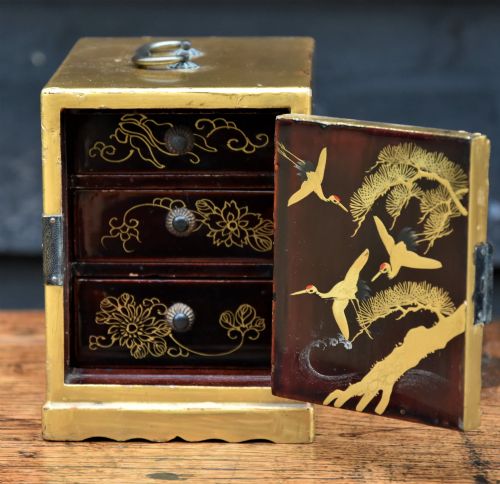
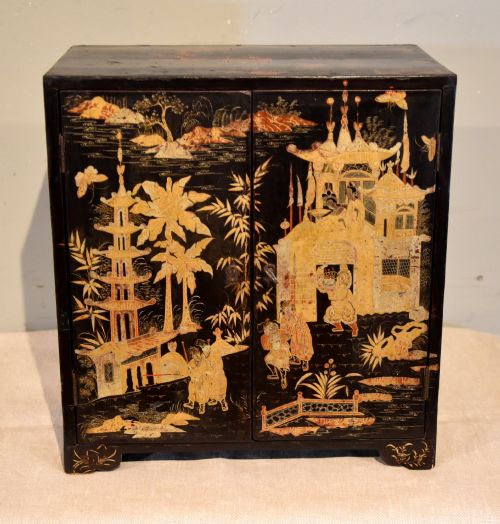


Lacquered Jewellery Cabinet
A lacquered jewellery cabinet is a compact storage box for valuables, bringing intricate decoration and historic craftsmanship straight to the tabletop.
Lacquered Jewellery Cabinet
A lacquered jewellery cabinet takes the form of a table cabinet, jewellery box, or workbox, designed to hold small precious items. These pieces span the nineteenth century and the early twentieth century, showing a mix of table cabinets and dedicated jewellery boxes.
The most common versions met on this page are Japanese Meiji period black lacquer table cabinets and Chinese export pieces, alongside Victorian papier-mâché and English penwork examples. Styles range from Chinoiserie and Regency to Georgian and Victorian designs, reflecting global trade and diverse decorative tastes.
Origins include Japanese, Chinese, and English workshops, producing table cabinets that feature fitted interiors, doors, and drawers. Buyers encounter pieces finished in black lacquer, yellow japanning, or gilt decoration, each serving as both a functional box and a decorative object.
How they were made
Construction relies primarily on wood, papier-mâché, and metal substrates, built into structured table cabinets and boxes. Craftsmen applied layers of lacquer to achieve smooth, durable surfaces suited to detailed painting and carving.
Decoration incorporates gold leaf, gilding, and intricate penwork, creating contrasting metallic motifs against dark lacquer grounds. Silk linings often furnish the interior compartments, while brass fittings provide functional hardware for doors and closures.
Lacquered Jewellery Cabinet Retail Price Guide 2026
Typical asking prices for lacquered jewellery cabinet among the pieces listed under this phrase on Sellingantiques today, from the lower quarter to the upper quarter. They describe what is for sale here now, not the wider market.
Listings feature items spanning the eighteenth, nineteenth, and early twentieth centuries, incorporating materials such as silk, brass, and gold leaf.
What varies in quality
Quality rests in the depth and execution of the surface decoration, distinguishing standard pieces from those with refined hand-painted gilt or intricate penwork. The crispness of the lacquer finish and the preservation of gold leaf determine the visual impact of each cabinet.
Internal organisation and hardware integration separate fine examples, where fitted drawers, silk interiors, and original brass fittings remain intact. The complexity of the structural form, from simple boxes to multi-tiered table cabinets with doors, marks the division between basic utility and high craftsmanship.
The Lacquered Jewellery Cabinet Glossary
- Lacquer
- A durable finish applied to wood or papier-mâché substrates, creating a hard, smooth surface that accepts painted and gilded decoration. This technique is central to Asian and European decorative boxes.
- Japanning
- A European imitation of East Asian lacquerwork, utilising varnishes and heat-drying methods on furniture and objects. It often appears in yellow or black finishes on early nineteenth-century workboxes.
- Kodansu
- A traditional Japanese small cabinet featuring multiple interior drawers and doors, designed for storing valuables. These pieces frequently display detailed gilt lacquer work from the Meiji period.
- Penwork
- A decorative technique using fine ink lines on a prepared surface to create detailed pictorial or geometric designs. It appears on English table cabinets from the late eighteenth century.
- Papier-mâché
- A composite material made from paper pulp or reinforced sheets mixed with binding agents, moulded and lacquered. Victorian makers utilised this medium for strong, lightweight jewellery cabinets.
Lacquered Jewellery Cabinet: Frequently Asked Questions
What is a lacquered jewellery cabinet used for?
These cabinets serve as compact storage vessels for rings, necklaces, and other small personal valuables. Their compartmentalised interiors and small drawers keep delicate items separated and protected.
Historically, they sat upon dressing tables or desks in domestic settings, offering both daily utility and a decorative display. Today, they continue to function as practical storage while adding historic character to a room.
How do I date a lacquered jewellery cabinet?
Dating relies on identifying the prevailing style, materials, and manufacturing techniques associated with specific periods. For example, Victorian papier-mâché pieces differ distinctly in substrate and decoration from Japanese Meiji period lacquer cabinets.
Construction methods, hardware types, and stylistic influences such as Chinoiserie or Regency provide further clues to origin and age. Comparing the specific gilt motifs and wood types against documented examples helps narrow down the decade of production.
Where were these cabinets made?
These pieces originate from a variety of workshops across East Asia and Europe, reflecting global trade routes and stylistic exchanges. Japanese and Chinese makers produced lacquer cabinets for both domestic use and export markets.
English workshops also produced regional variations, utilising techniques like penwork, japanning, and papier-mâché moulding. This international spread accounts for the diverse aesthetic traditions seen across the selection.
How do I care for antique lacquer?
Antique lacquer requires gentle treatment to preserve the delicate surface finish and any applied gold leaf. Dusting should be done lightly with a soft, dry cloth without chemical polishes or abrasive cleaners.
Keeping the cabinet away from direct sunlight and stable environmental humidity prevents the wood substrate from expanding and cracking the lacquer layer. Proper care ensures the historic finish remains intact for years to come.