

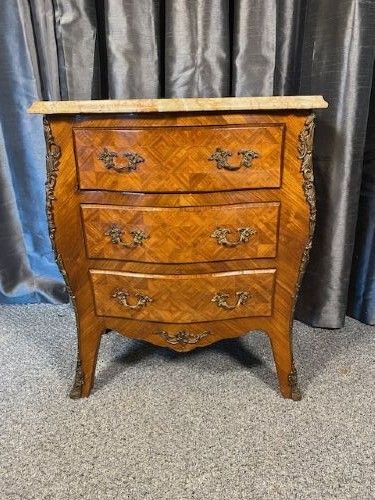
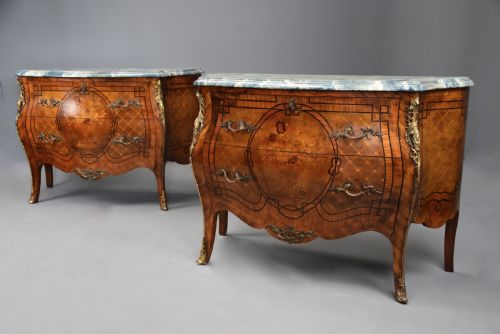
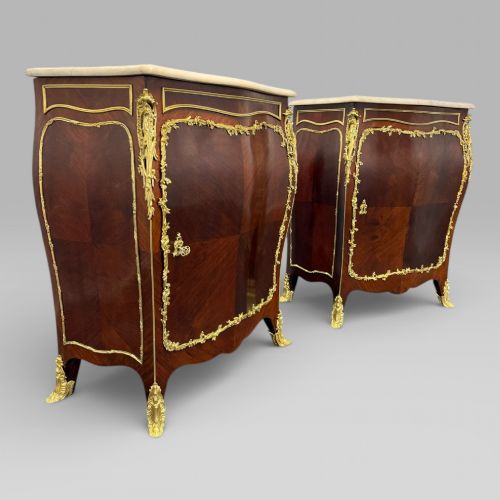
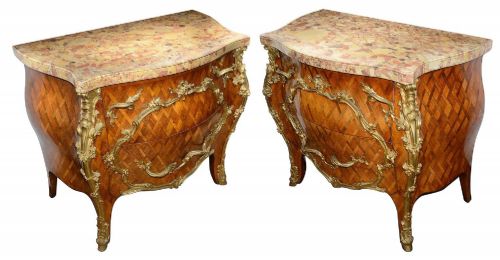
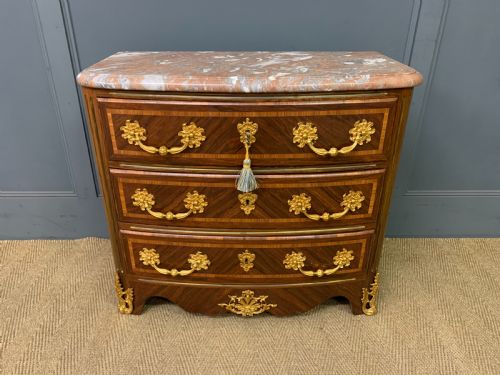


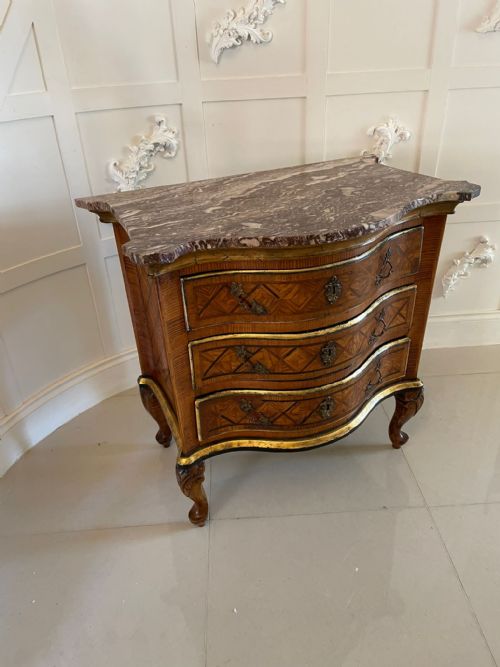


Kingwood Serpentine Chest
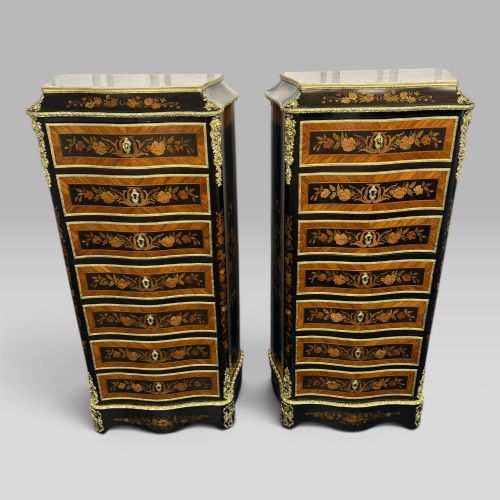
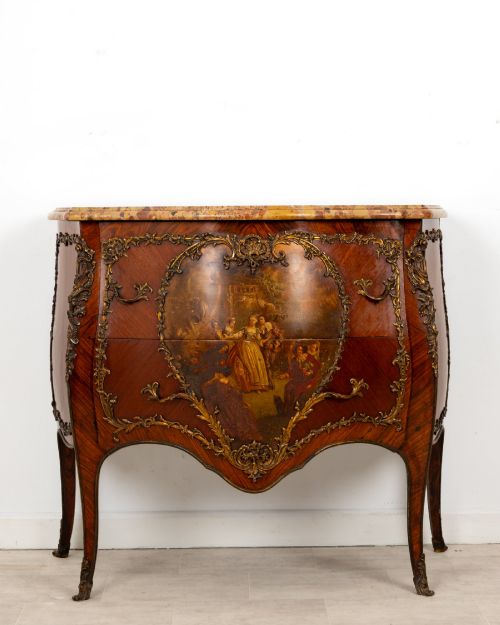
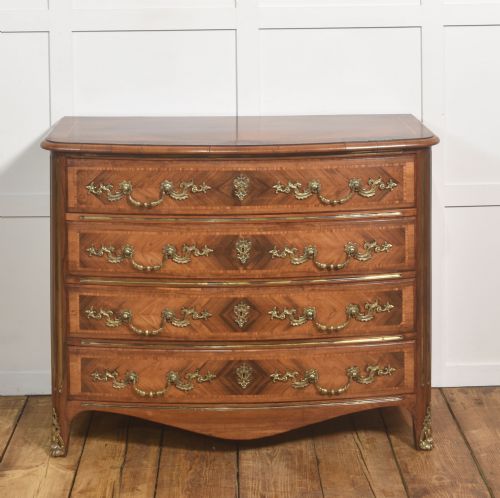
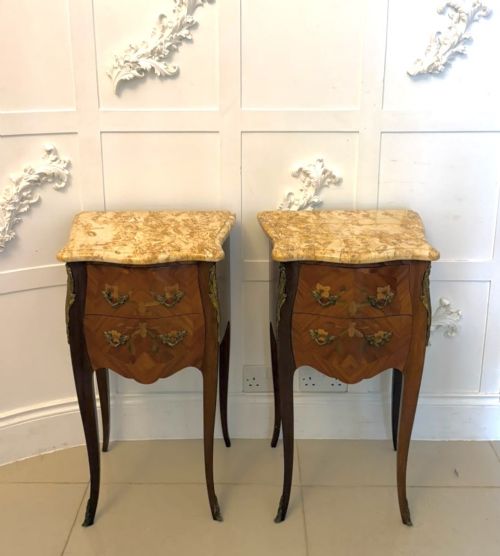
A kingwood serpentine chest brings together curved timber and rich mounts, offering a substantial piece of French furniture history for your room.
Kingwood Serpentine Chest
A kingwood serpentine chest typically presents as a commode or bedside cabinet with a curved front line, drawing heavily on French Rococo and Louis XV styles. These pieces range from authentic eighteenth-century examples to later nineteenth-century revivals and early twentieth-century interpretations.
The most common formats on this page are full-size commodes and smaller bedside cabinets or nightstands, occasionally appearing as miniature or apprentice furniture. They originate predominantly from French workshops spanning the 1700s through to the 1930s.
Buyers seeking this phrase encounter both grand gilt-bronze mounted commodes and more restrained parquetry-inlaid chests. The undulating serpentine profile remains the unifying architectural feature across all these periods.
Materials and Technique
Cabinetmakers constructed these chests using kingwood veneers arranged in intricate marquetry or parquetry patterns over sturdy carcases, often pairing the timber with contrasting rosewood or tulipwood. The distinctive grain of the kingwood provides the visual rhythm across the curved drawer fronts.
Heavy marble slabs, including scagliola varieties, sit atop many of these chests, cut to follow the exact serpentine contours of the woodwork. Mounts cast from ormolu, brass, and gilt bronze are pinned to the corners, handles, and apron to accentuate the sweeping lines.
Kingwood Serpentine Chest Retail Price Guide 2026
Typical asking prices for kingwood serpentine chest among the pieces listed under this phrase on Sellingantiques today, from the lower quarter to the upper quarter. They describe what is for sale here now, not the wider market.
Listings span eight distinct periods, with nineteenth-century revivals and early twentieth-century interpretations appearing alongside authentic eighteenth-century examples.
Assessing Quality
Quality reveals itself in the precision of the parquetry layout and how seamlessly the bronze or ormolu mounts follow the contours of the timber carcase. Finer pieces demonstrate crisp chasing on the metal mounts and an absolute fidelity to the serpentine curve in both marble top and wooden frame.
The choice of veneers and the complexity of the marquetry patterns separate standard production from exceptional cabinetmaking. Superior examples maintain structural integrity in the drawer mechanics and timber movement despite the complex curving shapes.
E. Kahn·Charles Cressant
The Kingwood Serpentine Chest Glossary
- Serpentine
- A shape characterised by a central convex curve flanked by two concave curves, creating a gentle rolling line along the front of the chest. This contour demands advanced woodworking skill to execute properly.
- Kingwood
- A dense, richly grained Brazilian timber utilised by master cabinetmakers for high-end decorative furniture. Its dark violet-brown tones feature striking lighter streaks.
- Ormolu
- Gilt bronze mounts applied to furniture to protect corners and provide ornamentation. The best examples display sharp hand-chasing after casting.
- Marquetry
- The art of applying decorative pieces of veneer to a structure to form intricate geometrical patterns or pictorial designs. It creates the patterned surfaces seen on many commode drawers.
- Bombe
- A swelling, outward-curving profile found on the sides and front of certain commodes and cabinets. This voluptuous form originated in France during the Rococo period.
Kingwood Serpentine Chest: Frequently Asked Questions
What rooms suit a kingwood serpentine chest?
These chests function well as statement pieces in a living room, hallway, or bedroom, where their curved profiles and polished marble tops draw the eye. Their decorative presence makes them natural focal points against plain walls.
Smaller versions, such as bedside cabinets and nightstands, fit easily beside a bed while offering practical enclosed storage space for evening essentials.
How do I date a kingwood serpentine chest?
Dating relies on examining construction methods inside the drawers, the style of the ormolu mounts, and the specific characteristics of the timber veneer. Eighteenth-century pieces display hand-cut joinery and period-specific mount casting techniques.
Nineteenth-century revival pieces often copy these earlier Louis styles closely, while twentieth-century examples show more uniform machine-assisted construction beneath the decorative surface.
Are these chests practical for everyday storage?
The drawer depths and interior spaces vary depending on whether the piece is a full commode or a compact bedside cabinet. Full-size chests offer generous capacity for linens or clothing.
Bombe and serpentine shapes do restrict the interior rectangular volume slightly compared to straight-sided chests, but they provide adequate storage for standard domestic items.