
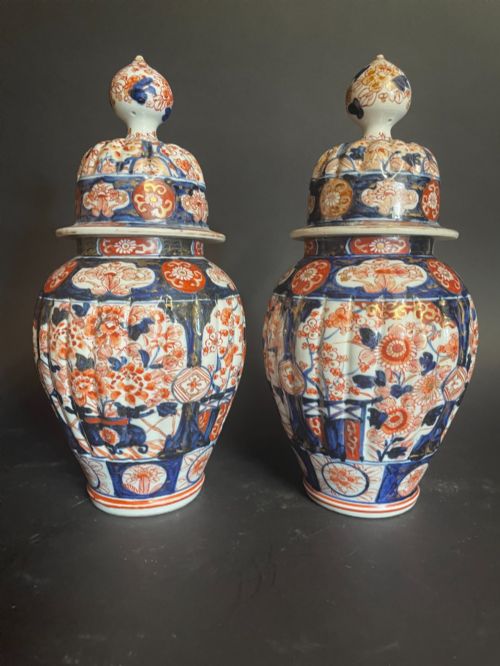
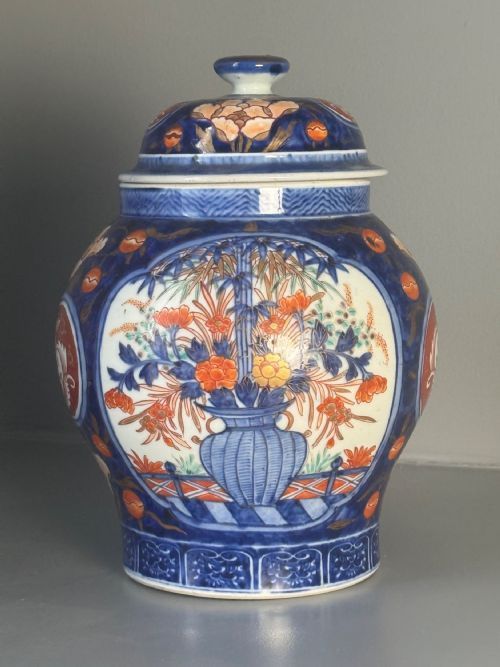


Japanese Imari Temple Jar
A japanese imari temple jar brings centuries of kilncraft into a room, offering rich cobalt and iron-red decoration that catches the light.
Japanese Imari Temple Jar
A japanese imari temple jar is a porcelain vessel made for display, frequently encountered as a lidded ginger jar or a baluster vase decorated in the Imari palette. These pieces span from the seventeenth century through the Edo and Meiji periods up to the early twentieth century.
Makers in Arita produced much of this porcelain for export, creating large covered vases and garnitures that feature strongly on this page. Collectors find both single vessels and matched pairs, often accompanied by original or associated lids.
The forms range from straight-sided jars to octagonal baluster shapes and large vases standing over thirty inches high. Each piece shows the characteristic blue and iron-red pigments, occasionally enriched with gilding.
Materials and construction
Potters shaped high-fired porcelain bodies on the wheel or pressed them into moulds, producing thick walls capable of supporting heavy glazes. Cobalt enamel provided the deep underglaze blue, while iron red and gold leaf were applied over the glaze in subsequent firings.
The glazing technique created a smooth, vitreous surface that protected the iron-red enamel and gilding from wear. Some later European iterations, such as French examples, adopted the same palette on porcelain to imitate the Eastern aesthetic.
Listings on this site range from seventeenth-century Arita pieces to early twentieth-century Edwardian interpretations in porcelain.
Judging quality and execution
The distinction between ordinary and superior pieces rests on the crispness of the cobalt painting and the precision of the overglaze enamels. Finer examples display meticulous hand-painted detail across the surface without blurring in the blue underglaze.
Proportion and potting weight also set the better pieces apart, particularly in large temple jars where maintaining symmetry during high-temperature firing required exceptional skill. The integration of the lid with the main body reveals the care taken by the workshop.
The Japanese Imari Temple Jar Glossary
- Imari palette
- A decorative scheme combining underglaze cobalt blue, iron red, and gold on a white porcelain ground. This palette originated in Japan and heavily influenced European ceramic design.
- Baluster
- A vase shape with a rounded lower body that tapers toward the neck. This form provides a stable base for detailed multi-panel decoration.
- Garniture
- A set of three or more matching vases and jars designed to be displayed together on a mantelpiece or cabinet. These sets form striking focal points in a room.
- Edo period
- The period in Japanese history lasting from sixteen hundred and three to eighteen hundred and sixty-eight. Pieces from this era command strong interest from collectors.
- Meiji period
- The era spanning from eighteen hundred and sixty-eight to nineteen hundred and twelve, characterised by increased export and large-scale decorative porcelain production.
Japanese Imari Temple Jar: Frequently Asked Questions
How old are these temple jars?
These ceramic pieces range from the seventeenth century through the Meiji period and into the early twentieth century. Many surviving examples date from the nineteenth century.
Specific dates depend on the potting style, the depth of the cobalt blue, and whether the piece originates from the Edo period or later export eras.
Are the lids original to the jars?
Finding a temple jar with its original matching lid remains a key consideration for collectors. Many lidded jars have been paired with replacement covers over the centuries.
Examining the glaze and fit at the rim helps determine if the cover belongs to the base.
How were temple jars displayed historically?
These large vessels were placed on mantels, tables, or floor stands in grand interiors to showcase wealth and taste. Garnitures of three or five pieces created symmetrical focal points in a room.
Today, they function well as standalone decorative pieces on sturdy furniture.
What does Arita mean in the listings?
Arita is the town in Hizen province where Japanese porcelain production originated. Kilns in this region produced the distinctive blue and red wares exported through port cities.
Pieces attributed to Arita represent the heart of traditional Imari manufacture.