
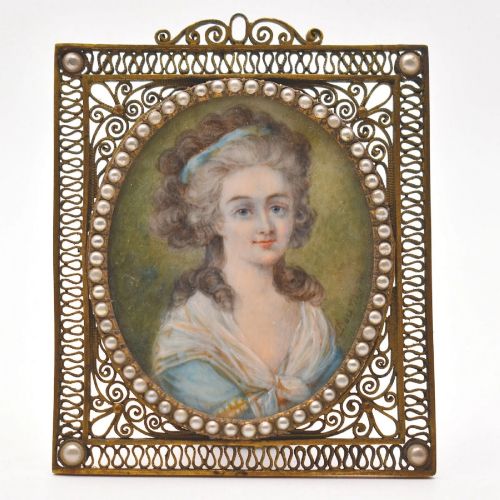


Ivory Miniature Painting
These ivory miniature painting examples capture intimate likenesses and classical scenes with remarkable delicacy, offering a tangible connection to historical portraiture.
Ivory Miniature Painting
An ivory miniature painting presents finely detailed portraiture and narrative scenes rendered on thin slices of animal tooth or tusk. Collectors searching for an ivory miniature painting encounter works predominantly from the eighteenth and nineteenth centuries, spanning Georgian and Regency periods alongside French Rococo expressions.
The format encompasses individual portrait miniatures of ladies, gentlemen, and officers, as well as figurative subjects after historical artists like Fragonard and Lorenzo Monaco. Most available examples utilise watercolour on ivory, often preserved within protective brass, gold, gilt metal, or ebonised wood frames beneath glass.
Materials and construction
Listings feature works from the eighteenth century, Georgian era, Regency period, and the year 1800, utilising watercolour, gouache, and oil on ivory.
Assessing quality and execution
Quality rests primarily on the precision of brushwork and the psychological depth achieved in the facial expression. Superior examples display masterful control over light and shadow, capturing lifelike texture in hair and fabric rather than relying on heavy, opaque pigment.
The integrity of the thin ivory substrate and the originality of the surrounding frame, whether gold or ebonised wood, significantly influence the standing of a piece. Finer works often bear attribution to recorded miniaturists or retain original housing with seed pearl detailing.
Charles Hayter·Nicolas Freese·Frederick Buck·George Engleheart·Archibald Skirving·William Grimaldi·Henry Jacob Burch·Edward Pugh·Samuel Cotes·Jeremiah Steele
The Ivory Miniature Painting Glossary
- Ivory miniature painting
- A small-scale artwork executed on a thin slice of elephant or marine mammal tusk. These portable portraits gained popularity across European and Indian traditions during the eighteenth and nineteenth centuries.
- Gouache
- An opaque water-based medium containing pigment and gum. It provided denser coverage than watercolour, allowing artists to create solid highlights and rich background tones on ivory panels.
- Ebonised wood
- Timber treated with chemical or physical finishes to resemble heavy, black ebony. It was frequently used for framing nineteenth-century portraits to create a sharp contrast with the luminous ivory.
- Seed pearl
- A very small, naturally occurring pearl often drilled and stitched or glued into decorative patterns. They frequently adorn the gilt metal frames of Georgian and Regency portrait miniatures.
Ivory Miniature Painting: Frequently Asked Questions
How were ivory miniatures displayed?
These small artworks were frequently hung in intimate domestic spaces or carried on the person as personal tokens of affection. Their protective cases allowed them to be kept in pockets or travel bags safely.
Many examples were fitted with small loops or hooks for suspension on walls or integration into larger portrait groupings within a domestic interior.
What subjects appear on these pieces?
Portraiture forms the majority of the subject matter, depicting identifiable sitters such as military officers, ladies in contemporary gowns, and young children. Commissions recorded family likenesses across generations.
Other examples draw on classical mythology, religious narratives, or grand processions, often executed after well-known painters like Fragonard or Lorenzo Monaco.
How do I distinguish Georgian from Regency pieces?
Georgian examples often feature elaborate hairstyles, powdered wigs, and heavier garments associated with the late eighteenth century. Frames from this period frequently incorporate rich gold or seed pearl ornamentation.
Regency works tend to display simpler classical drapery, natural hairstyles with ringlets, and lighter blue or white gowns. Frames from the 1800s and 1820s commonly utilise ebonised wood or simpler gilt metal mounts.