

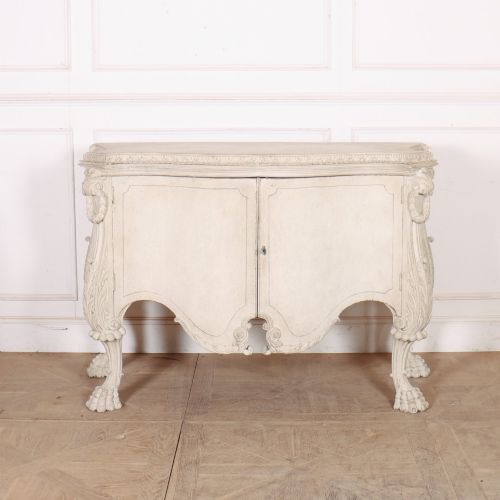
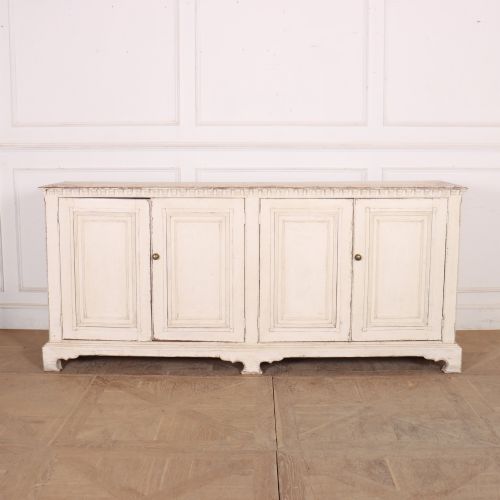
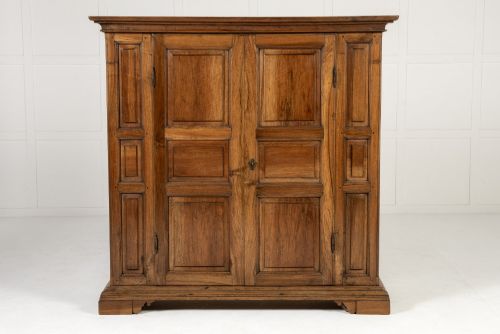


Italian Wooden Credenza
An italian wooden credenza anchors a room with profound craftsmanship, offering substantial storage and centuries of distinct regional character.
Italian Wooden Credenza
An italian wooden credenza encompasses heavy storage furniture ranging from monumental 18th-century sideboards to refined early 20th-century demi-lune cabinets. Buyers searching this phrase encounter robust walnut case pieces alongside intricately painted enfilades and commodes.
The selection leans heavily toward walnut and fruitwood constructions, frequently incorporating marquetry inlay, brass hardware, and iron elements. These forms function practically as side cabinets, linen cupboards, and buffets while displaying significant historic styles from the Renaissance Revival to Italian Rococo.
Materials and construction methods
Cabinetmakers constructed these pieces primarily using solid walnut and fruitwood timbers, often applying detailed hand-carving directly to the wood. Satinwood and marquetry inlay introduced contrasting tones and geometric or pictorial patterns across the surface of the case.
Makers integrated brass and iron for functional and decorative hardware, including hinges, locks, and handles. Painted wood finishes also appear, showing original pigments applied directly to the timber substrates.
Italian Wooden Credenza Retail Price Guide 2026
Typical asking prices for italian wooden credenza among the pieces listed under this phrase on Sellingantiques today, from the lower quarter to the upper quarter. They describe what is for sale here now, not the wider market.
Some 18th-century pieces conceal hidden compartments, such as secret drawers designed to keep valuables safely out of sight.
Judging quality and execution
The degree of hand-carved detail and the complexity of the marquetry inlay set individual examples apart. Pieces executed by noted wood sculptors or exhibition workshops display superior articulation in their Neoclassical or Baroque ornament.
The integrity of the timber selection and the preservation of original painted surfaces dictate the standing of a piece. Finer examples retain their original structural joinery, secret drawers, and operational brass or iron mechanisms without heavy timber replacement.
Pietro Ferrario
The Italian Wooden Credenza Glossary
- Marquetry inlay
- Decorative woodwork where small pieces of veneer are fitted into a ground material to form intricate patterns. This technique appears across various chest surfaces to create pictorial or geometric designs.
- Demi-lune
- A half-moon shape used for the footprint and top of specific side cabinets. This curved form requires specialised joinery.
- Enfilade
- A suite of rooms or a long line of connected storage units and cabinets sharing a unified design. In this context, it describes an extended sideboard or buffet arrangement.
- Commode
- A low chest of drawers with legs or a plinth base, functioning as a primary storage cabinet. Italian iterations frequently feature prominent walnut construction and detailed carving.
- Fruitwood
- Dense timber harvested from fruit-bearing trees, utilised by cabinetmakers for turning and contrasting inlay. It provides a smooth working surface for detailed joinery.
Italian Wooden Credenza: Frequently Asked Questions
Where did they place an italian wooden credenza?
Historic households positioned these large storage cabinets in dining halls, grand reception rooms, and private chambers to house plate, linens, and documents.
Today, they serve similar functions in dining spaces and large living areas as primary statement storage pieces.
How do I maintain the wood surface?
Protect the timber by avoiding direct sunlight and maintaining stable indoor humidity levels to prevent warping in the historic walnut or fruitwood.
Apply traditional wax sparingly and buff gently with a soft cloth to preserve the natural patina without sealing the grain.
What styles are common?
The selection includes Renaissance Revival, Baroque, Rococo, and Neoclassical designs reflecting centuries of Italian craftsmanship.
Earlier examples favour heavy carved walnut, while later 19th and 20th-century pieces incorporate lighter painted finishes and marquetry.
How can I date my cabinet?
Examine the construction joints, timber species, and hardware style to establish a baseline era from the eighteenth through the twentieth century.
Stylistic markers like Neoclassical symmetry or Baroque curves help align the piece with specific periods noted in the evidence.