
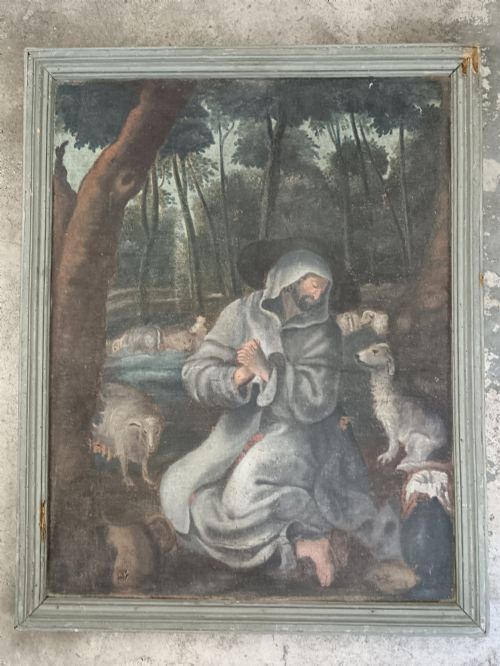
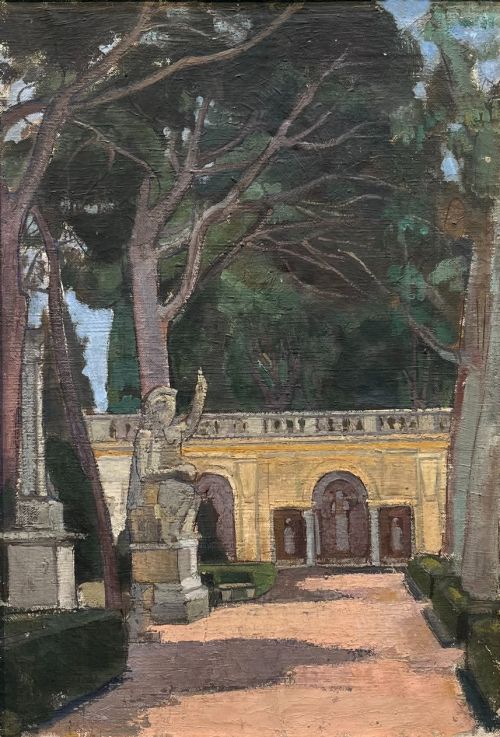
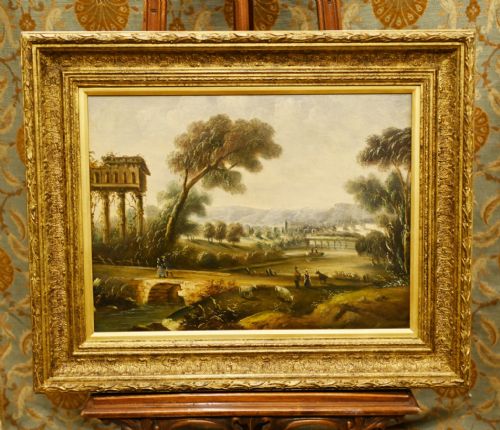


Italian School Oil Landscape
An italian school oil landscape brings the warmth and topography of the Mediterranean directly into a room through oil paint.
Italian School Oil Landscape
An italian school oil landscape captures scenes ranging from pastoral mountains and serene lakes to bustling harbours and coastal views of Naples, Sorrento and Capri. These works span multiple centuries, appearing in both grand canvases and intimate miniature wood panels.
Buyers frequently encounter nineteenth-century interpretations alongside eighteenth-century pastoral compositions and mid-century impressions. Architectural capriccio views and traditional European countryside settings also populate the selection.
Many of these paintings originate from the Grand Tour period or follow specific regional traditions such as the School of Posillipo. The subjects often blend classical architecture, dramatic topography and everyday figures under Mediterranean light.
Materials and construction
Artists worked primarily with oil paint applied to woven canvas supports or prepared wood panels. Some canvases were later attached to panel substrates for added stability.
Frames frequently utilise giltwood, gold leaf or gilded wood to complement the painted scenes. These traditional surrounds often feature decorative mouldings typical of their respective periods.
Current listings feature pieces spanning the eighteenth century through to the mid-twentieth century, executed in oil on canvas and wood panel.
Judging quality in the genre
Quality rests in the handling of light, atmospheric depth and brushwork rather than the sheer age of the piece. Stronger works demonstrate confident execution in foliage, architecture and water, whereas lesser examples rely on formulaic repetition.
The integration of figures and architectural elements within the landscape determines the sophistication of the composition. Well-preserved surfaces retain their original pigment richness and tonal contrasts without heavy intervention.
Fernando Del Basso·Giulio Cecchini·Consalvo Carelli·Antonio Allegri Correggio·Francesco Albani·Giacomo Nani
The Italian School Oil Landscape Glossary
- Capriccio
- An architectural fantasy placing together buildings, ruins and other architectural elements in a fictitious combination for picturesque effect. Artists often populated these scenes with small figures to give a sense of scale.
- Grand Tour
- A traditional trip of Europe undertaken by upper-class European young men of sufficient means flourished from about the seventeenth century onward. These travellers frequently acquired local artwork, including regional landscapes, as souvenirs.
- School of Posillipo
- A nineteenth-century group of painters based in Naples who focused on realistic landscape and marine painting en plein air. Their works capture the distinct light and topography of the southern Italian coastline.
- Pentimento
- A visible trace of earlier painting beneath a layer or layers of paint, showing that the artist made changes during the composition. This phenomenon often appears in older oil works as the top layers become more transparent over time.
Italian School Oil Landscape: Frequently Asked Questions
How do I date an italian school oil landscape?
Dating relies on stylistic clues, stretcher construction, canvas type and the character of the preparation layers beneath the paint. Eighteenth-century examples often show different canvas weaves and priming colours compared to nineteenth-century counterparts.
Frame styles also offer reliable chronological markers, though many paintings have been reframed over the centuries. Examining the reverse of the canvas or wood panel frequently reveals old inscriptions, collection stamps or dealer labels.
Where should I hang a coastal view?
These works suit spaces with good ambient light where the oil pigments and gilt frames can be appreciated without direct, damaging glare. Placing them away from direct heat sources protects both the wooden panels and the canvas tension.
Pairing a landscape with traditional or transitional interior schemes allows the warm Mediterranean tones to anchor the room. Many collectors group miniature wood panels together to create a focused display of regional views.
What is the difference between canvas and wood panel works?
Canvas supports allow for larger compositions and show a characteristic woven texture beneath the paint layers. Wood panels provide a rigid, stable surface often chosen for smaller, highly detailed cabinet paintings and miniatures.
Panels require stable environmental conditions to prevent warping from humidity changes. Canvases, conversely, may occasionally need re-tensioning or relining as the organic fibres age.
Are these paintings original period works?
The selection includes authentic period pieces ranging from the eighteenth to the mid-twentieth century, created by Italian artists or painters working under Italian influence. Evidence such as craquelure, pigment ageing and panel construction helps verify their age.
Some works represent later interpretations or followers of established masters, capturing the enduring appeal of Italian scenery. Each listing details the specific materials and estimated period based on physical evidence.