

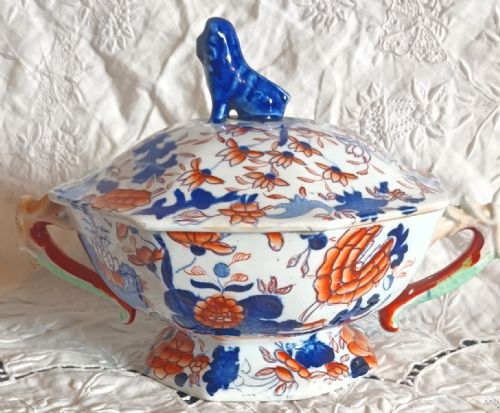


Ironstone Vegetable Dish
An ironstone vegetable dish is a heavy ceramic serving piece built for the nineteenth-century table.
Ironstone Vegetable Dish
An ironstone vegetable dish takes the form of a covered tureen, bowl, or serving vessel designed for nineteenth-century dining. These pieces arrive in Georgian, Regency, and Victorian styles, often decorated with transfer prints, hand-painted enamels, and gilt highlights.
The most common examples on this page are lidded tureens and covered serving dishes produced by Mason's in patterns such as Chinoiserie, Mandarin, and Japan Basket. Buyers also encounter pairs of sauce tureens with ladles and larger soup tureens dating across the nineteenth century.
How they were made
Potters built these vessels using dense ironstone ceramic and earthenware bodies designed to withstand daily service. Pieces received thick glaze coatings to protect the underlying ceramic and seal the surface.
Decoration relied on blue and white transfer printing alongside hand-applied enamel colours and gold leaf details. Workshops utilised moulded elements such as handles and finials shaped like bamboo or floral motifs.
Ironstone Vegetable Dish Retail Price Guide 2026
Typical asking prices for ironstone vegetable dish among the pieces listed under this phrase on Sellingantiques today, from the lower quarter to the upper quarter. They describe what is for sale here now, not the wider market.
Listings span the nineteenth century, including Georgian and Victorian eras, utilising materials such as ironstone ceramic, earthenware, enamel, and gold leaf.
What varies in quality
Quality rests in the crispness of the transfer print and the precision of the hand-painted enamels and gold leaf. Early nineteenth-century examples often display sharper moulding and more vibrant palette control than later productions.
The presence of matching lids, stands, or ladles alters the integrity of a piece. Finer versions maintain clean, unblemished glazes that show minimal firing kiln marks.
Mason's·Coalbrookdale
The Ironstone Vegetable Dish Glossary
- Ironstone
- A dense, durable ceramic body patented in the nineteenth century as a tougher alternative to porcelain. It formed the foundation for heavy domestic and institutional tableware.
- Tureen
- A deep covered bowl designed for serving soups, sauces, or vegetables at the table. These vessels often include matching stands and ladles.
- Transfer Print
- A decoration technique where an engraved copper plate transfers a design onto paper and then onto the ceramic body. This allowed for intricate repeating patterns like Chinoiserie.
- Chinoiserie
- A European decorative style interpreting Chinese artistic motifs. Pieces in this manner feature imaginary landscapes, oriental figures, and botanical elements.
- Gold Leaf
- Hammered gold beaten into extremely thin sheets and applied to ceramics for surface enrichment. It highlights handles, rims, and specific pattern details.
Ironstone Vegetable Dish: Frequently Asked Questions
How do I date an ironstone vegetable dish?
Dating relies on the maker's marks stamped or printed underneath the base, alongside the stylistic clues of the transfer print and moulding.
Early nineteenth-century pieces from the Georgian and Regency periods typically feature hand-painted pattern numbers and specific impressed factory marks.
Can I use these dishes for serving food?
Most buyers choose to use nineteenth-century ironstone for display or occasional table service rather than heavy daily dining.
Because the glaze and enamel on older ceramics can be sensitive to modern detergents, gentle hand washing protects the surface.
What is the difference between a tureen and a vegetable dish?
A tureen is specifically a deep vessel with a fitted lid intended to keep contents warm at the table, often accompanied by a matching ladle.
General serving dishes might include open bowls or platters, though nineteenth-century terminology frequently groups lidded vegetable tureens under both descriptions.
Why do some pieces have stands?
Large soup and vegetable tureens were paired with matching underplates or stands to catch drips and protect dining tables.
Finding a piece complete with its original stand significantly enhances the integrity of the set.