



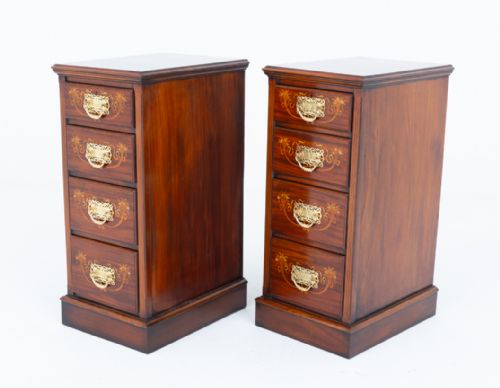


Inlaid Wooden Bedside Cupboard
An inlaid wooden bedside cupboard brings practical surface space and subtle decorative marquetry to a bedroom.
Inlaid Wooden Bedside Cupboard
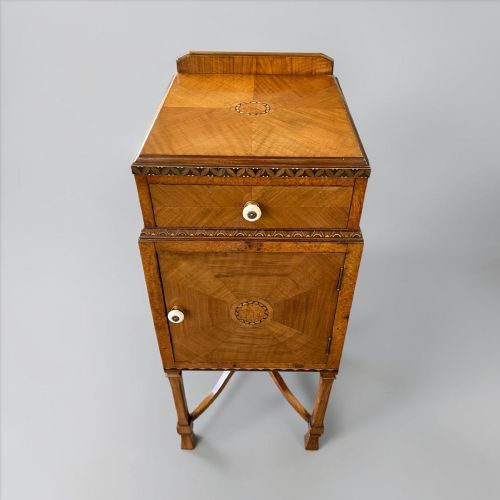
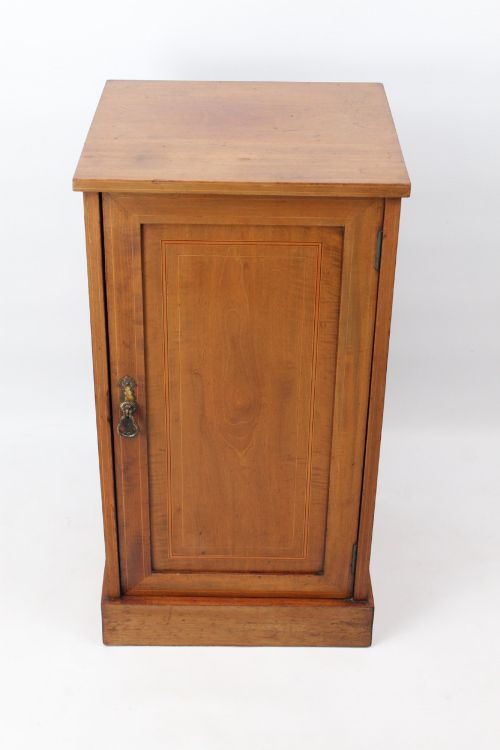
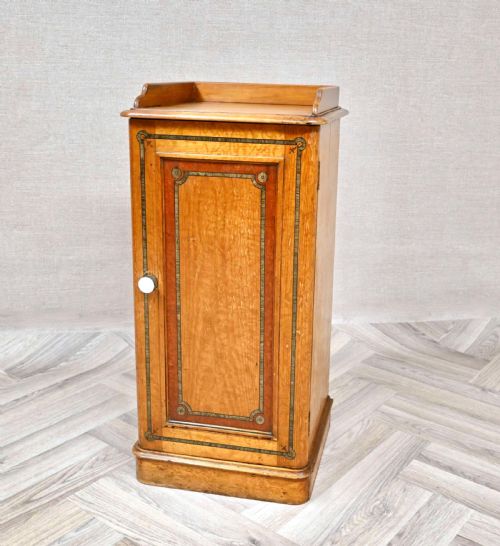
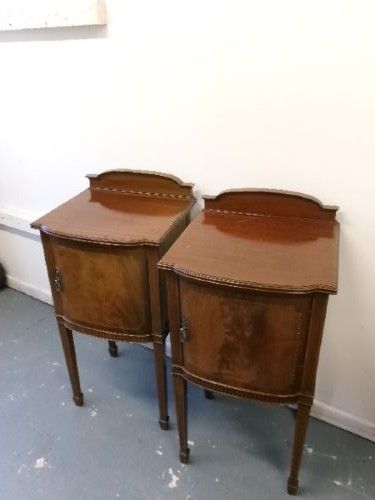
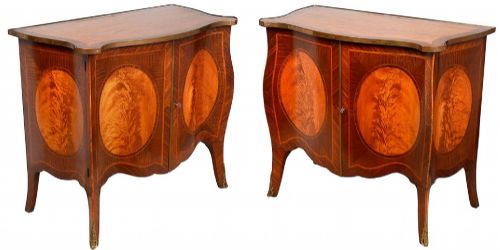
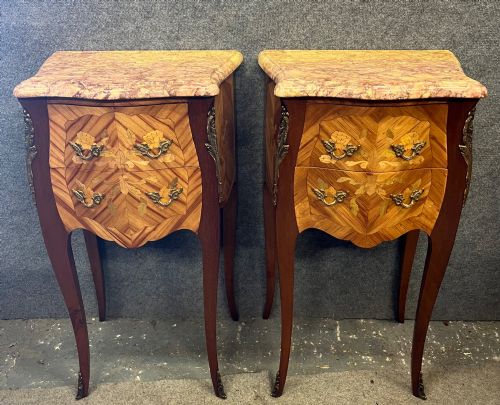
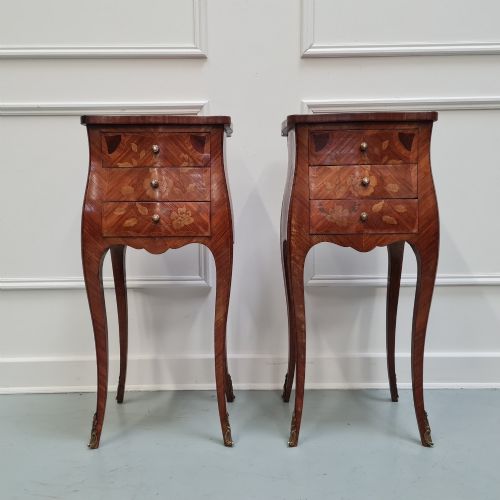
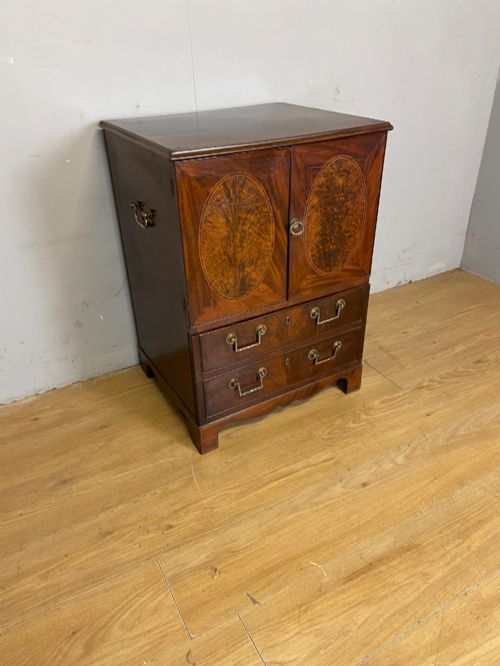
An inlaid wooden bedside cupboard combines enclosed storage with decorative surface detail, serving beside a bed or in a corner as a small lamp table. When you search for an inlaid wooden bedside cupboard, you encounter pieces originating from the nineteenth century, the Edwardian era, and the early twentieth century up to the 1930s. The selection spans single cabinets and matching pairs, taking forms such as standard bedside cabinets, small chests of drawers, bowfront designs, and marble-topped commodes.
Edwardian mahogany examples with delicate stringing or marquetry appear frequently alongside French styles featuring Kingwood, walnut, and marble tops. Cabinetmakers built these pieces to hold night-time necessities behind closed doors or within compact drawers, often pairing mahogany carcases with lighter satinwood or boxwood inlay. Regional variations bridge English Sheraton Revival interpretations and continental French Louis XV revival shapes.
Materials and construction
Cabinetmakers constructed these cupboards using solid timbers and carefully selected veneers, primarily relying on mahogany, walnut, and satinwood complemented by contrasting boxwood and ebony stringing. French pieces frequently utilise exotic woods such as kingwood and goncalo alves, matched with shaped marble tops and cast brass mounts. Marquetry decoration involves precision-cut wood veneers assembled into pictorial or geometric patterns and set flush into the primary surface.
Traditional joinery methods govern the construction of doors, drawers, and carcases, ensuring stability across shifting household temperatures. Surfaces receive hand-applied finishes that highlight the natural grain of the timber and the subtle colour variations of the multi-wood inlay.
The listings on this page span the Victorian era, the Edwardian period, and the 1930s, utilising mahogany, satinwood, walnut, and marble.
Craftsmanship and materials
The standard of execution in the marquetry and stringing separates routine production from superior cabinet work. Finely cut inlay fits flush with the surrounding timber without excessive filler, maintaining crisp geometric lines or naturalistic curves in the floral motifs.
The choice of primary wood and secondary timber dictates the structural integrity of the piece. Dense, well-figured mahogany, heavy marble slabs, substantial brass hardware, and precise drawer dovetailing distinguish the finer examples from simpler utilitarian cupboards.
Maple and Co·Gillows
The Inlaid Wooden Bedside Cupboard Glossary
- Marquetry
- Decorative veneer work arranged in pictorial or patterned designs across furniture surfaces. It requires distinct wood species cut to shape and fitted together before application.
- Stringing
- Thin inlay lines of contrasting wood, such as boxwood or ebony, embedded into channels on table tops and drawer fronts. This technique outlines panels and defines structural edges.
- Bowfront
- A convex curved cabinet or chest front that swells outward toward the viewer. This curved profile demands skilled woodworking to maintain alignment across doors and drawers.
- Sheraton Revival
- A late nineteenth and early twentieth century design movement drawing on the eighteenth-century neoclassical style of Thomas Sheraton. Pieces typically feature refined proportions, tapered legs, and subtle satinwood inlay.
- Pot cupboard
- A traditional term for a small bedside cabinet designed originally to enclose a chamber pot. Modern usage treats them simply as compact bedside storage.
Inlaid Wooden Bedside Cupboard: Frequently Asked Questions
How do I identify an Edwardian inlaid cupboard?
Edwardian inlaid cupboards often feature light mahogany timbers decorated with delicate boxwood stringing or classical floral marquetry. The proportions tend to be slender and upright.
They date from the early twentieth century and frequently exhibit tapered legs or subtle brass handles that reflect the revival of eighteenth-century neoclassical tastes.
Why do some cabinets have marble tops?
Marble tops on bedside cupboards originated largely from continental European workshop traditions, particularly in French designs. The stone provided a durable, easily cleaned surface resistant to spilled liquids.
These heavy stone slabs sit directly on top of the wooden carcase, sometimes accompanied by raised marble galleries or shaped wooden edges.
How do I care for inlaid wooden furniture?
Inlaid wooden furniture requires protection from direct sunlight and extreme humidity fluctuations to prevent veneer lifting and wood splitting. Maintaining a stable indoor environment preserves the natural timber.
Dust the surfaces regularly with a soft, dry cloth and apply occasional appropriate wax polish sparingly to nourish the wood grain without harming the delicate inlay.