


Inlaid Wheel Barometer
An inlaid wheel barometer is a mercurial weather glass housed in a distinct banjo-shaped wooden case, offering both atmospheric tracking and domestic elegance.
Inlaid Wheel Barometer
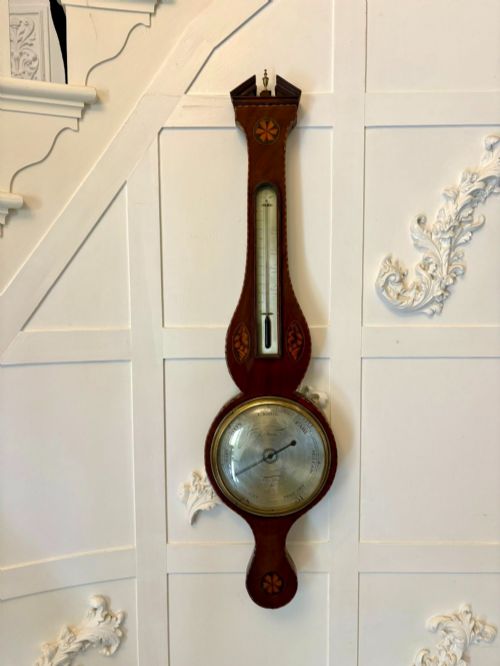
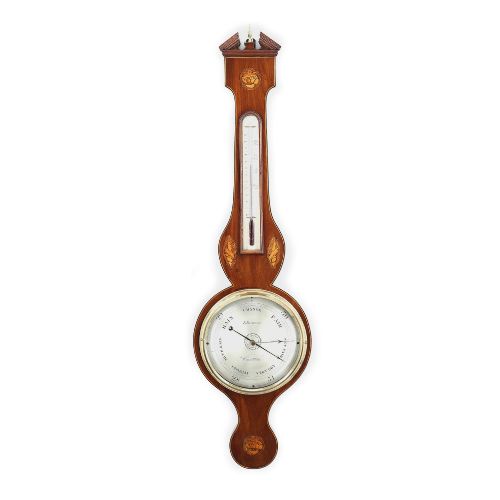
An inlaid wheel barometer combines scientific utility with decorative cabinet work, taking a characteristic rounded head and long trunk that earned it the alternative name of banjo barometer. The pieces gathered here span the Georgian, Regency, and Victorian eras, demonstrating how makers adapted the form across changing British tastes.
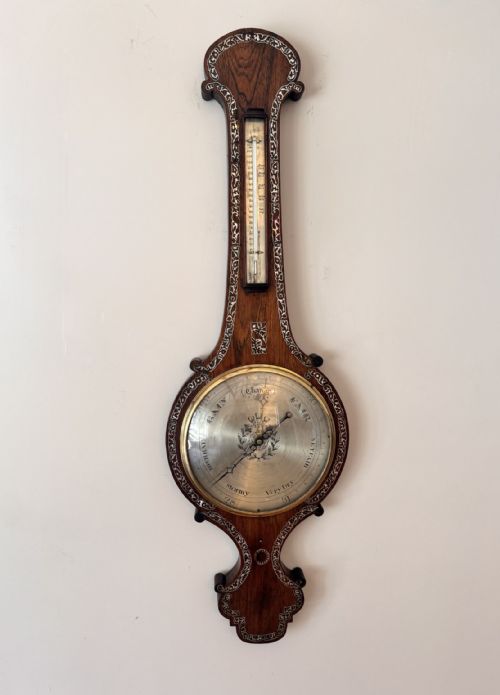
Most examples rely on rich timbers such as mahogany and rosewood, often enhanced by contrasting boxwood inlay, shell motifs, or mother-of-pearl accents. The dial face sits beneath glass at the top, while the lower trunk frequently houses a spirit thermometer, a hygrometer, or a dry bulb indicator.
The layout reflects a tradition of domestic instrumentation where precision mechanics met fine furniture making. Buyers encounter variations ranging from restrained late eighteenth-century proportions to more ornate mid-nineteenth-century interpretations set with mother-of-pearl.
Materials and Construction Methods
Cabinet makers built the distinctive cases using solid and veneered mahogany or rosewood, shaped with curved crests and tapered stems. Artisans applied boxwood stringing and marquetry, frequently incorporating delicate shell motifs or floral inlays into the throat and base of the trunk.
The interior houses a mercurial tube system linked to a brass indicator wheel, translating barometric pressure shifts into dial movements. Silvered metal dials provide the scale for readings, protected by a brass bezel and a glass cover.
Several makers from Como brought alpine weather forecasting traditions straight to British hallways, spelling Norwich and Weymouth with an authentic Italian flair.
Judging Quality and Execution
Quality rests in the crispness of the cabinet work, the complexity of the inlay, and the retention of original components such as the brass bezel and silvered dial plate. Finer pieces demonstrate precise boxwood stringing and well-executed shell or mother-of-pearl marquetry that integrates smoothly into the grain of the primary timber.
The integrity of the mercurial mechanism and the clarity of the engraved scale plate separate standard production from superior workshop output. Maker signatures engraved onto the dial or spirit level plate further distinguish pieces produced by established provincial and metropolitan makers.
B. Besozzi of Weymouth·Ganthony of London·Prada of High Wycombe·Molton of Norwich·Luisetti of London·Fagioli of Clerkenwell London·Giana Shrewsbury·L Casatelli of Liverpool·Vecchio & Co of Shaftsbury·A. Rivolta·J Groce York·F Salteri & Co Nottingham·Dominic Gatty·Schiavi of Chesham·Gugeri & Belotti London·D.Cattaneo & Co of Leeds
The Inlaid Wheel Barometer Glossary
- Banjo barometer
- A domestic wall barometer housed in a case shaped like a banjo, featuring a circular dial at the top and a long trunk below. This form dominated British hallways throughout the Georgian and Victorian periods.
- Mercurial barometer
- An instrument that measures atmospheric pressure using a column of liquid mercury enclosed in a glass tube. Changes in air pressure cause the mercury level to rise or fall, moving an internal pulley and wheel.
- Silvered metal
- A brass or copper dial plate treated to achieve a bright, reflective silver finish before being engraved with weather descriptions and numerical scales. This surface provides high contrast for black-filled lettering.
- Marquetry
- The art of applying thin veneers of different coloured woods and materials onto a structural carcass to create decorative patterns. In these pieces, it frequently takes the form of floral or shell designs.
- Boxwood inlay
- Narrow strips of pale boxwood inserted into grooves cut into darker timbers like mahogany or rosewood. It creates sharp linear borders around the edges of the barometer case.
Inlaid Wheel Barometer: Frequently Asked Questions
How do you read an inlaid wheel barometer?
The upper dial displays air pressure readings through a needle connected to the internal mercury tube. Turning the manual pointer allows you to track whether pressure is rising or falling relative to the current position.
Secondary dials on the instrument face often include thermometers for ambient temperature or hygrometers for humidity. Together, these indicators provide a comprehensive snapshot of changing atmospheric conditions.
Where were these barometers originally hung?
These instruments were designed for prominent placement in domestic hallways, reception rooms, and libraries of substantial homes. Their decorative cases served as both scientific tools and status symbols for visitors to see.
Positioning them away from direct sunlight and heat sources helped protect the delicate wood veneers and ensured more stable temperature readings for the internal mercury.
How can I tell a Georgian barometer from a Victorian one?
Georgian examples tend to feature restrained mahogany cases with delicate shell marquetry and simpler architectural pediments. Their dials often display clean, understated lettering characteristic of late eighteenth and early nineteenth-century craftsmanship.
Victorian pieces frequently incorporate rosewood, bolder proportions, and extensive mother-of-pearl inlay across the trunk and cistern cover. The engraving on the dial plates also becomes more ornate during this later period.
Are these barometers still accurate?
Many mercurial instruments retain their working sensitivity when the internal tube system remains intact and undisturbed. Changes in weather will continue to prompt movement in the indicator needle.
Transporting the instrument requires careful handling of the mercury column to prevent air bubbles from entering the glass tube. Professional calibration may be necessary after relocation.