
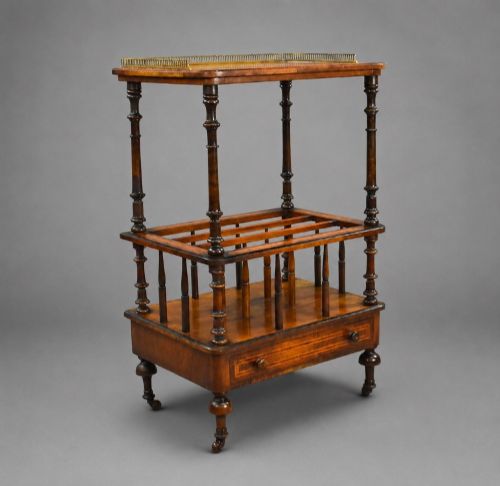


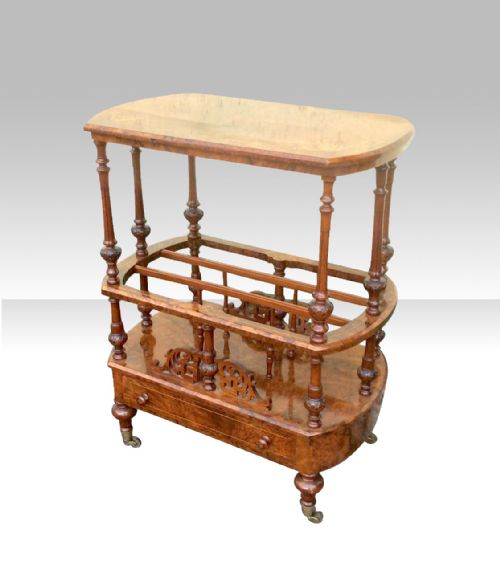


Inlaid Walnut Canterbury Stand
These inlaid walnut canterbury stand pieces are nineteenth-century reading and music holders that bring rich timber grain and fine marquetry into a room.
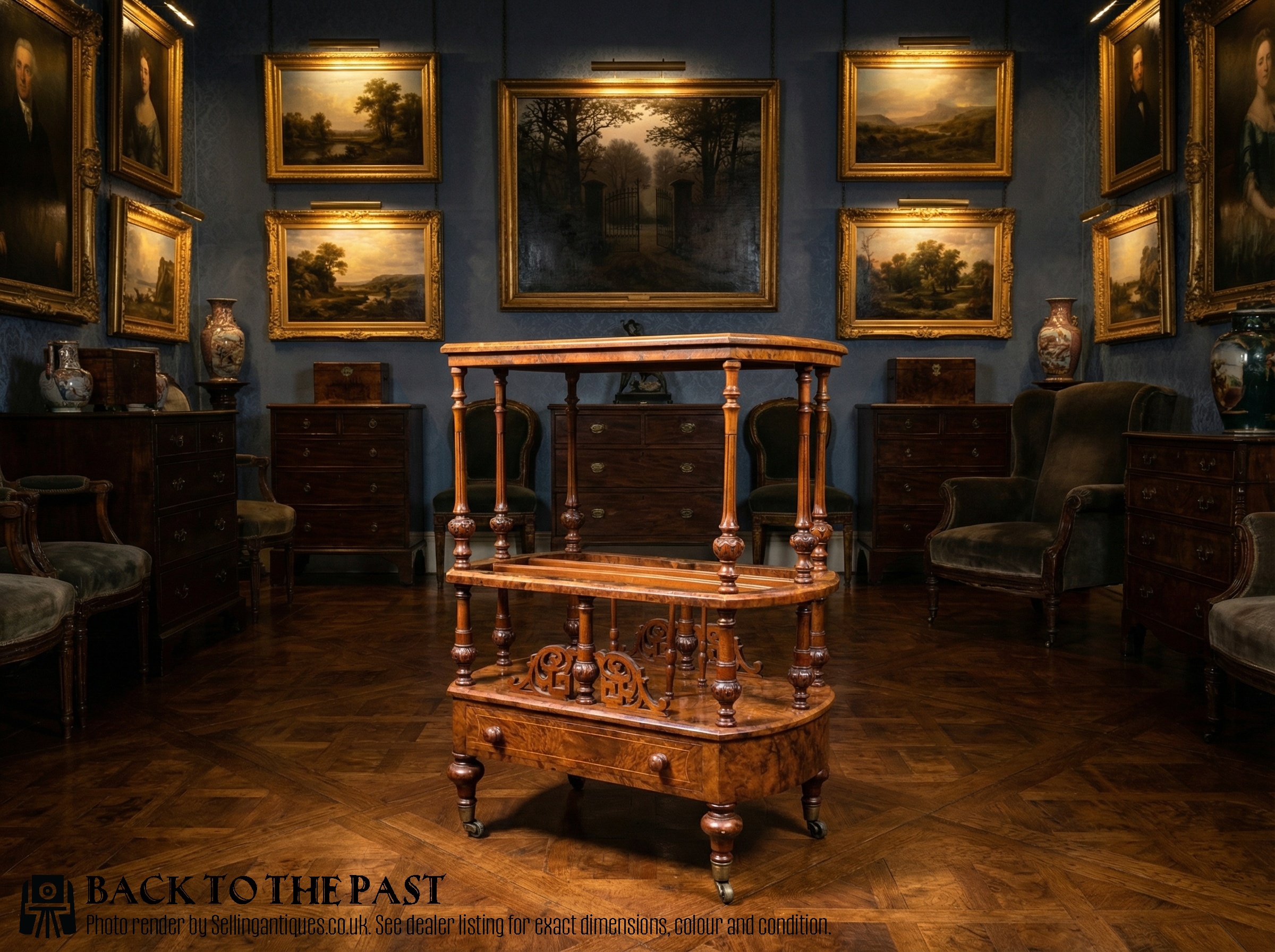
Inlaid Walnut Canterbury Stand
An inlaid walnut canterbury stand is a piece of nineteenth-century furniture designed to hold sheet music, periodicals, and books near a chair or table. The examples met on this page belong to the Victorian period, dating from the eighteen-sixties and eighteen-seventies.
The form appears in various guises across the listings, including music canterburys, magazine racks, whatnots, and occasional lamp tables. Many combine the traditional partitioned rack below with a drawer, a shelved whatnot top, or a cabinet enclosure.
Makers of the period built these pieces to serve active domestic uses in drawing rooms and parlours. Today, a buyer looks for this phrase to find a compact, decorative item that organises papers while displaying the warm tones of burr walnut.
How they were made
The construction relies heavily on walnut and burr walnut timbers, chosen for their distinctive figured grain and deep colour. Cabinetmakers laid marquetry, wood inlay, and boxwood lines into the surfaces to create geometric or floral patterns.
Makers incorporated brass elements, leather, and ceramic fittings as functional or decorative accents alongside fretwork panels. Drawers were integrated into the lower sections, and occasional pieces utilised turning and shaping to support upper tiers.
Victorian makers expected people to play the piano constantly, hence the need for a stand to keep all that sheet music from sliding onto the parlour floor.
What varies in quality
Quality in these pieces rests upon the choice of timber and the execution of the decorative inlay. Burr walnut with rich, lively figuring marks out the better examples from plain walnut surfaces.
The complexity of the form also dictates the standard of the piece, distinguishing simple magazine racks from substantial whatnots with drawers, fretwork, and combined music cabinets.
The Inlaid Walnut Canterbury Stand Glossary
- Canterbury
- A low stand with partitioned uprights for holding sheet music or loose papers. It often includes a small drawer beneath.
- Burr Walnut
- Timber taken from a growth or knot on a walnut tree, yielding highly decorative swirling grain patterns. Cabinetmakers used veneers of this wood on prominent surfaces.
- Marquetry Inlay
- The art of fitting pieces of contrasting coloured woods into a veneer ground to form pictures or ornamental patterns. It decorates the top panels and doors of many Victorian stands.
- Whatnot
- A piece of open shelving designed for displaying ornaments or holding books. In these listings, it often sits above the canterbury rack.
- Fretwork
- Ornamental woodwork pierced with patterns using a scroll saw or fretsaw. This technique appears on the partitions and galleries of several pieces.
Inlaid Walnut Canterbury Stand: Frequently Asked Questions
What is an inlaid walnut canterbury stand used for?
These pieces were originally designed to hold sheet music, books, and periodicals in nineteenth-century sitting rooms. Today, they serve a similar purpose for magazines and papers while adding period character to a room.
They also function as small side tables or lamp tables when fitted with an upper surface.
How do I date an inlaid walnut canterbury stand?
The listings for these pieces fall squarely within the Victorian period, spanning the mid to late nineteenth century. Clues to the date lie in the specific timber choices, such as burr walnut veneers, and the style of the marquetry inlay.
Cabinetmakers of this era frequently combined multiple functions, such as adding a drawer or a whatnot tier to the basic rack.
How do I care for burr walnut furniture?
Burr walnut benefits from being kept away from direct sunlight and sudden temperature changes, which can dry out the timber and veneer. Regular dusting with a soft, dry cloth maintains the surface finish.
Applying a suitable wax polish occasionally helps preserve the depth and lustre of the wood.