
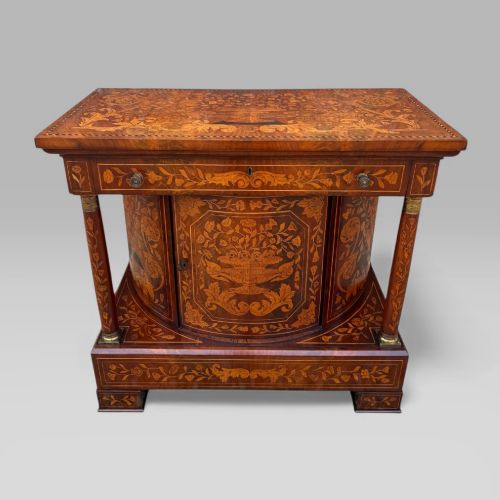
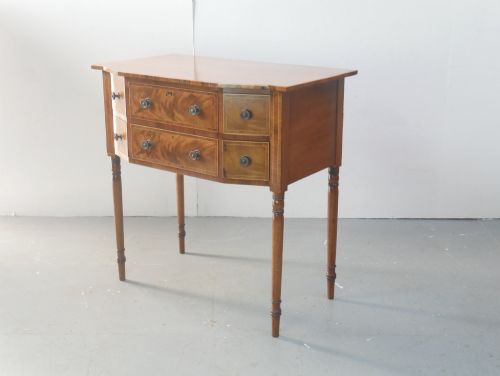
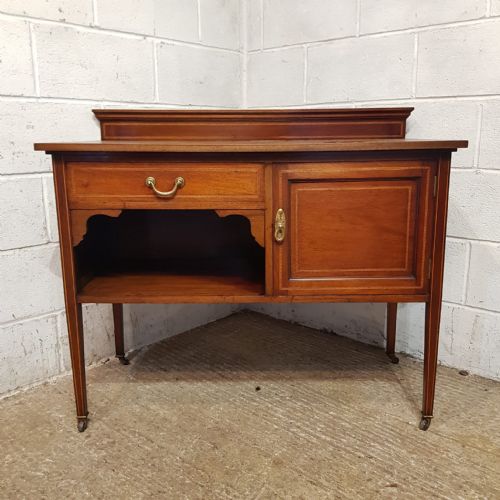


Inlaid Hall Cabinet
These inlaid hall cabinet examples bring together rich timbers and delicate marquetry to anchor an entrance with period character.
Inlaid Hall Cabinet
An inlaid hall cabinet serves as a striking focal point in an entrance space, providing both surface display and concealed storage. When searching for an inlaid hall cabinet, a buyer encounters forms spanning the eighteenth century through the Edwardian era.
The pieces appearing on this page include side cabinets, sideboards, washstands, and console tables executed in various regional styles. Mahogany and walnut form the structural core of many examples, accented with marquetry and contrasting stringing.
Edwardian and Victorian iterations appear frequently alongside earlier Georgian and Regency designs. These domestic items bring warmth and formal presence to hallways and corridors through figured timbers and deliberate proportions.
How they were made
Cabinet makers constructed these pieces using dense hardwoods such as mahogany, walnut, and cherrywood for the primary carcass and framing. Pine frequently appears as a secondary timber for internal linings and drawer construction.
Surface decoration relies on fine marquetry and contrasting veneers, utilising boxwood, satinwood, and fruitwood to create geometric panels or floral motifs. Brass hardware such as handles, hinges, and key escutcheons completes the functional detailing.
Periods represented span the eighteenth century, Regency, Georgian, Victorian, and Edwardian eras.
What varies in quality
The standard of an inlaid hall cabinet rests on the crispness of its marquetry and the choice of timber figure. Cabinets featuring finely cut fruitwood and satinwood displays demonstrate greater technical ambition than those with simple border banding.
Construction methods also separate standard examples from finer works, particularly in the precision of dovetail joints and the integration of internal fittings. Timber selection dictates the depth of grain pattern visible across the primary surfaces.
The Inlaid Hall Cabinet Glossary
- Marquetry
- Decorative veneer work forming pictures or patterns by using thin slices of wood. Fruitwood and boxwood often provide contrasting tones within these pictorial designs.
- Bowfront
- A convex curved cabinet front that swells outward toward the centre. This curved profile softens the linear geometry of an entrance hall.
- Stringing
- Thin inlay lines of a contrasting wood set flush into the surface timber. This technique outlines drawers and panels to define the structural borders.
- Credenza
- A sideboard or cabinet form originating in Italy and adopted for formal reception spaces. These low pieces offer surface display alongside enclosed cupboard storage.
Inlaid Hall Cabinet: Frequently Asked Questions
Where should I place a hall cabinet?
These cabinets suit entrance halls, corridors, and reception spaces where floor area permits a shallow storage piece. Their finished backs and compact footprints allow them to stand flat against prominent walls.
Positioning them near an entrance provides a convenient surface for incoming post and keys while establishing a formal character upon entry.
How do I care for antique wood?
Maintain antique timber surfaces by keeping them away from direct heat sources and sudden humidity shifts. Regular dusting with a soft, dry cloth preserves the finish without requiring heavy polishes.
Applying traditional wax sparingly helps nourish dry hardwood and protects delicate marquetry inlay over decades of domestic use.
What periods do these cabinets represent?
The pieces span multiple centuries, ranging from eighteenth-century Georgian and Dutch examples to nineteenth-century Victorian and Edwardian revivals. Each era brings distinct proportions and cabinet-making conventions to the form.
Edwardian satinwood versions often feature lighter tones, whereas Georgian and Victorian pieces emphasise deep mahogany and walnut figures.
How do sideboards differ from hall cabinets?
Sideboards traditionally serve dining functions with longer, low-slung surfaces and extensive storage for tableware. Hall cabinets and side cabinets prioritize compact footprints suited to narrow transitional spaces.
Both categories utilise decorative wood veneers and marquetry inlay, though hall cabinets generally emphasise vertical presence over broad serving surfaces.