
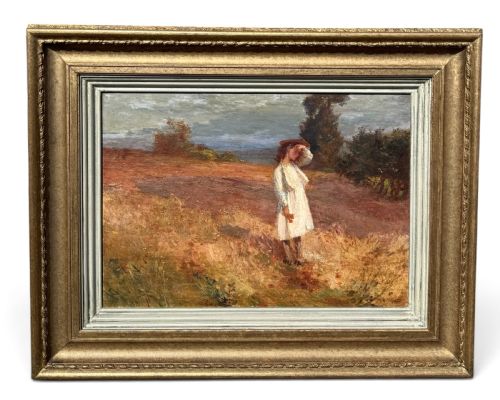
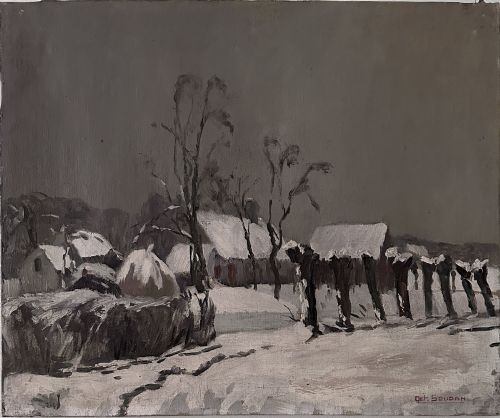


Impressionist Rural Scene Artwork
Impressionist rural scene artwork captures the quiet rhythm of agricultural life through loose brushwork and natural light.
Impressionist Rural Scene Artwork
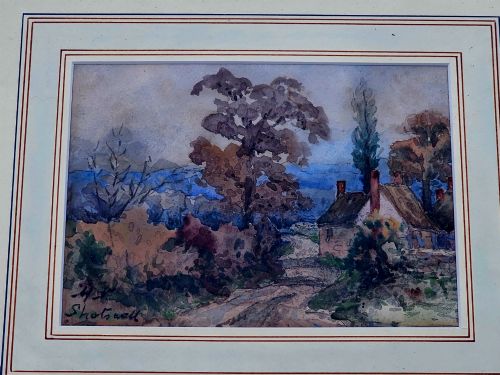
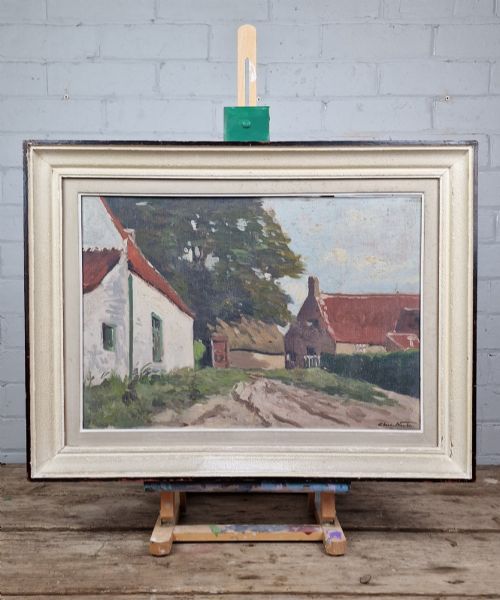
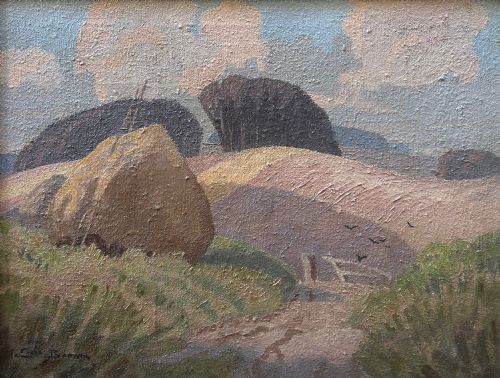
When you search for impressionist rural scene artwork, you encounter paintings depicting farmyards, haystacks, and field laborers from the late nineteenth century into the mid-twentieth century. These pieces record pastoral subjects such as working horses, sheep grazing, and village cottages set in British, French, and other European landscapes.
The most common formats on this page are oil paintings on canvas or board alongside watercolours on paper. Artists working in British Impressionism, Scottish Impressionism, and Post-Impressionism dominate the selection, utilising rapid application to render light on open terrain.
Materials and methods
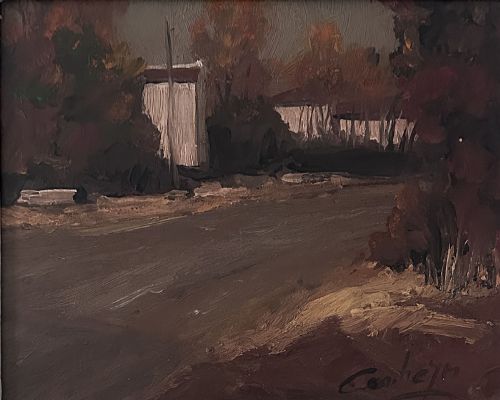
Canvases and wooden panels receive layers of oil paint applied with visible, textured brushstrokes to capture fleeting atmospheric conditions in the countryside. Watercolour paintings on paper utilise fluid washes of pigment to portray softer morning and twilight effects across fields and rivers.
Support materials range from stretched canvas and heavy paper to timber boards and panels, often housed in period frames suited to early twentieth-century domestic interiors.
Regional British and French landscapes dominate the selection, with a strong emphasis on farming and livestock.
Distinctions in quality
Quality rests on the confidence of the handling and the cohesion of the composition rather than the mere presence of a signature or a pastoral subject. Stronger examples demonstrate a sure command of light and shadow that defines form without relying on rigid outlines.
The integration of brushwork across the entire surface distinguishes accomplished works from more rigid academic studies. Palette choice also plays a role, with superior pieces maintaining tonal harmony across farmyard and landscape elements.
Charles Houben·Umberto Volpato·Raimond Louis Lecourt·Herbert Royle·Ernest Higgins Rigg·Owen Bowen·Ernest Pile Bucknall·Willem Anton Alexander Knip·Majorie Hoare·William Greaves·John Atkinson·William Grant Murray·James William Booth·George Soper·Florence Hess·Ralph Dorrance·Lorenzo Headley·Helmut Reuter·Arthur Winter Shaw·Robert Russell MacNee·Robert Gemmell Hutchinson·W Tatton Winter·Rowland Henry Hill
The Impressionist Rural Scene Artwork Glossary
- Post-Impressionism
- A development extending Impressionism that emphasises symbolic content and heavier outlines while retaining a vivid palette. Artists in this movement pursued individual expression over strict optical realism.
- Board
- A rigid wooden or composition support used by painters in place of stretched canvas. It provides a firm foundation for oil paint applications.
- Watercolour
- A painting method using water-soluble pigments on paper. This medium produces transparent washes that capture light effects swiftly.
- Panel
- A flat wooden support utilised for oil paintings. Panels offer stability and a smooth surface for detailed brushwork.
- Framed artwork
- A piece enclosed within a protective border structure. Frames often reflect the aesthetic of the period in which the painting was created.
Impressionist Rural Scene Artwork: Frequently Asked Questions
What subjects appear in impressionist rural scene artwork?
These works depict agricultural tasks and pastoral settings, including haystacks, farmyards, sheep grazing, and working horses in fields.
Scenes frequently capture rural life in Britain and France during the early decades of the twentieth century.
How do oil and watercolour pieces differ?
Oil paintings utilise heavy pigments on canvas or board, offering rich texture and deep colour saturation.
Watercolours employ translucent pigments on paper, creating lighter and more luminous atmospheric effects.
How do I date these artworks?
Dating relies on stylistic markers, artist records, and framing details that align with periods from the late nineteenth century to the mid-twentieth century.
Many pieces bear signatures or inscriptions noting specific years or locations.
Where should I display these paintings?
These landscape and farmyard scenes suit traditional living spaces, studies, or hallways where natural light complements their palettes.
Keeping them away from direct sunlight protects the pigments on canvas and paper.