




Impressionist Fishing Boat Art
Impressionist fishing boat art captures working vessels in open water and busy harbours through loose brushwork and vibrant light.
Impressionist Fishing Boat Art
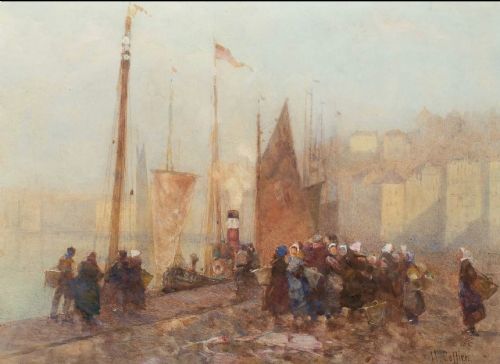
When you search for impressionist fishing boat art, you encounter harbour scenes and coastal views populated by working vessels. These works record coastal life from the nineteenth century through the mid-twentieth century.
The pieces on this page typically present British and European waters, ranging from Cornish ports to French and Brazilian harbours. You are most likely to meet watercolours on paper and oil paintings executed on canvas or board.
Works span movements such as British Impressionism, Post-Impressionism, and Victorian British Impressionism. Artists capture low tides, boat yards, and morning departures with loose, expressive handling of pigment.
Materials and technique
Painters relied primarily on oil paint and watercolour applied to canvas, board, or paper supports. Watercolours utilise fluid washes to capture open skies and reflective harbour water.
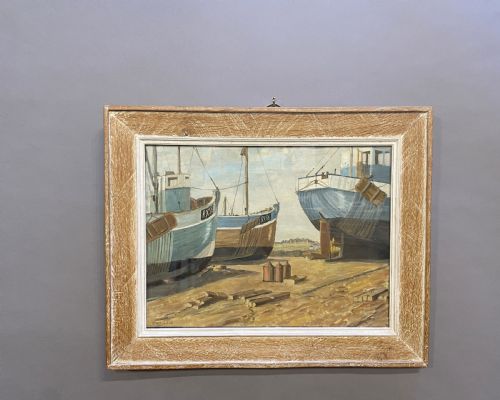
Oil paintings employ thick, textured brushwork known as impasto to render the wooden hulls of boats and the rough movement of the sea. Artists built up surfaces directly on canvas or wooden boards to convey immediate atmospheric conditions.
The inventory spans Victorian British Impressionism, Post-Impressionism, and mid-century movements.
Judging quality
Quality rests upon the artist's confidence in handling light and atmosphere rather than tight adherence to physical detail. Stronger works demonstrate a sure sense of tone and composition within the harbour setting.
The vitality of the brushwork and the harmony of the palette separate the finest canvases from simpler decorative pieces. Masterly handling transforms ordinary working boats into compelling studies of light and movement.
Hector Caffieri·Edward Matthew Elliott·William Lee Hankey·Frederick William Hattersley·William Lambert Bell·Owen Bowen·Antonio Godoy·Fred Mayor·Hendrik Yan Wolter·Henri Ottman·Frank Rousse·Robert Leslie Howey·Augustus William Enness·Alec Caruthers Gould·John W Gilroy·Maurice Sijs
The Impressionist Fishing Boat Art Glossary
- Impressionism
- A nineteenth-century painting style focused on capturing the visual impression of a moment, especially regarding shifting light and open brushwork. It prioritises overall atmospheric effect over precise detail.
- Watercolour
- A painting method where water-soluble pigments are suspended in a water-based solution on paper. It relies on the white of the paper showing through transparent washes of colour.
- Impasto
- Paint applied thickly to a canvas or board so that the strokes stand out from the surface. This technique adds tactile dimension to the depiction of water and wooden hulls.
- Board
- A rigid wooden or fibrous panel utilised as a support for oil painting. It offers a firm surface distinct from flexible woven canvas.
- Seascape
- A work of art depicting the sea, coastal views, or marine vessels in open water or harbour settings. These scenes form the core of coastal painting traditions.
Impressionist Fishing Boat Art: Frequently Asked Questions
What periods do these paintings cover?
The available selection spans from the nineteenth century through the 1960s, with a strong concentration in the early decades of the twentieth century. Artists worked through Edwardian times and the mid-century period.
These dates reflect the broader evolution of British and European impressionist painting styles in coastal towns and bustling ports.
How were these coastal scenes painted?
Artists utilised oil paint on canvas and board alongside watercolour on paper to record harbour views. They applied fluid washes for water and thicker brushstrokes for wooden vessels.
Many practitioners worked outdoors directly on location in fishing ports to capture changing tidal conditions and natural light.
Where do these harbour views originate?
The works depict various maritime locations across Britain and continental Europe. Common settings include Cornish fishing villages, Yorkshire ports, and French coastal towns.
Specific geographic locations named in the evidence range from St Ives and Polperro to Honfleur and the French Riviera.
How do I care for antique watercolours?
Watercolour paintings on paper require careful protection from direct sunlight to prevent the pigments from fading over time. Framing behind conservation glass helps shield the paper from environmental moisture.
Displaying these works away from direct heat sources preserves both the paper support and the delicate washes.