
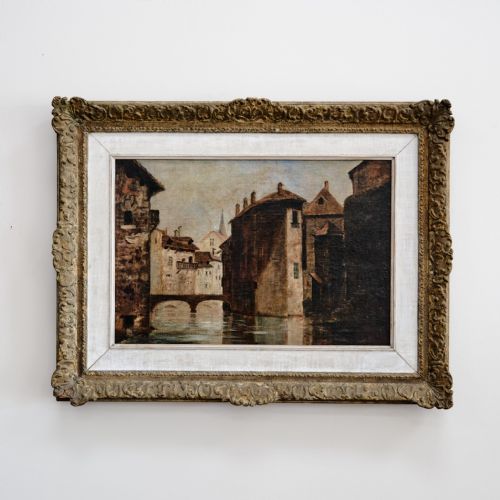
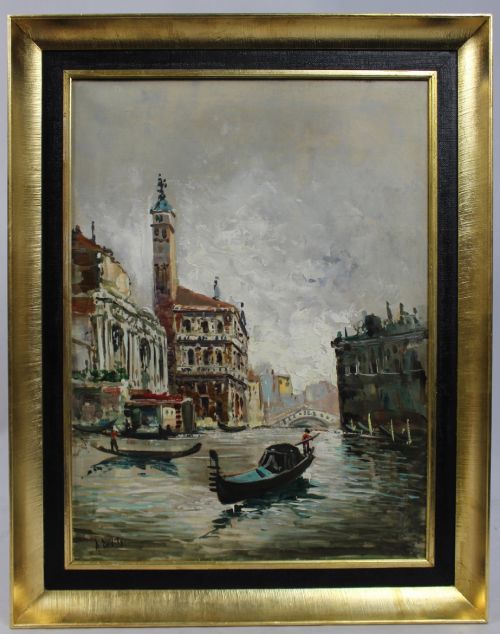


Impressionist Canal Landscape Painting
Impressionist canal landscape painting captures water and light through loose brushwork, offering buyers a lively glimpse of historic waterways.
Impressionist Canal Landscape Painting
An impressionist canal landscape painting depicts urban waterways, barges and bridges using visible brushstrokes and atmospheric light. When exploring this selection, buyers encounter works ranging from nineteenth-century French and British interpretations to mid-century continental views.
The subjects focus heavily on Venetian waterways, Dutch canals and French rivers. Most pieces on this page originate from the nineteenth and twentieth centuries, spanning periods such as the nineteen-thirties, nineteen-forties and nineteen-fifties.
Formats divide mainly between oil paintings on canvas or board and watercolours on paper. Artists capture changing daylight upon water, old mansions and gondolas beneath bridges.
Materials and technique
These works rely primarily on oil paint or watercolour applied to canvas, wood panels or paper supports. Pigments are worked with fluid, expressive strokes to render the shifting reflections on water and the texture of stone buildings.
Artists often employ gesso preparations on wooden boards or canvases to create a stable ground before applying oil layers. Watercolour examples use paper to achieve translucent washes that capture bright skies and misty canal atmospheres.
The listings span from the nineteenth century through the nineteen-sixties, utilising oil paint, watercolour, canvas, wood and paper.
Distinctions in quality
Quality rests in the handling of light and the surety of the brushwork rather than the subject matter alone. Superior examples demonstrate a confident control of tone that defines depth and movement in water without relying on rigid lines.
The vitality of the pigment application and the harmony of the palette separate standard decorative pieces from accomplished works. Strong compositions balance architectural elements with the fluid expanse of the canal.
Antonio DeVity·Fred Lawson·E A Minardo·Claude Jousset·Marc Aldine·Antoine Bouvard Senior·Herbert Royle·Hercules Brabazon Brabazon·Frank Wasley·Henry Wimbush·Helen Donald-Smith·Charles Clement Calderon
The Impressionist Canal Landscape Painting Glossary
- Impressionist
- A style of painting emphasising loose brushwork and the depiction of light rather than strict botanical or architectural accuracy. This approach prioritises atmospheric effects over fine detail.
- Canvas
- A heavy woven fabric stretched across a wooden frame to serve as a support for oil paint. It provides a slightly textured surface that holds thick layers of pigment.
- Gesso
- A plaster mixture applied to wood panels or canvas to prepare the surface for painting. It creates a smooth, durable ground for oil applications.
- Watercolour
- A paint consisting of pigment suspended in a water-based solution, typically applied to paper. It produces luminous, transparent washes of colour.
Impressionist Canal Landscape Painting: Frequently Asked Questions
How do I date an impressionist canal painting?
Dating relies on stylistic clues, framing methods, and the type of canvas or paper support used by the artist. Signatures and exhibition labels on the reverse also help establish a firm period.
Changes in pigment technology and stretcher frame construction across the nineteenth and twentieth centuries provide further chronological indicators for experts.
Where were these canal scenes usually painted?
Venice is a primary recurring location, alongside Dutch waterways, French rivers, and British canals. Artists travelled extensively to capture these specific urban and rural water settings.
Views often feature recognisable landmarks such as the Grand Canal or local bridges flanked by period architecture.
Are these paintings executed on canvas or board?
The works utilise a variety of supports including woven canvas, wooden panels, and heavy paper for watercolours. Oil paint appears frequently on both canvas and prepared board surfaces.
Each material interacts differently with the pigment, influencing the final texture and preservation of the artwork.
How should I care for a vintage oil painting?
Keep paintings away from direct sunlight and dramatic fluctuations in room temperature to protect the canvas and oil pigments. Gentle dusting with a soft, dry brush is generally sufficient for surface maintenance.
Avoid using water or chemical cleaners on the painted surface or the gesso ground.