




Hunting Flask in Leather
A hunting flask in leather is a robust travelling companion designed for the field, pairing a glass bottle with a protective hide case.
Hunting Flask in Leather
When you search for a hunting flask in leather, you encounter functional equestrian equipment made to slide into a saddle holster or a fitted case. These items date primarily from the Victorian, Edwardian, and George V eras, stretching from the late nineteenth century into the nineteen-thirties.
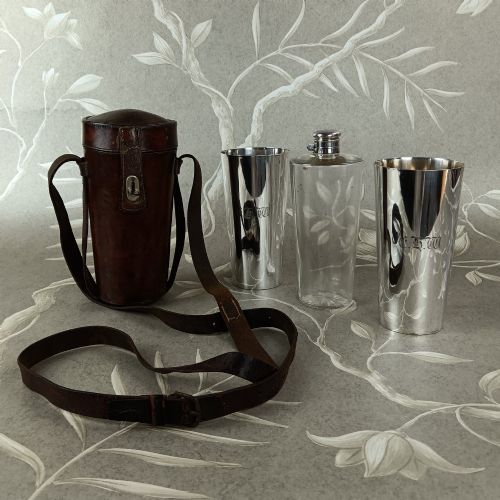
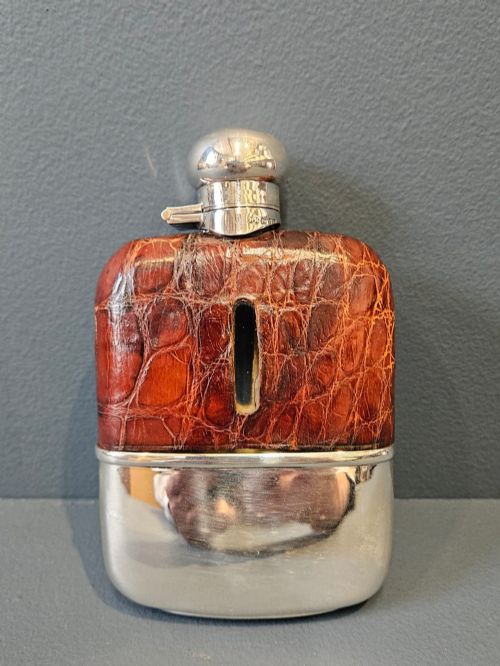
The most common versions on this page are glass bottles encased in stitched leather, often accompanied by a silver-plated or sterling silver bayonet cap that doubles as a small drinking cup.
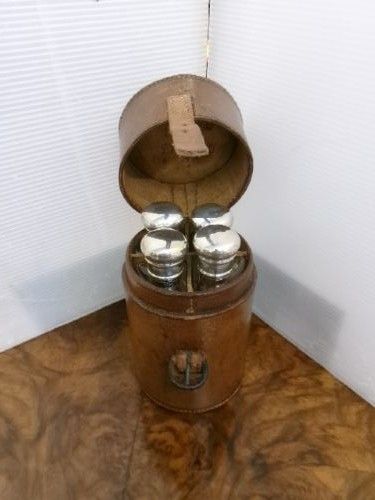
Beyond standard hip flasks, the selection includes specialised saddle flasks shaped to fit an equestrian saddle, field campaign spirit sets, and occasional powder or shot flasks intended for shooting rather than drinking.
Materials and construction
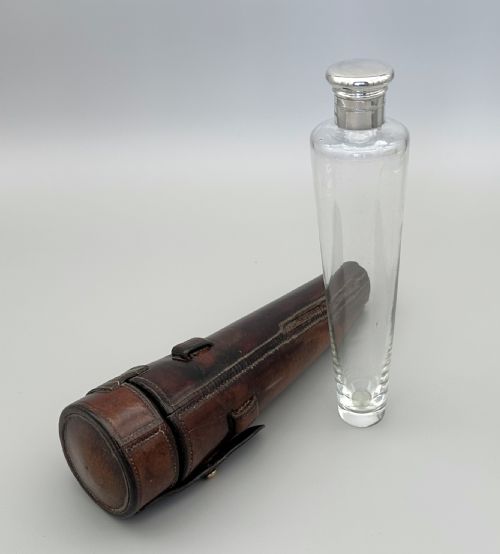
Makers formed the inner containers from heavy moulded glass, sometimes bound directly in stitched leather or housed within a removable leather case equipped with a retaining strap. The leather used ranges from standard bridle hide to exotic crocodile skin on more luxurious examples.
Mounts, caps, and cups utilise metals such as copper, brass, silver plate, and solid sterling silver. Tops often feature bayonet closures with cork seals to prevent leaks during movement.
Hunting Flask in Leather Retail Price Guide 2026
Typical asking prices for hunting flask in leather among the pieces listed under this phrase on Sellingantiques today, from the lower quarter to the upper quarter. They describe what is for sale here now, not the wider market.
Makers such as James Dixon & Sons produced both utilitarian field flasks and elaborate campaign spirit sets.
Distinctions in quality
Quality rests on the integrity of the materials and the precision of the fit between the glass bottle, its metal mounts, and the leather case. Superior pieces retain their original matching silver tops and show fine, even stitching on the hide.
The presence of hallmarks, original fitted leather cases, and maker marks from established workshops elevate an example above standard utility pieces.
James Dixon & Sons·Hukin & Heath
The Hunting Flask in Leather Glossary
- Bayonet cap
- A type of bottle top that pushes down and twists a quarter turn to lock securely against a cork seal. This mechanism prevents accidental spills while on horseback.
- Saddle flask
- A flask shaped with a curved or tapered bottom to fit neatly into a leather saddle case. These were essential items for mounted field sports.
- Spirit set
- A portable collection containing a flask and multiple beakers housed together in a fitted leather case. They were designed for outdoor entertaining during campaigns or field excursions.
- Silver plate
- A layer of silver fused to a base metal such as copper or brass. It provided the appearance of solid silver at a lower cost.
Hunting Flask in Leather: Frequently Asked Questions
What is a hunting flask in leather?
A hunting flask in leather is a glass container housed within a protective hide case, designed to carry spirits during equestrian pursuits and field sports. These pieces date from the nineteenth and early twentieth centuries.
The leather case protected the glass from knocks during a ride, while the metal cap often doubled as a small cup for a drink in the field.
How were saddle flasks used?
Saddle flasks were specifically shaped to slide into leather holsters attached to a horse's saddle. Riders used them to carry refreshing drinks during long days hunting or riding across open country.
The curved or tapered profile kept the flask secure in its case despite the movement of the horse.
How do I date a leather hunting flask?
Dating relies on hallmarks on the silver components, the style of the leather stitching, and the overall shape of the glass bottle. Victorian examples often feature chunkier glass and robust plated mounts, while Edwardian pieces can be more refined.
Maker marks stamped onto the metal caps or collars also help pinpoint the exact workshop and decade of production.
Are these flasks still waterproof?
Many historic flasks retain their original cork seals inside the bayonet caps, but the cork can dry out and shrink over time. Testing with water is recommended before attempting to carry liquids.
Replacement corks can often be fitted by a specialist if you intend to use the flask in the field today.