


Honey Pine Mule Chest
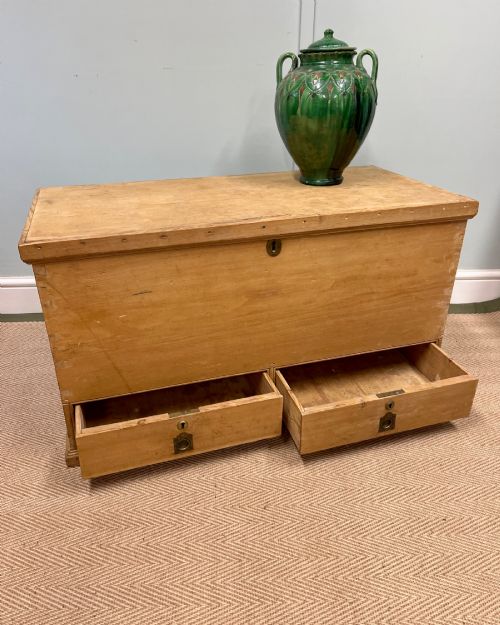
A honey pine mule chest brings warm domestic utility and generous storage into a room, combining a lift-lid compartment with lower drawers beneath.
Honey Pine Mule Chest
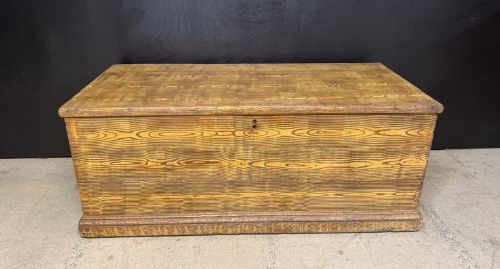
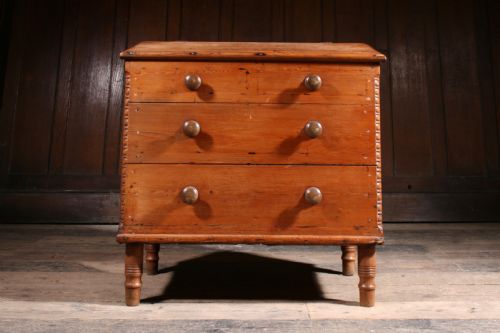
When you search for a honey pine mule chest, you are looking at sturdy utilitarian storage furniture designed to hold linens, blankets, and personal belongings. These pieces combine a traditional box or chest top with one or more drawers built into the base, creating a hybrid form that bridges the gap between a blanket box and a chest of drawers.
The versions you are most likely to meet on this page span the Georgian and Victorian periods, with examples originating from country workshops as well as regional traditions like Welsh country furniture. They appear in forms described variously as mule chests, blanket boxes, and panelled chests, often bearing the warm honey tones of aged pine.
Mule chests served as essential household storage long before fitted wardrobes became common in domestic interiors. Their straightforward construction made them practical fixtures in farmhouses and rural homes, where durability mattered far more than elaborate ornament.
How they were made
The construction of these pieces relies primarily on solid pine timbers, selected for availability and workability in regional joinery workshops. Makers frequently joined panels using traditional framing techniques to accommodate the natural expansion and contraction of softwoods over time.
Surface treatments recorded on these chests include wax finishes that enrich the grain and colour of the pine, alongside occasional traces of old paint. Hardware such as iron hinges and brass pulls provide functional and structural reinforcement to the lids and lower drawers.
One extra wide Georgian box waited patiently for centuries just to hold your spare duvet.
What varies in quality
Quality in these chests is largely determined by the proportion of the piece and the integrity of the original timber. Better examples display careful joinery in the drawer construction and well-balanced dimensions between the upper trunk and the lower drawer section.
The character of the aged pine surface also shifts the quality perception, where honest patination achieved through decades of handling and waxing outshines overly stripped or heavily restored exteriors. Original hardware and sound structural framing distinguish superior regional pieces from lesser or heavily altered equivalents.
The Honey Pine Mule Chest Glossary
- Mule chest
- A storage chest featuring a hinged lid above one or more drawers built into the base. This form developed in the eighteenth century as an evolution of the standard blanket box.
- Panelled chest
- A piece constructed with wooden panels set into a heavier structural frame to prevent warping. This technique allows the wood to move naturally with changes in humidity.
- Blanket box
- A simple lidded chest used primarily for storing textiles and bedcovers. Unlike a mule chest, it lacks the lower drawer component.
- Patina
- The surface sheen and colour acquired by wood over long periods of use, light exposure, and polishing. It serves as an indicator of age and handling.
- Welsh country
- A regional style of British vernacular furniture known for robust construction and straightforward utility. Pieces from this tradition often utilise local pine and straightforward joinery.
Honey Pine Mule Chest: Frequently Asked Questions
What is the difference between a mule chest and a blanket box?
A blanket box consists simply of a lidded compartment for storing textiles. A mule chest incorporates one or more drawers beneath the main storage well.
This addition of drawers allowed users to access smaller items without having to lift the heavy lid or disturb items stored on top.
How do I date a pine mule chest?
Dating relies on observing construction methods, timber characteristics, and hardware types used in the piece. Hand-cut dovetails and pegged frame joints typically point to earlier Georgian craftsmanship.
Later Victorian examples often feature machine-sawn elements and different internal construction details while retaining the traditional form.
How should I care for a waxed pine chest?
Maintenance involves applying a suitable beeswax polish periodically to nourish the dry pine and protect the surface. Avoid placing the chest near direct heat sources or in strong sunlight, which can dry out the timber.
Regular dusting with a soft, dry cloth preserves the finish and prevents accumulation in the corners of the mouldings and panel grooves.