
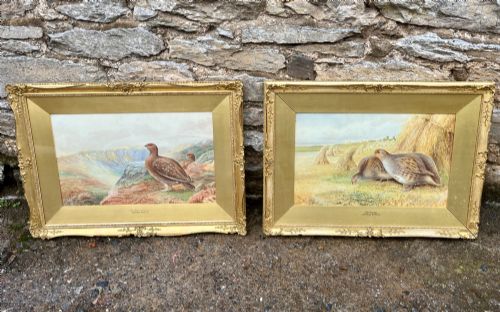


Highland Sporting Art
Highland sporting art captures the rugged drama of Scottish field sports through detailed depictions of game birds, hunting dogs, and moorland scenes.
Highland Sporting Art
Highland sporting art encompasses oil paintings, watercolours, prints, and carpet mosaic pictures depicting the rich wildlife and hunting traditions of the Scottish landscape. When searching for highland sporting art, buyers encounter works executed primarily during the Victorian and Edwardian eras, alongside pieces stretching back to the eighteenth century.
The subjects on this page focus heavily on game birds, setters, pointers, retrievers, stags, and Highland ponies accompanied by hunters or guns. Many works capture quiet moments of rest on the moor, while others portray the intensity of the hunt amidst dramatic terrain.
Most pieces date from the nineteenth and early twentieth centuries, reflecting the era's fascination with outdoor pursuits and natural realism. Creators such as Robert Cleminson and William Crampton frequently appear, anchoring the genre in traditional British sporting aesthetics.
Materials and Techniques
Artists working in highland sporting art relied heavily on oil on canvas or oil on board to achieve rich textures in animal pelts, feathers, and moorland vegetation. Watercolours on paper offered a lighter medium, frequently employed for delicate studies of game birds and fish.
Framing played a vital role in presentation, with period pieces commonly housed in giltwood frames that added warmth and depth to the dark tones of the canvases. Specialised techniques such as carpet mosaic pictures also emerge, demonstrating diverse interpretations of traditional sporting subjects.
Listings feature works spanning the eighteenth, nineteenth, and twentieth centuries, executed in oil, watercolour, and print.
Assessing Quality
Quality in these works rests upon the artist's anatomical accuracy in rendering animals, particularly the musculature of hunting dogs and the plumage of game birds. Stronger compositions balance the wildlife against the atmospheric depth of the Highland landscape.
The handling of light and texture distinguishes finer pieces, where brushwork brings movement to a pony's coat or the ripples of a trout stream. Original framing and the clarity of artist signatures or documented attributions further elevate a work's standing.
George Rankin·Colin Graeme Roe·Robert Cleminson·Harry Davis·John Charles Tunnard·Richard Ansdell·John Crossley·James Russell·William Crampton·Stephen Elmer·Benjamin Marshall·Archibald Thorburn
The Highland Sporting Art Glossary
- Giltwood
- Wood that has been covered with a thin layer of gold leaf or gilt. This finish is typical of traditional frames housing nineteenth-century oil paintings.
- Watercolour
- A painting method in which the paints are made of pigments suspended in a water-based solution. These works on paper require protection behind glass.
- Oil on Canvas
- Pigment mixed with drying oil applied to a stretched woven fabric support. This combination allows for rich blending and deep surface textures.
- Carpet Mosaic
- A decorative picture constructed using textile techniques to form a pictorial image. Examples in this genre adapt traditional sporting subjects into woven or assembled compositions.
Highland Sporting Art: Frequently Asked Questions
How do I care for these paintings?
Keep oil paintings and watercolours away from direct sunlight and dramatic shifts in household temperature. This prevents the canvas from sagging and protects delicate watercolours from fading behind glass.
Dust frames gently with a dry cloth and avoid using liquid cleaners on the painted surfaces. Professional framing checks help ensure the backing boards remain secure over time.
Are these works signed by the artists?
Many pieces feature visible signatures or artist inscriptions embedded within the composition or recorded on the framing. Signed works by established nineteenth-century painters carry clearer attribution for collectors.
Unsigned works still offer stylistic clues through brushwork, subject matter, and framing details that link them to specific periods or regional schools.
What subjects are most common?
Game birds such as grouse, black game, and pheasants appear frequently alongside working dogs like setters, pointers, and retrievers. Stags and Highland ponies resting in moorland landscapes also form a core subject group.
Fishing scenes involving trout and salmon provide an additional variation within the broader scope of Scottish outdoor sporting themes.
How do I date a piece?
Dating relies on stylistic indicators, artist lifespan records, and the materials used in the canvas stretcher or frame construction. Victorian and Edwardian works often display specific costume details or gun types, such as flintlock shotguns.
Examine the reverse of the canvas or frame for old gallery labels, inscriptions, or stamps that offer clues to the creation period.