


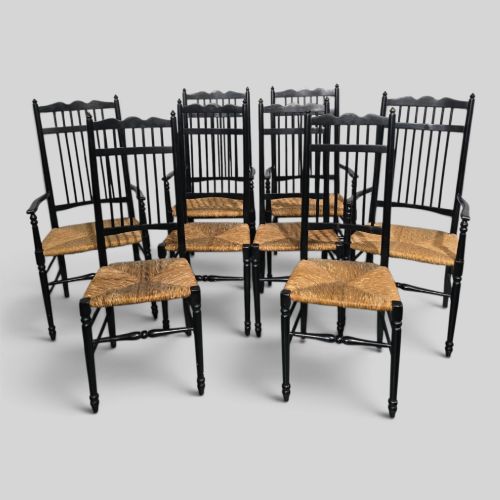
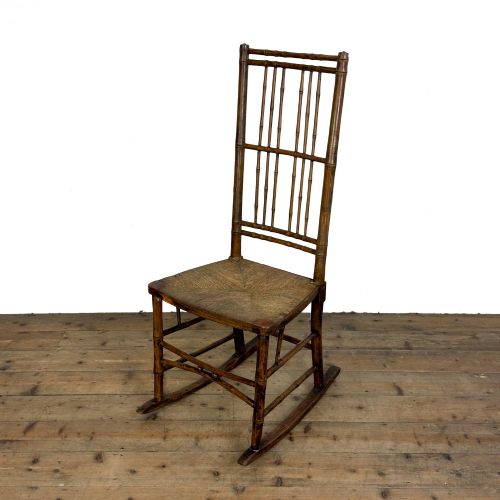


High Back Rush Chair
A high back rush chair brings rustic vertical line and woven comfort to an interior, drawn from country vernacular and Arts and Crafts traditions.
High Back Rush Chair
When you search for a high back rush chair, you find seating that prioritises tall proportions and traditional woven seats across various historic periods. The pieces appearing here span the Victorian era, the Edwardian period, and the early twentieth century up to nineteen thirty.
Forms range from side chairs and dining chairs to armchairs, rocking chairs, and child high chairs. Many examples align with Arts and Crafts, Victorian Country, Aesthetic Movement, and country vernacular styles.
Makers and retailers such as Liberty and Morris and Co feature in the heritage of these designs, alongside vernacular country house workshops. You are most likely to meet ladderback and spindle forms executed in beech, oak, or elm.
Materials and construction
Frames are constructed from solid hardwoods including oak, beech, and elm, sometimes with ebonised finishes or faux bamboo turning. Joinery relies on traditional pegged and mortise and tenon methods suited to upright ladderback and spindle frames.
Seats are hand-woven using natural rush or seagrass, wound tightly around the rails to form a durable, textured surface. These organic materials provide flexible support that complements the rigid upright wooden framework.
Periods represented span the Victorian era, Edwardian years, and early twentieth century up to nineteen thirty.
Judging quality in construction and material
Quality rests in the balance between the architectural height of the back frame and the structural integrity of the lower joints. Heavier timbers like oak and select elm offer greater permanence than lighter secondary woods.
The tightness and uniformity of the rush or seagrass weaving dictate the longevity of the seat platform. Finer examples show careful alignment in turned spindles and ladderback rails that maintain tension across the upright frame.
Morris and Co·Liberty
The High Back Rush Chair Glossary
- Rush
- A marsh plant used for weaving chair seats. It provides a durable, pliable surface with a natural greenish-brown hue that mellows with age.
- Ladderback
- A chair back featuring multiple horizontal wooden slats between two upright posts. This traditional form offers strong lumbar support in country seating.
- Spindle
- A slender, turned piece of wood used in chair backs or arms. It provides decorative detail while distributing weight evenly.
- Ebonised wood
- Timber stained or treated to imitate ebony. This dark, formal finish appears frequently on Aesthetic Movement and Victorian seating.
High Back Rush Chair: Frequently Asked Questions
Are high back rush chairs comfortable?
The high upright frame supports the shoulders and back, while the woven organic seat yields slightly to the body.
Over time, the natural materials conform to regular use without losing structural tension.
How do I clean a rush seat?
Natural rush requires gentle dusting with a soft brush or dry cloth to remove debris between the fibres.
Moisture can weaken plant fibres, so liquid cleaners and damp cloths are best avoided.
Where were these chairs used?
Such seating appeared in dining rooms, country houses, and vernacular cottage interiors.
Tall backs provided draught exclusion and formal presence in domestic spaces.