
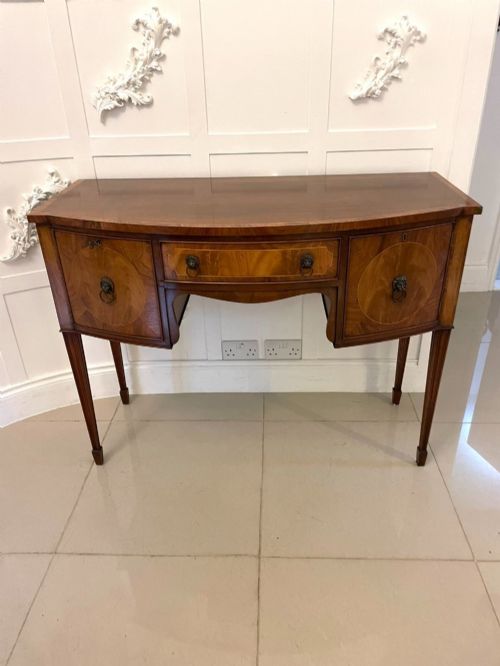
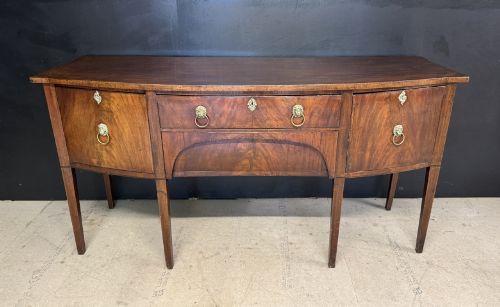

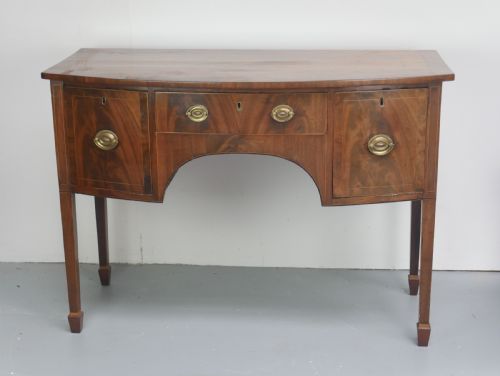
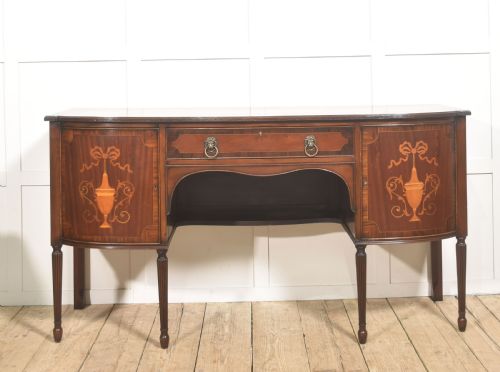


Hepplewhite Bowfront Sideboard
These hepplewhite bowfront sideboard designs bring curving lines and figured timbers to a dining room with genuine Georgian elegance.
Hepplewhite Bowfront Sideboard
When you search for a hepplewhite bowfront sideboard, you are looking at formal dining room furniture built with a distinctive curved front. These pieces emerge from the Georgian and George III periods, though later revivals from the nineteenth and early twentieth centuries also appear.
Materials and Construction
Cabinetmakers constructed these pieces primarily using solid mahogany and flame mahogany veneers, selected for their rich grain patterns. Drawer fronts and borders frequently incorporate contrasting satinwood and boxwood inlay to accentuate the curved silhouette.
Original brass hardware, including drop handles and backplates, secures the drawer assemblies while adding a bright metallic contrast to the dark timber. Structural joinery relies on traditional framing techniques to support the sweeping bowfront shape over centuries of use.
Listings for this phrase feature mahogany almost exclusively, accompanied by boxwood and satinwood inlay across Georgian and later periods.
Separating the Finest Examples
The quality of a hepplewhite bowfront sideboard rests in the precision of its timber selection and the restraint of its decorative inlay. Superior pieces display continuous, highly figured flame mahogany across the drawer banks without jarring grain discrepancies.
Finer construction is evident in the crispness of the boxwood and satinwood stringing, alongside well-proportioned legs that integrate smoothly with the curved apron. Less distinguished pieces often show heavier proportions, simpler secondary timbers, or later replacements of the original brass hardware.
George Hepplewhite
The Hepplewhite Bowfront Sideboard Glossary
- Bowfront
- A curved cabinet front that swells outward in the centre, softening the linear geometry of a room. This shape required skilled joinery to bend timber and veneer accurately.
- Inlay
- A decorative technique where contrasting woods like satinwood or boxwood are fitted into recesses in the primary timber. It creates sharp geometric borders and delicate floral motifs.
- Flame mahogany
- A veneer cut from the fork of a mahogany tree where the branches join the trunk, producing a rippling, flame-like pattern. It was highly prized for principal display surfaces.
- George III
- The period of British history spanning the reign of King George III, noted for refined furniture design and cabinetmaking. Pieces from this era form the core of traditional dining room antiques.
- Stringing
- Thin, linear inlay used to outline drawers, legs, and tabletops in contrasting lighter woods. This subtle detail defines the edges of formal furniture.
Hepplewhite Bowfront Sideboard: Frequently Asked Questions
What is a hepplewhite bowfront sideboard?
A hepplewhite bowfront sideboard is a formal dining room cabinet featuring a gracefully curved front and delicate inlay work. These pieces originate primarily from the Georgian era and reflect the refined furniture designs associated with George Hepplewhite.
They combine deep storage drawers with slender legs, offering both practical utility and elegant proportions for the dining room.
How do I spot a reproduction sideboard?
Distinguishing older pieces from later revivals involves examining the secondary timbers, the consistency of the hand-cut dovetails, and the wear patterns on the drawer runners. Nineteenth and twentieth-century interpretations often utilise machine-sawn elements and standardised hardware.
Closer inspection of the veneer thickness and the mellowing of the mahogany underneath the finish also helps clarify the exact period of manufacture.
Where should I place a sideboard?
These sideboards suit formal dining rooms, spacious hallways, or large living areas where their curved profile can be viewed without obstruction. They function well against a principal wall, often paired with a mirror or serving items above.
Keep the timber away from direct heat sources and strong sunlight to protect the fragile mahogany veneers and boxwood inlay from drying out.
How do I care for mahogany furniture?
Maintain mahogany surfaces by dusting gently with a dry, soft cloth and applying a quality beeswax sparingly when the wood appears dry. Avoid commercial silicone polishes that can build up a sticky residue and dull the antique finish.
Maintaining a stable room temperature and moderate humidity prevents the solid timbers and delicate inlays from warping or cracking over time.