
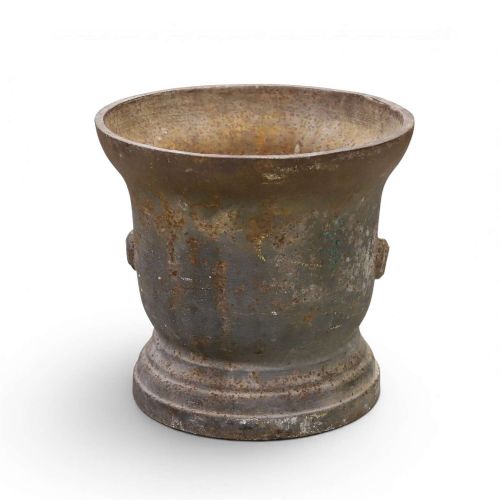
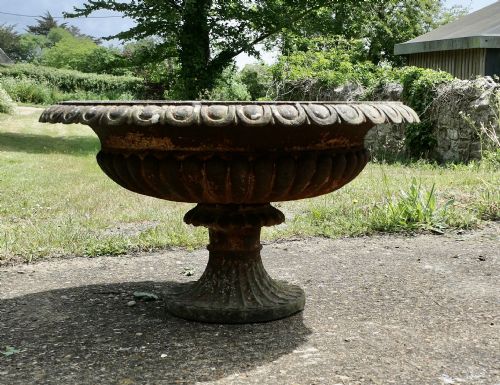


Heavy Cast Iron Planter
A heavy cast iron planter anchors a terrace with unyielding substance, built to weather the elements while framing hardy foliage.
Heavy Cast Iron Planter
A heavy cast iron planter takes the form of garden urns, pedestals, and jardinières designed for formal and informal planting schemes alike. You will most frequently encounter nineteenth-century Victorian examples alongside later Edwardian and mid-century interpretations.
The selection spans from French chateau kitchen mortars to grand portico stands and twin garden urns intended for architectural display. These items serve a dual purpose as structural ornaments and functional vessels for large shrubs or seasonal displays.
How they were made
Foundries produced these objects by pouring molten iron into sand moulds, yielding thick walls and robust structural integrity. Secondary materials like copper, hardwood, and applied paint appear in specific utilitarian or decorative contexts.
Moulding techniques allowed for deeply cast fluting, classical revival motifs, and Neoclassical details that remained crisp despite decades of outdoor exposure. The sheer weight of the finished metal eliminated the need for ground anchoring.
Heavy Cast Iron Planter Retail Price Guide 2026
Typical asking prices for heavy cast iron planter among the pieces listed under this phrase on Sellingantiques today, from the lower quarter to the upper quarter. They describe what is for sale here now, not the wider market.
An apothecary mortar originally intended for grinding herbs in a French kitchen easily finds a second life holding stubborn geraniums.
What varies in quality
The sharpness of the cast ornament distinguishes standard utility vessels from pieces commissioned for grand architectural settings. Crisp fluting and well-defined classical motifs denote superior pattern work and careful foundry practice.
Proportion and balance dictate the visual success of an urn or jardinière, particularly when paired as matching items. Pieces with integrated stands or portico arrangements demonstrate a higher degree of design ambition.
The Heavy Cast Iron Planter Glossary
- Jardiniere
- An ornamental pot or stand for holding plants or flowers. These vessels often feature decorative exterior relief work suited for prominent garden locations.
- Urn
- A vase-shaped vessel, typically with a footed base and sometimes handles, used for ornamental planting. They form the core of classical garden decoration.
- Mortar
- A heavy bowl used for pounding substances, occasionally adapted from domestic or apothecary use into robust planters. Their thick walls provide exceptional durability.
- Portico
- A porch leading to the entrance of a building, influencing the scale and architectural styling of associated iron stands. Items designed for these spaces match classical building proportions.
Heavy Cast Iron Planter: Frequently Asked Questions
How do I clean a cast iron planter?
Gently brush away loose dirt and debris using a soft bristle brush without harsh chemical detergents.
Avoid high-pressure washing that can strip protective paint layers and expose the bare metal to rapid oxidation.
Can these planters stay outside in winter?
Cast iron withstands frost remarkably well due to its dense, heavy structure and thick vessel walls.
Ensure drainage holes remain clear so expanding ice does not crack the lower sections of the pot.
How do I date a Victorian urn?
Examine the casting seams, surface texture, and stylistic clues such as Neoclassical or classical revival motifs.
Earlier examples often display hand-finished details from sand casting that differ from twentieth-century production methods.
Are these planters too heavy for a balcony?
The substantial mass of cast iron requires careful weight load verification before placement on elevated structures.
Consider the combined weight of the iron vessel, damp soil, and mature plants when planning your terrace layout.