

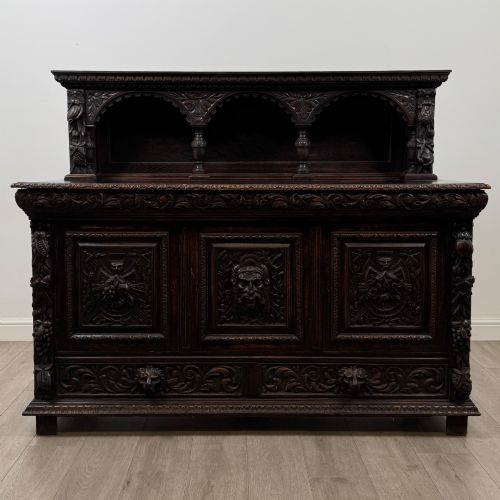


Heavily Carved Sideboard
A heavily carved sideboard brings bold Victorian presence to a room, offering deep relief work and substantial storage in solid oak.
Heavily Carved Sideboard
A heavily carved sideboard represents a major statement piece from the nineteenth century, combining utility with dense ornamental woodwork. These substantial furniture items function primarily as dining room storage or display surfaces.
Most examples found here date to the Victorian era, particularly around eighteen eighty, and emerge in robust dark or bleached timber. Buyers encounter forms ranging from simple cupboards and pedestal sideboards to elaborate mirror back designs and dressers.
Makers drew heavily on historical aesthetics, producing pieces that reflect Gothic Revival, Renaissance Revival, and Charles II Revival movements. Such works suit rooms designed for period drama and architectural weight.
How they were made
Cabinet makers relied predominantly on solid oak, alongside walnut and occasional glass panels, constructing carcasses built to support intense surface decoration. Timber selection prioritised durability and a strong grain capable of holding deep chisel work.
The characteristic deep relief relies on skilled hand carving executed across doors, pediments, and structural panels. Certain modern variants show bleaching treatments applied to the historic oak to lighten the overall tone.
Heavily Carved Sideboard Retail Price Guide 2026
Typical asking prices for heavily carved sideboard among the pieces listed under this phrase on Sellingantiques today, from the lower quarter to the upper quarter. They describe what is for sale here now, not the wider market.
One remarkably specific historic piece arrives complete with sign writing for the Steinkeller Beer Keller.
What varies in quality
The distinction between ordinary and exceptional pieces rests entirely on the depth, sharpness, and ambition of the carving. Master carvers achieved crisp undercutting and balanced composition, whereas lesser workshops produced flat, repetitive stamping.
Proportion and timber selection equally govern the hierarchy, separating standard utility furniture from monumental exhibition pieces. Original hardware, glass components, and untouched patination further elevate the standing of a given example.
The Heavily Carved Sideboard Glossary
- Gothic Revival
- An architectural and decorative style drawing on medieval forms, featuring pointed arches and heavy tracery. It heavily influences nineteenth-century case furniture.
- Renaissance Revival
- A nineteenth-century movement reviving classical motifs, symmetry, and robust sculptural details. Pieces in this style display prominent architectural pediments and figures.
- Mirror Back
- A sideboard superstructure incorporating an integrated mirror plate, often framed by carved woodwork. This design element reflects light and displays decorative ceramics.
- Pedestal Sideboard
- A specific form featuring cupboard pedestals flanking a central recess or drawer section. It provides substantial floor-standing storage capacity.
- Buffet Deux Corps
- A large two-part cupboard structure used for storing and serving food. The term denotes a towering profile with distinct upper and lower sections.
Heavily Carved Sideboard: Frequently Asked Questions
Where should I place a heavily carved sideboard?
These large pieces demand a generous wall space in a dining room or spacious hallway where their depth and height will not crowd the floor plan.
Ensure the room has sufficient ambient light to reveal the detailed relief work without the piece dominating the entire interior scheme.
How do I care for historic oak furniture?
Maintain the timber by applying a traditional beeswax sparingly and buffing with a soft cloth to preserve the natural grain.
Keep the cabinet away from direct heat sources and sudden temperature shifts to prevent the solid oak panels from splitting.
What is a mirror back sideboard?
A mirror back version includes an upright wooden frame holding a glass mirror attached to the rear of the top surface.
This design brightens darker dining spaces and provides a backdrop for displaying silver or glassware.
How can I tell a Victorian piece from earlier styles?
Victorian examples often combine historical revivals, such as Gothic and Renaissance motifs, executed with industrial-era machine assistance alongside hand chiselling.
examine the interior construction and timber joints to confirm the nineteenth-century manufacturing date.