
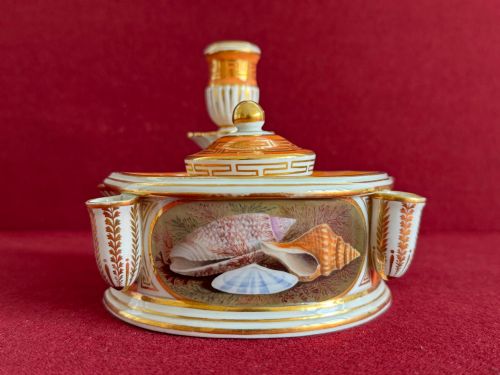
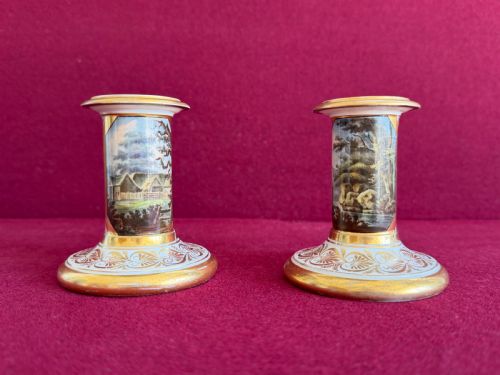


Hand Painted Ceramic Candlesticks
These hand painted ceramic candlesticks bring remarkable colour and period charm to a table, combining sculptural forms with delicate painted detail.
Hand Painted Ceramic Candlesticks
When you search for hand painted ceramic candlesticks, you encounter a range of eighteenth and nineteenth century porcelain and earthenware items. These domestic accessories encompass simple column forms alongside elaborate figural groups featuring musicians and allegorical figures.
You are most likely to meet pairs originating from prominent English factories such as Derby, Worcester, Spode, and Minton. Continental examples from German workshops like Sitzendorf and Dresden also appear, frequently displaying intricate bocage work and rich gilding.
How they were made
Many items received final enrichments of gold leaf and gilding to highlight moulded scrolls and decorative borders. Subsequent kiln firings permanently set these enamel colours and metallic highlights into the glaze.
The listings span from 1750 through the Georgian, Regency, and Arts and Crafts periods, utilising materials such as soft-paste porcelain, earthenware, and gold leaf.
What varies in quality
The complexity of the modelling also separates standard production from superior work. Elaborate rococo scrolls, detailed bocage foliage, and heavy gold leaf application indicate higher workshop output during periods such as the Georgian and Regency eras.
Barr Flight and Barr·Spode·Derby·Sitzendorf·Dresden·Minton
The Hand Painted Ceramic Candlesticks Glossary
- Bocage
- An open lattice of applied ceramic leaves and flowers used as a background behind figures. This decorative technique requires delicate hand-modelling.
- Soft-paste porcelain
- An artificial ceramic body composed of clay, glass frit, and other materials. It produces a warm texture beneath the glaze and was common in eighteenth-century English factories.
- Patch-mark period
- A phase in early Derby porcelain production identified by small unglazed patches on the base left by the kiln supports. It helps date pieces to the mid-eighteenth century.
- Gilding
- The application of gold leaf or powdered gold onto the ceramic surface to create decorative highlights. It is frequently found on Regency and Rococo Revival items.
Hand Painted Ceramic Candlesticks: Frequently Asked Questions
How do I date these candlesticks?
Dating relies on examining the ceramic paste, the painting style, and any factory marks on the base. Eighteenth-century pieces often feature patch-marks or distinct soft-paste bodies.
Later nineteenth-century examples display tighter moulding and different enamel palettes typical of the Victorian period or continental factories.
Were these used for daily lighting?
These decorative ceramic pieces were primarily designed for formal dining tables and mantelpieces in wealthy households. Their delicate painted enamel and gold leaf meant they served as much for display as for illumination.
Pairs and four-arm candelabra provided symmetry and reflected candle flame during evening entertaining.
How should I clean them?
Dust gently with a soft dry brush to remove surface particles without disturbing delicate elements like bocage leaves. Avoid using water or chemical cleaners that might damage the hand-painted enamel and gold leaf.
Keeping them away from direct sunlight helps preserve the vibrancy of the original colours.
What is rococo revival?
Rococo revival is a nineteenth-century design style that reinterprets the asymmetric curves and scrollwork of the mid-eighteenth century. In ceramics, it manifests as elaborate moulded C-scrolls and naturalistic floral motifs.
Pieces in this style often combine bright polychrome enamels with heavy gilding.