




Haberdashery Card Drawers
Haberdashery card drawers are multi-drawer storage units designed for shop fittings, offices and libraries, prized for their dense configuration of small compartments.
Haberdashery Card Drawers
Haberdashery card drawers group multiple small compartments into banks, chests and filing cabinets, serving commercial and administrative roles. When you search for haberdashery card drawers, you encounter units designed for organising stock, index cards or letters in shops and offices.
The pieces on this page span the Victorian era, 1900, 1910, 1920 and 1930, capturing domestic and commercial storage forms. You find Edwardian walnut and mahogany pieces alongside industrial oak, pine, painted wood, brass, metal and steel examples.
Forms range from large shop fittings and office cabinets to multi-drawer filing chests and library card sets. The most common configurations on this page are banks of drawers and filing cabinets built for efficient categorisation.
Construction and Materials
These storage units utilise solid timbers such as oak, mahogany, walnut, pine and painted wood, paired with brass and metal hardware. Carpenters constructed robust carcases to house numerous small drawers that endure frequent daily handling.
Industrial utility and commercial designs incorporate steel and metal components alongside traditional wood construction to maximise durability. Patent locking mechanisms and specialised pull handles appear on specific filing and cabinet variants.
Haberdashery Card Drawers Retail Price Guide 2026
Typical asking prices for haberdashery card drawers among the pieces listed under this phrase on Sellingantiques today, from the lower quarter to the upper quarter. They describe what is for sale here now, not the wider market.
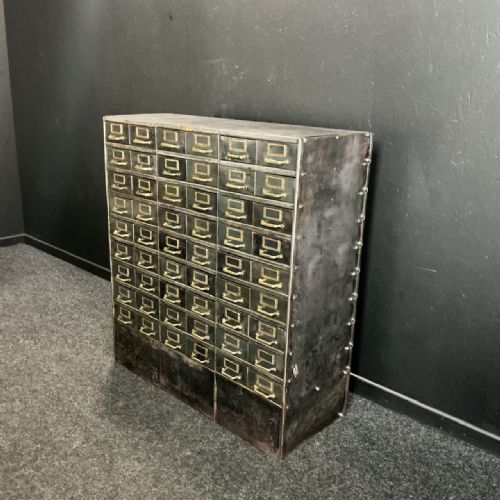
One extraordinary shop fitting on this site packs exactly fifty pine drawers into a single piece.
Assessing Quality and Build
Quality in these units rests on the selection of timber and the complexity of the drawer configuration, distinguishing simple pine carcases from finely figured mahogany or walnut fronts. The integration of patent hardware and brass pulls elevates the standard of individual cabinets.
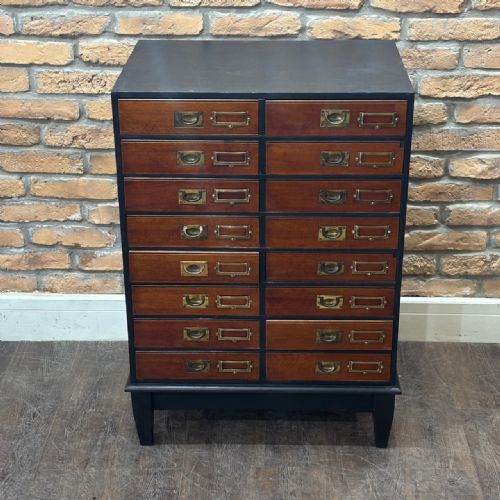
The scale of the multi-drawer arrangement influences the architectural presence of the piece, ranging from modest satin walnut chests to expansive fifty-drawer shop fittings. Superior examples maintain smooth operation across dozens of tightly fitted compartments.
The Haberdashery Card Drawers Glossary
- Bank of Drawers
- A set of numerous small drawers housed within a single heavy timber carcase. These units were built for commercial storage and office filing.
- Shop Fitting
- Furniture built specifically for retail interiors to display or store merchandise. These pieces often feature large numbers of drawers to sort small goods.
- Patent Cabinet
- A storage unit incorporating a proprietary mechanical filing or locking system. Such systems were invented to improve office organisation.
- Satin Walnut
- A timber derived from the American sweetgum tree, valued for its lustrous grain and used for drawer fronts in Edwardian furniture.
Haberdashery Card Drawers: Frequently Asked Questions
What were haberdashery card drawers used for?
These multi-drawer units stored small haberdashery items, index cards, letters and office documents in retail shops, libraries and businesses.
The large number of compartments allowed merchants and clerks to organise stock or paperwork efficiently within a single piece of furniture.
How do I date an antique drawer unit?
Dating relies on identifying period characteristics in the timber, hardware, construction methods and overall style, spanning the Victorian era through the 1930s.
Edwardian pieces often feature walnut or mahogany, whereas industrial units from the 1920s frequently utilise oak, painted wood or metal.
Where should I place these in a home?
These cabinets suit studies, hallways or living spaces where compact compartmentalised storage is useful for stationery, collections or small items.
The narrow, multi-drawer footprint provides significant surface organisation without dominating floor space.
Are all multi-drawer cabinets from shops?
No, while many large units originated as shop fittings or haberdashery counters, others served as office filing cabinets, library card catalogues or domestic chests of drawers.
Commercial, library and office pieces share the multi-drawer format but vary in internal depth and hardware design.