




Guilloche Enamel Silver Jar
When searching for a guilloche enamel silver jar, a buyer finds a refined dressing table accessory combining precious metal, glass and patterned translucent colour.
Guilloche Enamel Silver Jar
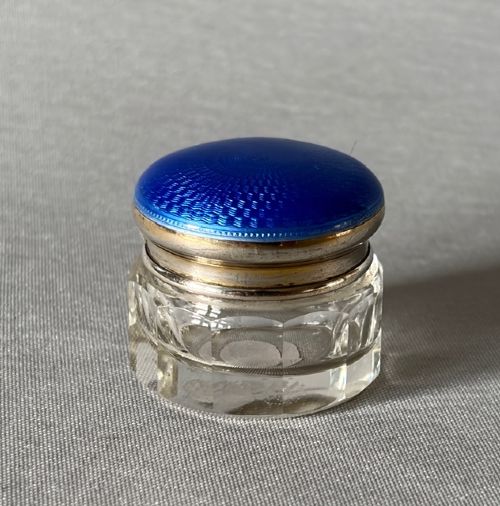
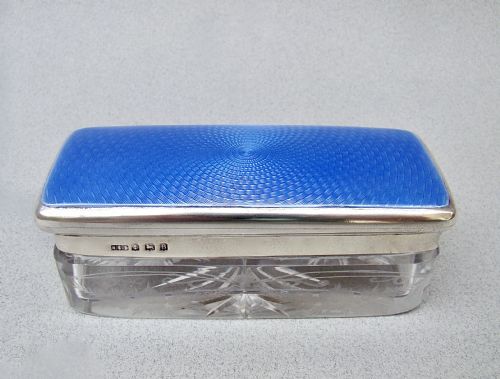
A guilloche enamel silver jar primarily functions as a dressing table accessory, vanity container, or small scent bottle for holding toiletries and trinkets. These items typically pair a solid sterling silver mount or lidded top with a glass or cut glass base.
Most examples originate from the early twentieth century, spanning the Edwardian period through the Art Deco era and into the mid-century. Buyers frequently encounter pieces bearing hallmarks from assay offices such as Birmingham and London, alongside continental European origins.
The defining characteristic is the metal lid decorated with machined geometric patterns beneath a translucent layer of enamel. Colours range from deep blues and pinks to lilac, green, and champagne tones.
Materials and technique
Makers formed the lids using sterling silver, frequently applying an engine-turning lathe to engrave precise, repetitive geometric patterns into the metal surface. This mechanical engraving created the foundational texture required for the technique.
Craftsmens then coated the engraved silver surface with translucent enamel in various colours, allowing the underlying machined pattern to reflect light through the glassy glaze. The base vessels were typically formed from heavy cut glass, clear glass, or occasionally agate.
Guilloche Enamel Silver Jar Retail Price Guide 2026
Typical asking prices for guilloche enamel silver jar among the pieces listed under this phrase on Sellingantiques today, from the lower quarter to the upper quarter. They describe what is for sale here now, not the wider market.
The archive records vanity jars and scent bottles created by Birmingham and London silversmiths throughout the early twentieth century.
Assessing quality and craftsmanship
Quality rests in the precision of the engine-turning beneath the enamel and the clarity and depth of the coloured glass layer. Finer pieces display intricate, sharply defined geometric guilloche work that interacts dynamically with the light.
The weight and thickness of the sterling silver mount and the quality of the glass cutting on the jar body also separate standard examples from finer productions. Maker attribution to notable silversmiths further elevates the standing of an individual piece.
Henry Clifford Davis·Henry Perkins·James Deakin and Sons·Henry Matthews·The Adie Brothers·Charles Green and Co·William Neale and Son·Deakin and Francis·W.G. Sothers·Mappin and Webb
The Guilloche Enamel Silver Jar Glossary
- Guilloche enamel
- A decorative technique where metal is mechanically engraved with precise geometric patterns and covered with a translucent enamel glaze.
- Sterling silver
- An alloy of silver containing ninety-two point five percent pure silver and seven point five percent other metals, standard for quality British wares.
- Engine-turned
- A method of mechanical decoration using a specialised lathe to cut intricate, repetitive patterns into metal surfaces.
- Dressing table jar
- A small container designed for a vanity or dressing table to hold cosmetics, pins, or trinkets, usually fitted with a removable lid.
- Hallmark
- An official stamp applied to precious metals indicating the standard of purity, the assay office, and the year of manufacture.
Guilloche Enamel Silver Jar: Frequently Asked Questions
What were these jars used for?
These vessels held cosmetics, pins, powders, and small trinkets on Edwardian and Art Deco dressing tables. They formed part of matching vanity sets used during daily grooming routines.
Over time, they transitioned from functional dressing table items into decorative display pieces collected for their colourful enamel lids and silver mounts.
How do I date a piece?
Dating relies heavily on the silver hallmarks stamped onto the mount or lid. These marks indicate the assay office, standard of silver, and a specific date letter.
Stylistic indicators such as geometric Art Deco motifs or Edwardian floral engraving also help place the piece within a specific decade.
Are the bases glass or silver?
The majority of pieces feature a heavy cut glass or clear glass base paired with a solid sterling silver lid. A smaller number of listings comprise entirely silver or lidded bowl forms.
The glass bases often feature star-cut or patterned bottoms to reflect light through the contents and the decorated lid.
How should I clean the enamel?
Enamel requires gentle care to avoid scratching the glassy surface or loosening it from the silver mount. Use a soft, dry cloth for dusting and avoid harsh chemical dips.
Silver polish should be kept strictly away from the enamel surface to prevent permanent dulling or staining of the translucent glaze.