

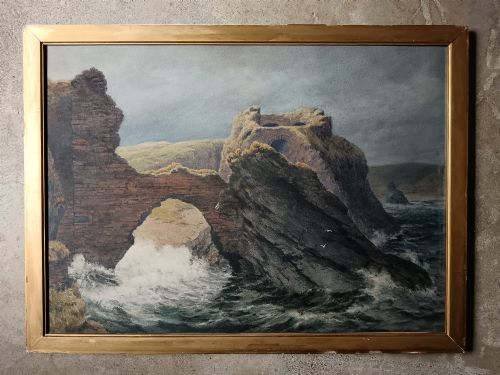


Grey Ocean Landscape Artwork
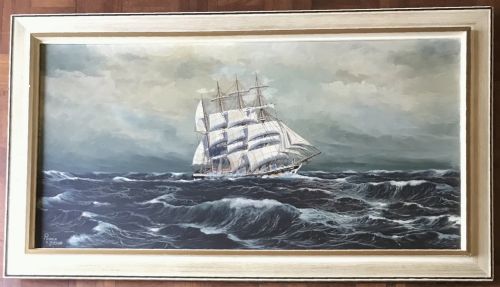
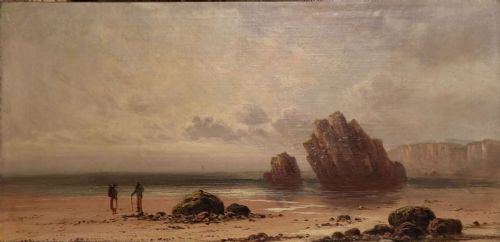
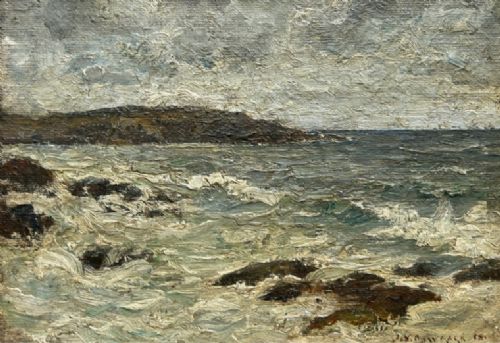
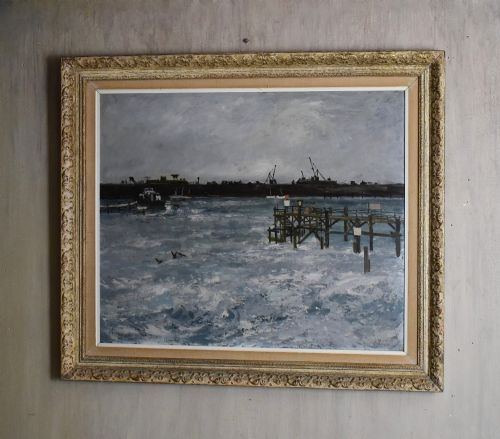
Grey ocean landscape artwork captures heavy skies, rocky shores and open water through the eyes of Victorian, Edwardian and mid-century painters.
Grey Ocean Landscape Artwork
Grey ocean landscape artwork covers maritime views, coastal scenes and harbour paintings produced across the Victorian era, the early twentieth century and the mid-century period. Buyers seeking grey ocean landscape artwork encounter depictions of rocky beaches, North Sea havens, stormy waters and fishing fleets recorded in oil or watercolour.
The pieces appearing on this page span British Impressionism, Victorian marine painting, Staithes School works and 19th Century realism. Subjects range from Scottish castles and Cornish harbours to Portuguese lighthouses and Norwegian barques at anchor.
Most examples date from the nineteenth century up through the nineteen-sixties, with a strong representation of British coastal scenery. Mediums divide between fluid watercolours on paper and textured oils on canvas or wood panels.
How They Were Made
Artists built these marine paintings using oil paint on canvas, oil on wood, or watercolour pigment on paper. Oils allowed for heavy impasto application to render choppy waters and dramatic sea stacks, while watercolours offered a transparent wash suitable for atmospheric skies and distant headlands.
Works on paper were typically protected beneath glass and housed within traditional wooden frames. Oil paintings on canvas utilised stretchers and heavy wooden framing to support the weight of the composition.
Materials recorded across the works include paper, glass, wood, canvas, oil paint, and watercolour pigment.
What Varies in Quality
The strength of a composition rests on the artist's ability to render the weight of heavy skies and the movement of coastal water without stiffness. Brushwork ranges from tight, academic realism to loose, expressive impressionist strokes that capture the atmosphere of a North Sea gale.
Condition varies according to how the paper or canvas has aged, with watercolours particularly sensitive to light exposure and dampness. Original period framing also contributes to the integrity of the piece, as matching contemporary frames preserve the historic context of the work.
John E. Aitken·John Moxon·Charles William Adderton·William Greaves·Frederick Stuart Richardson·Percy Brooke·Joseph Newington Carter·William Boyce·Herbert James·Edward T Jones·Thomas Bush Hardy·Owen Bowen·Peter Brannan
The Grey Ocean Landscape Artwork Glossary
- Impasto
- Paint applied thickly to a canvas so that it stands out from the surface. This technique allows artists to build visible texture in crashing waves and rocky cliffs.
- Marine painting
- Artwork that depicts ships, harbours, coastal scenery and the open sea. This genre encompasses both calm coastal inlets and turbulent maritime storms.
- Watercolour
- A paint consisting of pigment suspended in a water-based solution, typically applied to paper. It creates luminous washes well suited for misty sea air and cloudscapes.
- Sea stack
- A geological landform consisting of a steep and often vertical column or columns of rock in the sea. They frequently appear in nineteenth-century coastal paintings as dramatic focal points.
- Staithes School
- A group of northern English artists influenced by French Impressionism who painted coastal scenes outdoors. Their work often focuses on fishing communities and rugged Yorkshire shores.
Grey Ocean Landscape Artwork: Frequently Asked Questions
What periods do these paintings come from?
The selection includes works from the Victorian era, the Edwardian period, and the mid-twentieth century.
Most pieces originate from British and Scottish coastal art traditions dating between eighteen-eighty and nineteen-sixty.
Are these paintings executed in oil or watercolour?
Artists used both oil paint and watercolour pigment depending on the desired effect.
Oils appear on canvas or wood panels with heavy texture, while watercolours are executed on paper under glass.
How should I frame and display a watercolour?
Watercolours require protection behind glass to prevent atmospheric damage to the paper and pigment.
Display them away from direct sunlight to preserve the delicate tones of grey skies and coastal water.
What subjects typically appear in these scenes?
Common subjects include stormy North Sea havens, beached fishing boats, lighthouses, and rocky headlands.
Many works document specific coastal locations in Yorkshire, Cornwall, Scotland, and Devon.