

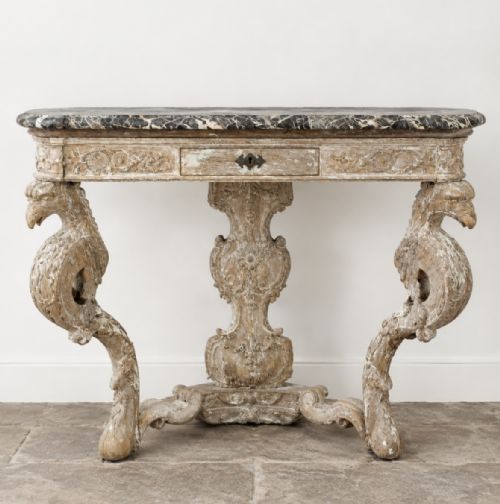
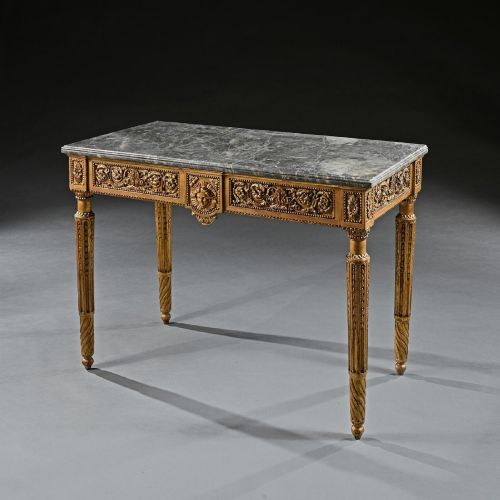
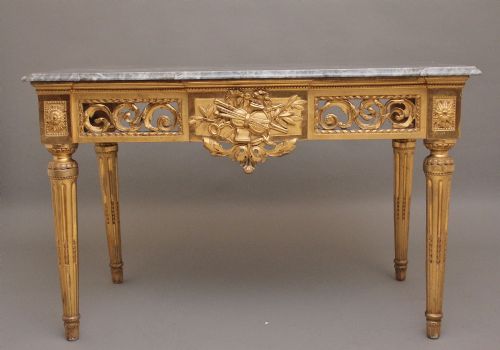
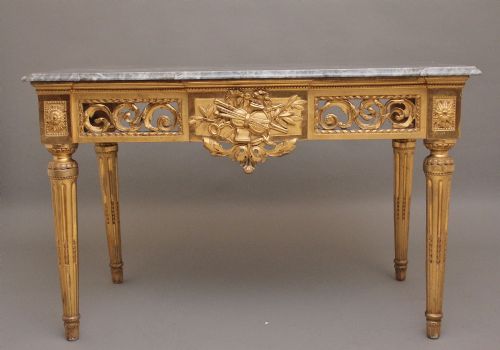





Grey Carved Pier Table
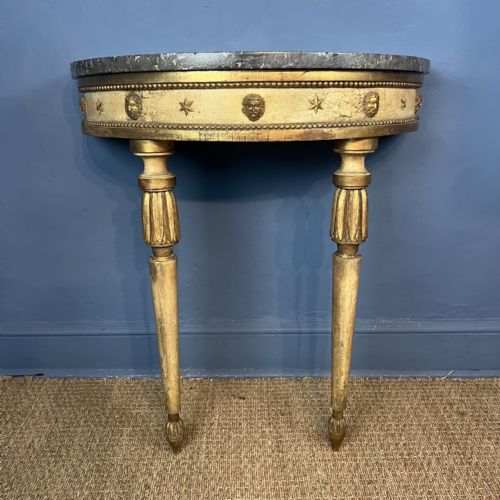
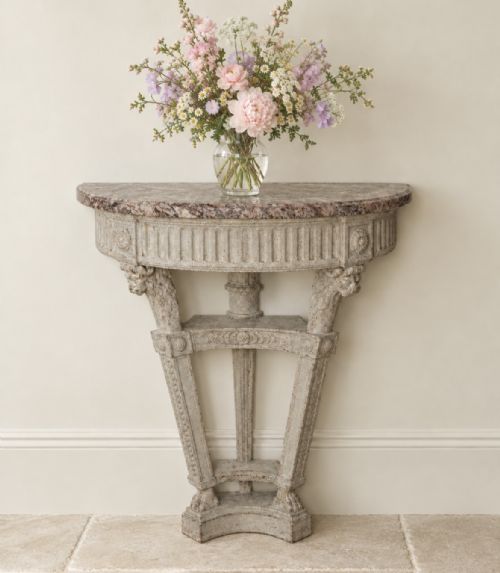
A grey carved pier table brings neoclassical elegance and heavy stone surfaces into a grand hallway or drawing room.
Grey Carved Pier Table
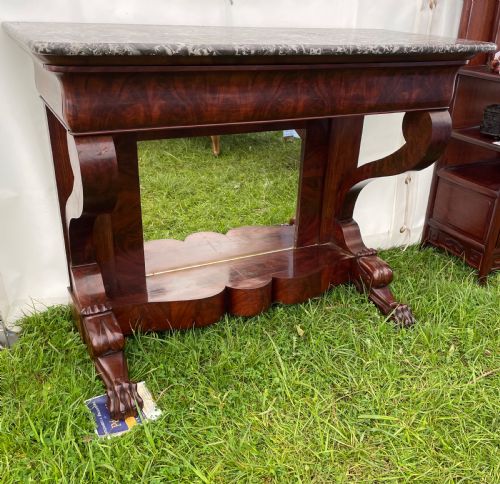
A grey carved pier table typically appears as a console table designed to sit flat against a wall, frequently beneath a mirror or window pier. The selection here spans the eighteenth century, nineteenth century, and early twentieth century, drawing on French, Italian, and English design traditions.
Makers and workshops produced these forms in variations such as Italian neoclassical, French rococo, Louis XVI, and Chippendale style. Buyers encounter painted wood, cream painted surfaces, giltwood, mahogany, and walnut, often paired with heavy marble tops.
Materials and construction
Carpenters and carvers shaped solid timbers including oak, mahogany, walnut, and painted woods to form the structural framework and decorative apron. Surface decoration frequently involved giltwood, gold leaf, and painted finishes applied over carved wooden bases.
Heavy marble slabs form the characteristic tabletops, resting directly on the carved wooden frames designed to support the significant weight of the stone.
Grey Carved Pier Table Retail Price Guide 2026
Typical asking prices for grey carved pier table among the pieces listed under this phrase on Sellingantiques today, from the lower quarter to the upper quarter. They describe what is for sale here now, not the wider market.
Some nineteenth-century country house tables weigh considerably more than expected due to exceptionally thick slabs of period marble.
Distinctions in quality
The refinement of the carved wooden ornament dictates the upper tier of the range, separating deeply hand-chiselled acanthus leaves and scrolling motifs from simpler linear mouldings. The integration between the heavy marble top and the supporting wooden frame reveals the precision of the original joinery.
Original painted or gilt surfaces that retain their historic patination outrank pieces subjected to unsympathetic modern repainting or excessive restoration.
The Grey Carved Pier Table Glossary
- Pier table
- A side table built specifically to stand against the wall space between two windows. These tables traditionally anchored large vertical mirrors.
- Console table
- A table supported by wall brackets or console legs rather than four independent vertical posts. They are designed for shallow spaces.
- Giltwood
- Wood that has been coated with thin gold leaf or powder. This finish was favoured in neoclassical and rococo interiors for reflecting candlelight.
- Neoclassical
- A style spanning the eighteenth and nineteenth centuries that revived classical Greek and Roman motifs. It relies on symmetry, straight lines, and classical foliage.
Grey Carved Pier Table: Frequently Asked Questions
Where should a pier table go?
These tables belong in hallways, drawing rooms, or entrance spaces where floor depth is limited. Placing one against a flat wall beneath a mirror or artwork follows its historical placement.
Because they rely on the wall for absolute stability, ensuring proper attachment prevents tipping, particularly when supporting heavy marble tops.
How do I care for the marble top?
Marble requires gentle cleaning with damp cloths and mild, non-acidic soap. Harsh chemicals and citrus juices etch the polished stone surface over time.
Using coasters and mats protects the historic surface from staining and moisture rings.
Are these tables free-standing?
Traditional console and pier tables were engineered to lean against or fix directly to a wall. Their leg configurations often lack the four-corner stability required for central room placement.
Checking the base structure clarifies whether a table needs wall anchoring for safe daily use.
How do I distinguish regional styles?
Italian and French examples often display elaborate rococo scrolling, giltwood, and painted finishes. English and later nineteenth-century pieces tend toward restrained mahogany or walnut constructions.
Examining the carving depth and secondary woods helps identify the workshop origin and period.