
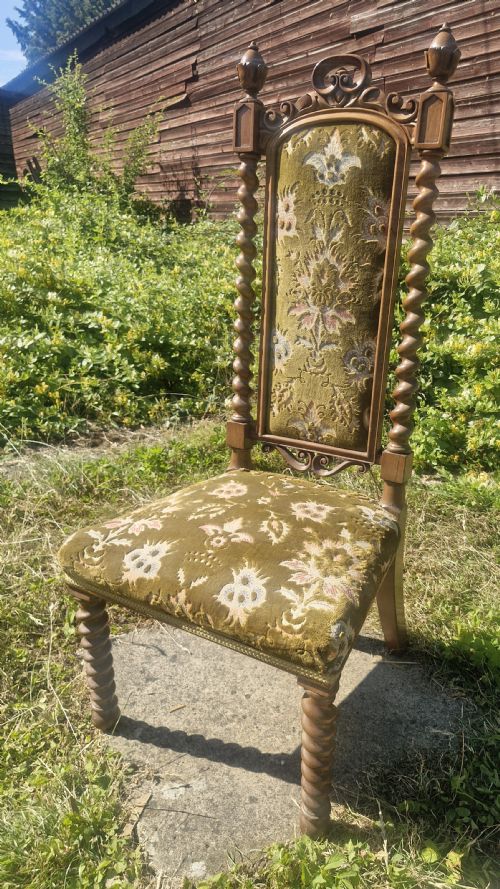


Green Tapestry Seat
A green tapestry seat brings rich woven texture and period form into a room, offering both decorative presence and traditional comfort.
Green Tapestry Seat
When you search for a green tapestry seat, you encounter a variety of upholstered forms ranging from open armchairs and scroll back occasional chairs to stools, ottomans, and multi-seater sofas. These pieces span multiple centuries and stylistic revivals, capturing the shifting tastes in domestic seating from the Georgian and Regency eras through the Victorian period and into the early twentieth century.
The versions you are most likely to meet on this page include nineteenth-century walnut and rosewood frames upholstered in patterned textiles, alongside Edwardian and Art Deco seating. Origin work covers English and French regional designs, incorporating styles from Louis XIII and Louis XVI revivals to Jacobean and Victorian Gothic influences.
Forms vary from compact window stools and footstools to substantial wing library armchairs and high back chairs. Each object combines a sturdy wooden frame in timber, mahogany, walnut, or rosewood with woven textile upholstery, creating functional seating with distinct historical character.
What varies in quality
The distinction between standard examples and superior pieces rests on the craftsmanship of the wooden frame and the finesse of the textile work. Carved walnut and rosewood frames with refined proportions demonstrate higher artisan skill than simpler structural builds.
The execution of the tapestry upholstery itself dictates much of the visual merit, particularly where detailed needlepoint panels or hand-stitched elements are present. Finer execution in both the timber joinery and the woven surface elevates the standing of the piece.
Some winged chairs arrived with built-in draught protection, proving that ancestors took their fireside comfort very seriously indeed.
Heals
The Green Tapestry Seat Glossary
- Tapestry fabric
- A heavy woven textile featuring pictorial or geometric designs used for durable upholstery. This material defines the surface texture of the seating.
- Needlepoint
- A type of canvas work embroidery executed with a yarn threaded through a stiff open-weave mesh. This technique produces detailed decorative panels on chair backs and seats.
- Rosewood
- A dense, dark timber prized for its rich grain and utilised in fine nineteenth-century frames. It provides a heavy and polished structural base.
- Scroll back
- A chair design featuring a curved top rail or backrest that rolls outward. This profile appears frequently on nineteenth-century occasional chairs.
- Wing back
- An armchair style featuring protective side panels designed to shield the sitter from draughts. These upholstered extensions frame the upper portion of the chair.
Green Tapestry Seat: Frequently Asked Questions
What periods do these seats cover?
The listings span several centuries, encompassing Georgian, Regency, and Victorian eras, alongside Edwardian and Art Deco periods.
Design influences also draw on earlier revivals such as Jacobean and Louis XIII styles, reflecting manufacturing dates from the late eighteenth century into the early twentieth century.
What woods were used for the frames?
Makers utilised a selection of strong timbers to construct the structural supports for these chairs and stools.
Walnut, mahogany, and rosewood appear frequently across the pieces, occasionally complemented by bentwood and brass elements.
Are the tapestry covers original?
Upholstery treatments vary across the selection, with some items retaining period needlepoint panels and textile work.
Other pieces feature updated or replacement fabric applied to maintain the functional condition of the antique frame.
Where were these pieces made?
The furniture originates primarily from English and French workshops spanning the eighteenth, nineteenth, and early twentieth centuries.
Regional cabinet makers and larger firms produced these seats to serve domestic functions in halls, morning rooms, and libraries.
What seat forms are available?
The selection includes a diverse range of domestic seating formats designed for various rooms in the home.
Buyers encounter open armchairs, wing chairs, side chairs, two-seater sofas, ottomans, and footstools.