


Green Solitaire Ring
A green solitaire ring brings a single striking green stone to the hand, offering a clean line across decades from the Edwardian era to the mid-century.
Green Solitaire Ring
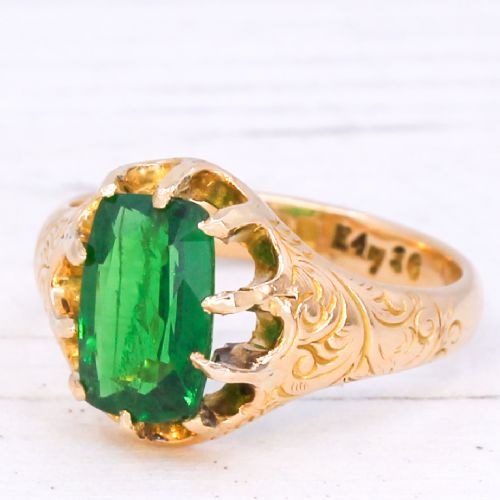
A green solitaire ring centres on one notable green gemstone held within a single setting, ranging from early twentieth-century designs to mid-century examples.
The green stones found in these rings include emerald, tsavorite garnet, jade, jadeite, bloodstone, chalcedony, green tourmaline, and green sapphire.
Mountings span early 1900s work, Edwardian pieces, Art Deco creations, and 1950s or 1960s mid-century forms.
How they were made
Goldsmiths set these green stones in yellow gold, 9ct gold, 15ct yellow gold, 18ct gold, 14ct white gold, and platinum.
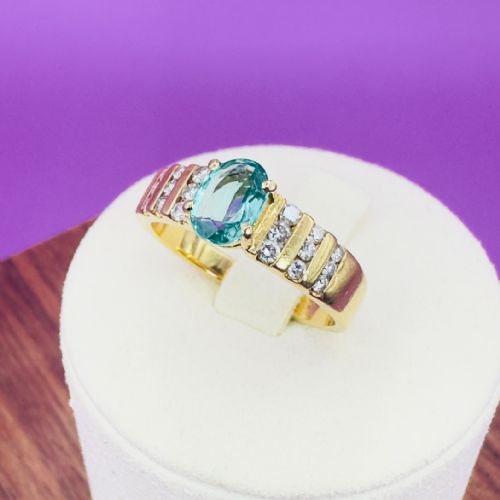
Stones receive cuts such as oval cuts, cabochon cuts, and carved forms, sometimes accompanied by supporting diamonds.
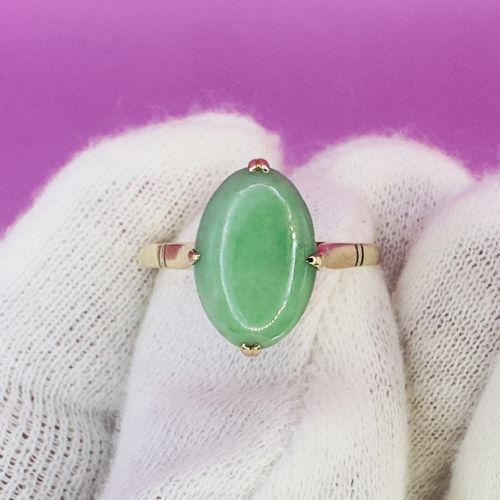
Some stones prefer a smooth, rounded dome instead of sharp facets, letting the jade or chalcedony do the talking without any fuss.
What varies in quality
Quality rests in the depth and clarity of the central green stone, alongside the weight and presence of the gem.
The choice of precious metal, from platinum down to 9ct gold, alters the structural weight and finish of the mount.
The Green Solitaire Ring Glossary
- Solitaire
- A ring design featuring a single primary gemstone set alone on the band. This focuses attention entirely on the central stone.
- Cabochon
- A gemstone shaped and polished with a smooth, rounded surface rather than faceted. This style suits stones like jade and chalcedony.
- Tsavorite
- A green garnet variety known for vivid colour saturation. It appears in early twentieth-century pieces.
- Chalcedony
- A cryptocrystalline form of silica with a waxy lustre. Edwardian jewellers utilised this material in smooth ring settings.
Green Solitaire Ring: Frequently Asked Questions
What periods do these green rings come from?
The pieces span the early 1900s, Edwardian years, Art Deco period, and the mid-century decades up to the 1960s.
Designs reflect the shifting aesthetic priorities of each era, from delicate early mountings to bold mid-century stones.
Which green stones appear most often?
Emeralds dominate the selection, accompanied by green sapphires, tsavorite garnet, jade, bloodstone, chalcedony, and green tourmaline.
Each mineral brings a distinct shade of green and reacts differently to light within its setting.
Are diamonds used alongside the green stones?
Many pieces pair the central green stone with small accent diamonds, either flanking the main gem or forming a cluster around it.
Plain solitaire versions rely entirely on the single green stone and the precious metal band.
What metals hold these green stones?
Goldsmiths utilised platinum, 18ct gold, 15ct yellow gold, 14ct white gold, and 9ct gold to construct the bands and settings.
Choice of metal often aligns with the period of manufacture, such as platinum in earlier pieces and white gold in mid-century work.