
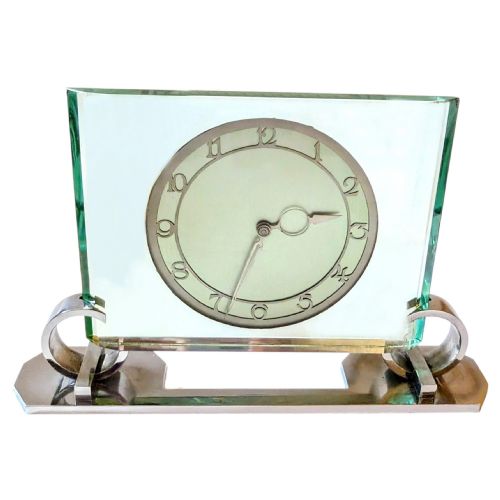


Green Mantle Clock
These green mantle clock pieces bring rich colour and historic timekeeping to a room, spanning Victorian and Art Deco design.
Green Mantle Clock
A green mantle clock sits upon a fireplace surround, sideboard or desk, measuring time with mechanical movements housed within stone, glass or metal cases. These objects range from heavy nineteenth-century architectural stone pieces to streamlined twentieth-century designs.
The versions most commonly met here include Victorian marble and slate architectural housings alongside Art Deco green glass, onyx and mirror glass models. French makers contributed heavily to the earlier ornate styles, while English firms dominated the later twentieth-century glass and bakelite production.
Materials and Construction
Makers shaped heavy natural stones including green marble, onyx and slate into substantial architectural cases, often inlaying contrasting materials or mounting them with brass, bronze and ormolu ornaments. Enamel and porcelain dials display the hours beneath glass bezels, driven by brass mechanical movements.
Twentieth-century production shifted toward modern industrial materials, combining green glass, mirror glass and chrome with electric or wind-up movements. Bakelite also emerged as a primary moulded material for geometric Art Deco cases.
Quality and Craftsmanship
The distinction between ordinary and superior pieces rests on the precision of the case carving and the complexity of the movement. Heavier stone housings with crisp mouldings, bronze figures and integrated garniture sets represent higher tiers of craftsmanship.
Mechanical sophistication also determines worth, separating standard wind-up mechanisms from complicated movements featuring perpetual calendars, equation of time indicators or moon phases.
Smiths Clockmakers·Garrards·GEC·Brocot·Ambec
The Green Mantle Clock Glossary
- Garniture
- A matching set of decorative objects, usually comprising a central clock flanked by twin vases or urns designed to sit together on a mantle.
- Ormolu
- Gilded bronze used extensively for decorative mounts and feet on nineteenth-century French cases. It provides a bright golden contrast against dark marble or slate.
- Slate
- A dense grey or black stone frequently used as the primary structural body for Victorian architectural clocks, often painted or marbled to resemble richer stone.
- Onyx
- A banded variety of chalcedony utilised for polished decorative clock cases, valued for its translucent layers and variegated green tones.
Green Mantle Clock: Frequently Asked Questions
How do I wind an antique clock?
Most mechanical clocks require a small key inserted into the dial face to tension the internal springs. Turn the key gently until resistance is felt, taking care not to over-wind the movement.
Different models run for varying durations, ranging from standard eight-day movements to thirty-hour designs. Consult the specific winding requirements of your mechanism before adjusting the time.
Where should I place a mantle clock?
These clocks are traditionally positioned on the mantlepiece above a fireplace, though any level surface such as a sideboard or desk serves adequately. Ensure the furniture is stable and free from excessive vibration.
Because many older mechanical movements rely on a balanced pendulum to keep accurate time, placing the case on a level plane is essential for proper operation.
How do I tell Victorian from Art Deco clocks?
Victorian models typically feature heavy marble, slate or ormolu housings decorated with classical revival motifs, columns, or bronze figures. They emphasise ornate symmetry and traditional craftsmanship.
Art Deco pieces display streamlined geometric forms using green glass, chrome, bakelite or onyx. Their aesthetic prioritises modern industrial materials and minimalist symmetry over historic ornamentation.
What is a crystal regulator clock?
A crystal regulator is a mantle clock enclosed by glass panels on all sides, allowing a clear view of the interior movement and suspended pendulum. These pieces became popular during the late nineteenth century.
The transparent housing showcases the polished brass works and mercury or compensated pendulums from every angle, reflecting light within the room.