
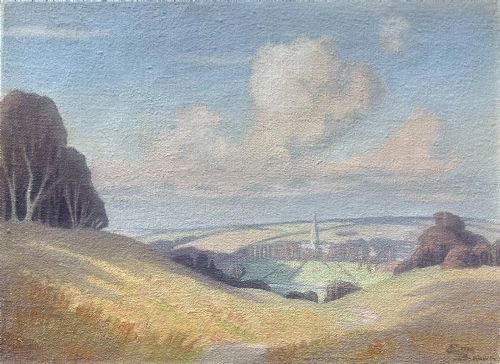
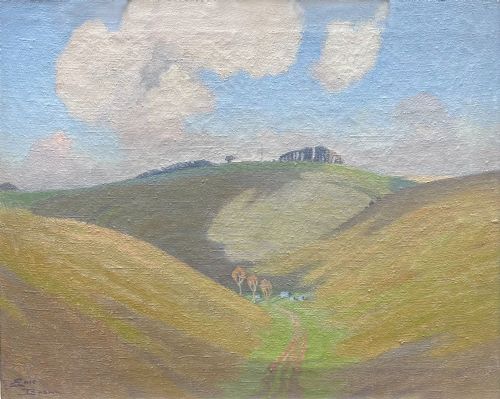
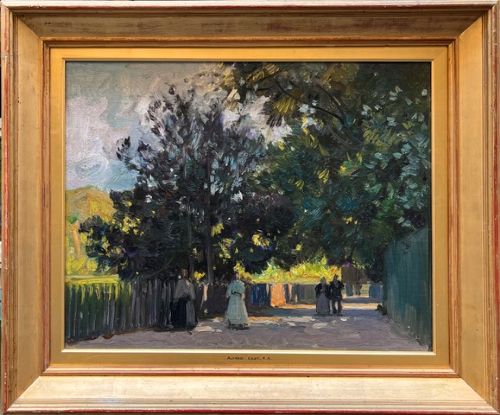
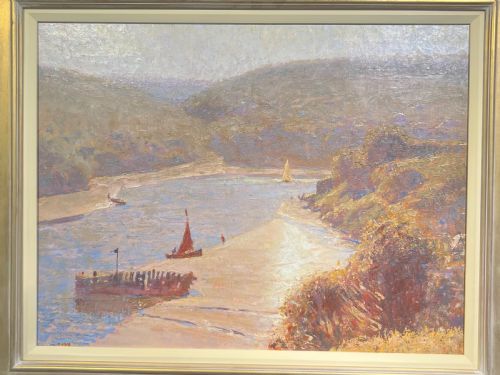


Green Hill Landscape Artwork
Green hill landscape artwork captures open terrain and rolling elevations on canvas or paper, offering enduring pastoral views for the home.
Green Hill Landscape Artwork
Green hill landscape artwork encompasses paintings and watercolours depicting rural elevations, river paths, and elevated terrain. These pieces range from Victorian topographical views to mid-century modern interpretations of hills and valleys.
Buyers encounter oil paintings on canvas and delicate watercolours on paper spanning the nineteenth century through the mid-twentieth century. Subjects include specific locations such as Dorset, the Purbeck Hills, and Cardigan Bay.
The selection includes framed oil paintings and works associated with British Impressionism, Post-Impressionism, and Fauvism. Each piece records a distinct approach to capturing natural topography and rural scenery.
Materials and methods
Artists relied primarily on oil paint applied to canvas or wood panels, alongside watercolours worked on paper. Impasto technique appears in mid-century examples, building physical texture into the pigment to describe rolling terrain.
Gilt frames frequently accompany these works, providing a finished border that complements the palette of the painting. Support materials range from traditional woven canvas to rigid wooden boards and absorbent paper.
Listings feature works executed in oil paint, watercolour, and gilt across the nineteenth century and mid-twentieth century.
Distinctions in quality
Quality rests upon the artist's handling of light, atmosphere, and spatial depth within the composition. Stronger works convey the specific weight of the landscape and the character of the terrain through confident brushwork.
Condition of the canvas, pigment stability, and the integrity of the original frame influence the standing of an individual piece. Works displaying clear provenance or exhibition histories carry additional weight among collectors.
Eric Brown·Sir Alfred East·Cecil Allan Mould·Joseph Edward Hennah·James Fry·Sidney James Beer·Bernard Walter Evans·Rowland Henry Hill·James L. Brooke·Clarence Woodburn·Charles Walter Radclyffe·Martin Lamotte·Edmund John Niemann
The Green Hill Landscape Artwork Glossary
- Impasto
- Paint applied thickly to a canvas or panel, standing out in relief from the surface. This technique allows the artist to build physical texture into foliage, earth, and sky.
- Watercolour
- A painting method where coloured pigments are suspended in a water-soluble vehicle on paper. It produces transparent washes of colour suited to atmospheric effects.
- Fauvism
- An early twentieth-century style characterised by strong colours and painterly qualities over realistic values. Practitioners prioritized expressive brushwork and bold palettes.
- British Impressionism
- A movement focusing on everyday subject matter and natural light using visible brushstrokes. Artists captured outdoor scenes with an emphasis on transient atmospheric conditions.
- Canvas
- A closely woven heavy fabric used as a surface for oil painting. It provides a durable ground stretched over a wooden frame.
Green Hill Landscape Artwork: Frequently Asked Questions
What periods do these paintings cover?
The works span from the nineteenth century through the Victorian and Edwardian eras, extending into mid-century modern and 1930s modernist movements.
This broad timeline incorporates various regional British and French artistic interpretations of rural scenery.
How should I frame and hang these works?
Many examples retain their original gilt frames, which should be preserved where possible to maintain the historical context of the piece. Hang them away from direct sunlight to protect oil paint and watercolours from fading.
Ensure wall fixings match the weight of the framed wood and canvas structures securely.
What is the difference between oil and watercolour versions?
Oil paintings utilise heavy pigment on canvas or wood, offering a rich textured surface that often includes impasto details. Watercolours use paper supports and transparent washes for lighter, more fluid atmospheric effects.
Both mediums capture hill and valley topographies but present distinct visual textures.
Are these works signed by the artists?
Several pieces feature direct signatures from painters such as Sidney James Beer and James Fry, while others are attributed through historical records and exhibition labels.
Signatures help establish the specific provenance and attribution of individual landscape compositions.