



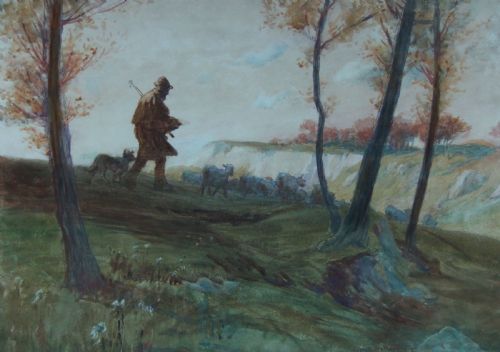
Green Fields Watercolour
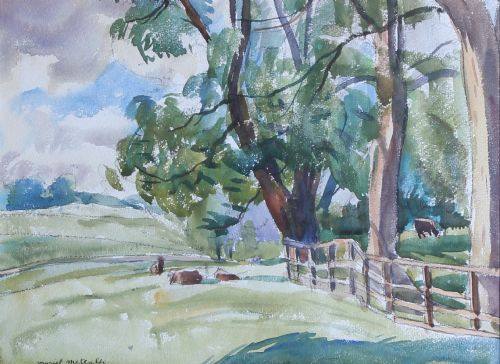
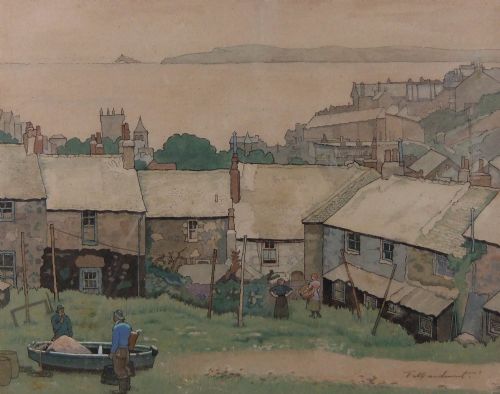
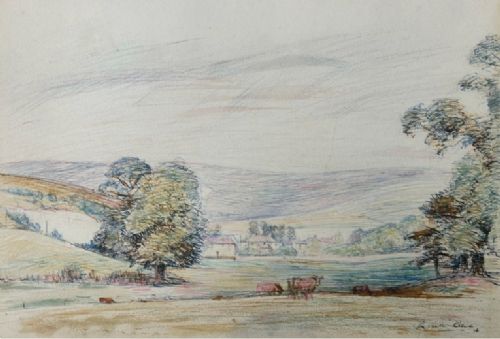
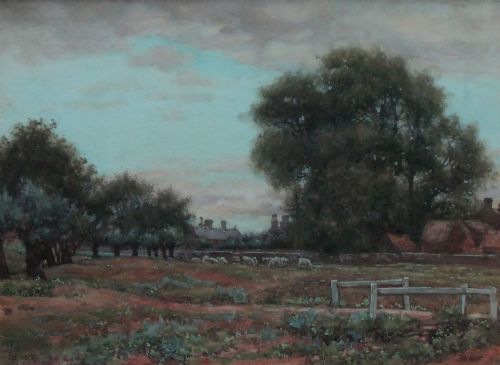
These green fields watercolour pieces capture British rural life and pastoral landscapes across several decades.
Green Fields Watercolour
When you search for green fields watercolour, you are looking at works on paper that depict pastoral scenes, agricultural labour, and rural landscapes. These paintings record the countryside through various artistic movements ranging from Victorian naturalism to the St Ives School.
The pieces you are most likely to meet on this page span from the late nineteenth century through to the mid twentieth century. They often feature subjects such as cows in pastures, ploughing bulls, harvest time, and country estates.
Makers and artists represented include figures like Thomas Maidment, Oswald Garside, and Claude Muncaster. Their works demonstrate how British artists interpreted rural views using traditional mediums on paper.
Materials and technique
These works are executed using watercolour pigment applied to paper, often accompanied by underlying graphite lines to map out the composition. The support materials typically consist of watercolour paper, housed within wood and glass framing.
Artists built up their pastoral scenes through transparent washes of pigment, allowing the white of the paper to provide luminosity. Detail was added through finer brushwork and sometimes graphite underdrawing, capturing the light and atmosphere of the English countryside.
Green Fields Watercolour Retail Price Guide 2026
Typical asking prices for green fields watercolour among the pieces listed under this phrase on Sellingantiques today, from the lower quarter to the upper quarter. They describe what is for sale here now, not the wider market.
Several paintings record hardworking bulls and horses taking a well-earned rest from ploughing the fields.
Assessing quality
The distinction between works at different levels of quality rests upon the sureness of the brushwork and the artist's handling of light and atmosphere. Stronger pieces display a confident command of watercolour pigment, creating depth and movement in sky and pasture.
Condition also plays a part, particularly the preservation of the paper support and the vibrancy of the pigments against fading. Framed examples that retain their structural integrity and display clear attribution to documented artists command greater attention.
Muriel Metcalfe·Thomas Maidment·Russell Sidney Reeves·Oswald Garside·Thomas Hunn·John Atkinson·Charles Clifford Turner·Arthur Claude Strachan·Walter Duncan·George Faulkner Wetherbee·Claude Muncaster·J. D. Walker
The Green Fields Watercolour Glossary
- Watercolour pigment
- Colouring material ground with a water-soluble binder, used for painting on paper. This medium allows for luminous washes that define these pastoral views.
- Graphite
- A form of carbon used for drawing lines and underdrawing on paper. Artists utilised it to sketch compositions before applying pigment.
- English School
- A classification for art produced by British painters, particularly in landscape and pastoral genres. It encompasses the various stylistic shifts seen across the centuries.
- Victorian Pastoral
- A style focusing on idealized or realistic depictions of rural life and agricultural work during the nineteenth century. These scenes often emphasise harmony between humans, animals, and the land.
- St Ives School
- An artist community and movement associated with Cornwall, known for modern interpretations of landscape and marine subjects. Works from this tradition bring a distinct regional perspective to British art.
Green Fields Watercolour: Frequently Asked Questions
What periods do these watercolours cover?
The works span from the late nineteenth century through the Edwardian era and into the mid twentieth century. They reflect stylistic shifts from Victorian pastoralism to modern British approaches.
This timeline allows collectors to trace how artists altered their treatment of rural subjects over several decades.
How should I display a watercolour?
Watercolours require protection from direct sunlight to prevent the pigments from fading over time. Framing behind glass with suitable mount board keeps the paper safe from environmental damage.
Placing them in rooms with stable humidity levels ensures the paper support remains preserved for years to come.
What subjects appear in these paintings?
The imagery focuses heavily on the British countryside, featuring agricultural scenes like harvest time, ploughing bulls, and cattle grazing in pastures. Topographical views and estate landscapes also feature prominently.
These depictions offer a window into rural labour and rural topography across different regions of Britain.
Are these works signed by the artists?
Many of the paintings bear signatures or attributions to specific painters, while others represent the broader output of the English School. Signatures provide direct links to the individual hands that created the works.
Unsigned pieces rely on stylistic evidence and period characteristics for their attribution.