




Green Cottage Garden Artwork
Green cottage garden artwork captures rural domestic life through oils and watercolours spanning the Victorian era to the 1940s.
Green Cottage Garden Artwork
Green cottage garden artwork encompasses paintings depicting traditional rural dwellings, rustic gardens, and pastoral scenes created across the nineteenth and twentieth centuries. When searching for green cottage garden artwork, buyers encounter a rich selection of British Impressionism, Edwardian Pastoral, and Victorian Rural Genre pieces.
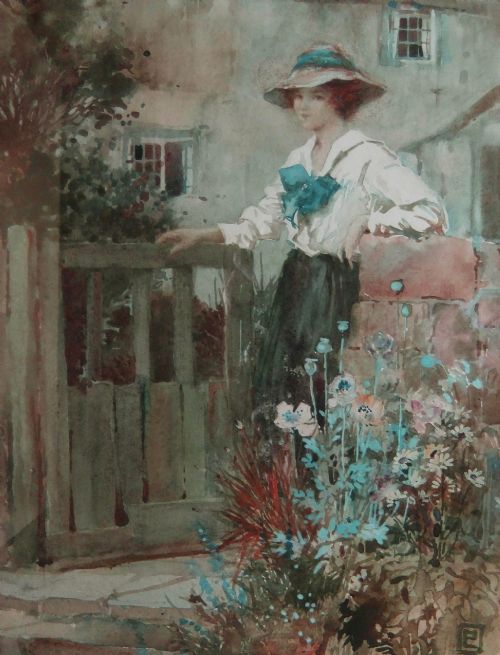
The most common examples on this page are watercolours and oil paintings on canvas or paper dating from the 1900s to the 1930s. These works frequently record figures engaged in domestic tasks such as feeding hens, knitting outside, or tending flowers.
The origins of these works are rooted in English School traditions, capturing vernacular architecture and cultivated country plots. Artists of the period focused on domestic tranquility, utilising natural light and botanical detail to record rural scenery.
Materials and methods
Artists relied primarily on oil paint on canvas or wood panels, and watercolour pigment applied to paper under glass. These mediums allowed painters to achieve both the rich texture necessary for foliage and the delicate translucence required for atmospheric skies.
Support materials include prepared canvas stretched over wooden frames, heavy watercolour paper, and occasionally wood panels. Works are housed within framing structures that protect the paper and canvas surfaces.
The listings span from the Victorian era to 1940, with the 1920s representing the most heavily represented decade for these garden scenes.
Distinguishing quality
Quality in these paintings is defined by the artist's handling of light, botanical accuracy, and compositional balance within the garden setting. Superior works demonstrate confident brushwork that distinguishes leaf structures, floral blooms, and architectural timber without relying on rigid lines.
The distinction between standard examples and finer pieces rests on the vitality of the figures and the depth of the pastoral atmosphere. Masterful paintings integrate the cottage and its surrounding greenery into a cohesive, convincing environment rather than a static backdrop.
Percy Lancaster·Owen Bowen·Ernest Higgins Rigg·Kershaw Schofield·Herbert Royle·Arthur Claude Strachan·Benjamin D. Sigmund·George Frederick Nicholls·Minnie Smythe
The Green Cottage Garden Artwork Glossary
- British Impressionism
- A painting style developed in the late nineteenth and early twentieth centuries focusing on loose brushwork and natural light. It marks a departure from rigid academic realism towards atmospheric effects.
- Victorian Rural Genre
- Artworks depicting scenes of everyday country life, labour, and domesticity. These subjects reflect contemporary romanticised views of rural English society.
- Edwardian Pastoral
- A visual style characterised by idyllic, peaceful depictions of the English countryside and country houses. Artists working in this mode emphasised harmonious relationships between people and nature.
- Watercolour Pigment
- Finely ground colour particles suspended in a water-soluble binder, applied to paper. This medium demands precision, as corrections are difficult to make once the pigment sinks into the fibres.
Green Cottage Garden Artwork: Frequently Asked Questions
What periods do these paintings date from?
The works span from the nineteenth century through the Edwardian period and into the 1940s. Most examples date from the early decades of the twentieth century.
Victorian pieces lean towards heavier oil painting techniques, while later 1920s and 1930s works frequently utilise watercolour to capture bright garden light.
How do I identify a watercolour from an oil painting?
Watercolours are painted on paper and displayed under glass to protect the delicate pigment from moisture and fading. Oil paintings utilise canvas or wood panels with a textured, heavier paint layer.
Close inspection reveals the weave of the canvas in oil works, whereas watercolours show the flat texture of the paper beneath translucent washes.
What subjects appear most frequently?
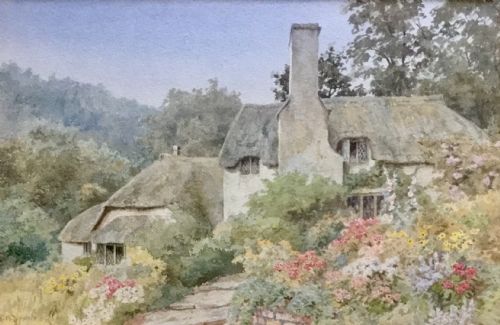
Common subjects include thatched cottages, walled gardens in summer, domestic scenes with figures feeding hens, and children with pets. Artists focused on recording the traditional English countryside.
These compositions celebrate rural domesticity, often pairing floral displays with rustic architectural elements like cottage gates and stone walls.
How should I care for a antique watercolour?
Watercolours require protection from direct sunlight to prevent the pigments from fading over time. Framing with acid-free mounts ensures the paper remains undamaged.
Keeping the artwork in a stable environment away from excessive humidity preserves both the paper support and the pigments.