
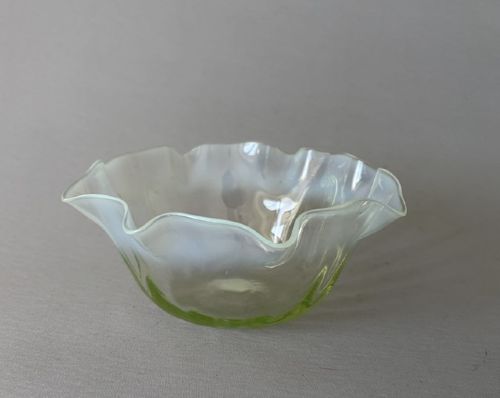
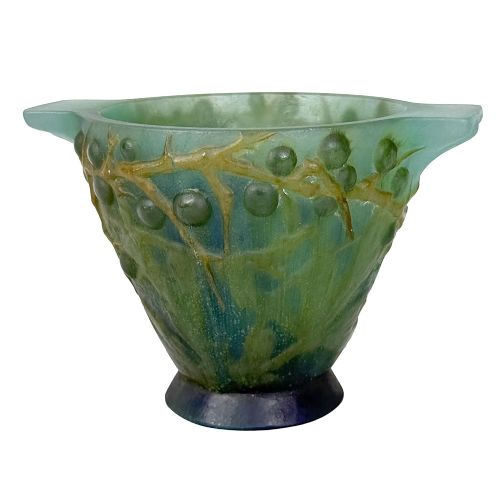


Green Art Glass Bowl
A green art glass bowl brings rich verdant colour and tactile form to a room, drawing the eye through distinctive technique and period style.
Green Art Glass Bowl
A green art glass bowl spans several decades of creative production, ranging from Victorian Venetian Revival and Arts & Crafts pieces to Art Nouveau, Art Deco, and Mid-Century Modern designs. These decorative objects take various forms including decorative bowls, centrepieces, dessert dishes, and baskets.
The pieces on this page originate from diverse European and British traditions, featuring works from English, French, Belgian, Italian, and Scottish makers. Collectors encounter everything from delicate moulded crystal to robust utilitarian vessels adapted for display.
Makers utilised specific regional methods, resulting in distinct tactile qualities that define each period. Whether exploring an early Scottish production or a continental creation, the variety of forms reflects the changing decorative tastes across the nineteenth and twentieth centuries.
How they were made
Glassmakers employed techniques such as blowing, moulding, and pate de verre to shape the molten material. Molten glass received its distinct coloration through metallic oxides, while internal patterns were created using cane decoration, latticinio threads, or aventurine inclusions.
Metal mounts frequently accompanied the glassware, incorporating silver plate, sterling silver, or chrome elements around the rims and handles. Processes like acid-etching, enamelling, and iridescent surface treatments added depth and shimmer to the finished vessels.
Some bowls include glass frogs designed to keep stubborn flower stems exactly where you put them.
What varies in quality
The brilliance of the glass body and the depth of the green hue indicate the standard of materials used in production. Purity in the crystal and skilled control over colour saturation distinguish superior pieces from standard output.
Precision in surface decoration, whether applied enamel, cane work, or iridescent sheen, demonstrates the artisan's control. Integrated metalwork, such as silver-plated frames or hallmarked sterling mounts, adds another layer of craftsmanship that influences the overall merit of the object.
Venini·Amalric Walter·Daum France·WMF·Salviati Venice·Monart·Val St Lambert·Stuart·René Lalique·Joseph Lucas·Walther and Sohne·Loetz
The Green Art Glass Bowl Glossary
- Pate de verre
- A glass-casting method where finely crushed glass is mixed with a binder and fired in a kiln. This technique produces dense, softly textured objects with mottled colour.
- Vaseline glass
- Glass containing uranium dioxide that exhibits a distinct yellow-green fluorescence under ultraviolet light. It gained popularity during the nineteenth and early twentieth centuries.
- Latticinio
- Opaque white or coloured glass threads embedded within clear glass to form delicate net or lace patterns. Venetian glassmakers revived and perfected this intricate method.
- Aventurine glass
- Glass containing suspended metallic crystals, often copper, which create a glittering, spangled effect within the material. It requires precise temperature control during cooling.
- Iridescent glass
- Glass treated with metallic vapours while hot to produce a rainbow-like sheen on the surface. Loetz and other factories utilised this finish to mimic ancient patinated glass.
Green Art Glass Bowl: Frequently Asked Questions
What is Monart glass?
Monart glass is a type of art glass produced in Scotland by John Moncrieff, heavily influenced by continental glassmaking traditions. These pieces are celebrated for their rich, clouded colours and sophisticated rounded shapes.
Collectors prize early Monart bowls for their subtle internal bubbles and layered optical effects. They stand out among British studio glass for their weighty presence and distinct colour combinations.
How should I display my bowl?
Place your green art glass bowl where natural light can pass through the body to reveal the colour saturation and internal details. Placing the piece near a window or on a glass shelf highlights surface iridescence and cane work.
Ensure the supporting surface is stable and away from heavy household traffic to protect delicate rims and metal mounts. Rotating the bowl occasionally allows different angles of the craftsmanship to catch the light.
Are metal mounts marked?
Many silver-plated and sterling silver mounts feature maker marks, retailer stamps, or hallmarks stamped directly into the metal. These stamps can indicate the manufacturing firm, the silver standard, and sometimes the date of production.
Examining the base or rim with a magnifying glass often reveals these small diagnostic details. Such marks provide secure points of reference for dating the piece accurately.