



Grand Tour Souvenir Tazza
A grand tour souvenir tazza is a classical decorative bowl brought home by travellers from Italy, prized for its carved stones and patinated bronzes.
Grand Tour Souvenir Tazza
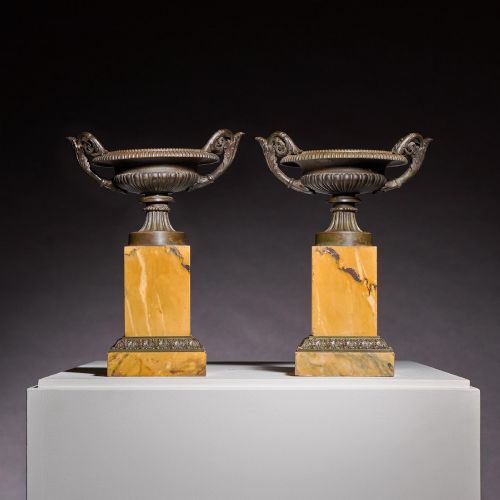
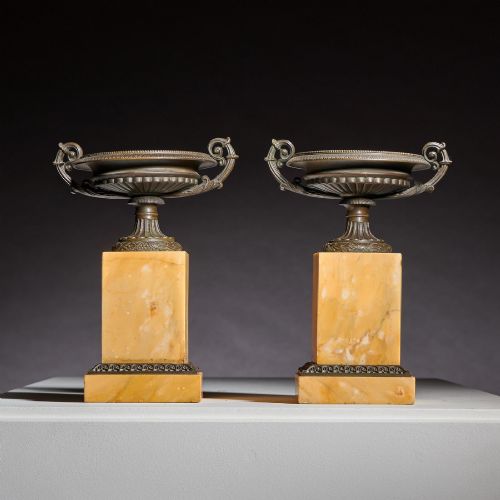
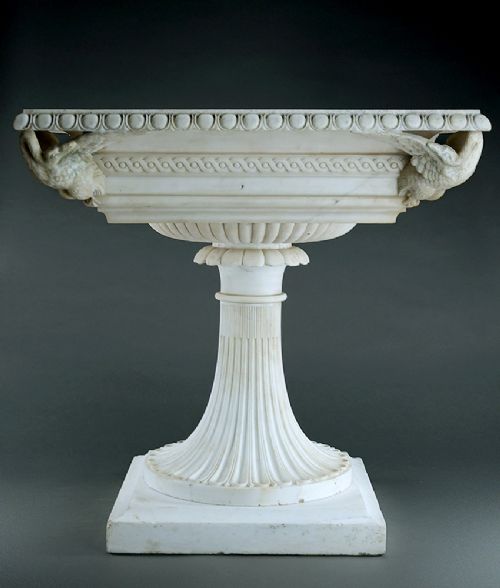
A grand tour souvenir tazza represents the classical taste of nineteenth-century travellers visiting Italy, echoing ancient forms discovered at archaeological sites. These ornamental pieces take the shape of shallow bowls or urns, often standing on square or stepped plinths.
The versions met on this page span the nineteenth century and the year eighteen fifty, appearing as single items or balanced pairs. Makers modelled them after the antique, drawing on classical architecture and sculpture for their inspiration.
Materials and construction
Artisans built these pieces using contrasting hardstones and metals, combining white marble, Siena marble, red marble, and alabaster with cast bronze and ormolu. Highly figured stones such as alabastro egiziano and rouge griotte provide vivid colour and distinct natural patterns across the bowls and bases.
The stonework involves precise turning and carving, paired with patinated or gilded metal mounts that secure the classical proportions. Black marble block bases frequently anchor the heavier stone and bronze compositions.
Grand Tour Souvenir Tazza Retail Price Guide 2026
Typical asking prices for grand tour souvenir tazza among the pieces listed under this phrase on Sellingantiques today, from the lower quarter to the upper quarter. They describe what is for sale here now, not the wider market.
Listings feature nineteenth-century pieces incorporating bronze, white marble, Siena marble, red marble, malachite, and alabaster.
Distinctions in quality
Quality rests in the selection of the stone and the crispness of the metal casting. Highly figured marbles with rich mineral veining and complex polychrome combinations elevate an object above simpler monochrome alternatives.
The fineness of the bronze chasing and the harmony between the metal mounts and the stone vessel distinguish superior workshop output. Scale also plays a part, moving from smaller domestic ornaments to monumental proportions.
The Grand Tour Souvenir Tazza Glossary
- Tazza
- A shallow bowl on a base or pedestal, used as an ornamental object. This form derives from ancient drinking vessels.
- Grand Tour
- An extended journey through Europe undertaken by wealthy young men to study classical art and culture. Souvenirs purchased along the way recorded these travels.
- Ormolu
- Gilded bronze used for decorative mounts and architectural details. The technique involves applying a gold amalgam to a bronze base.
- Siena Marble
- A yellow ornamental marble quarried in Italy, known for its intense colour and dark grey or black veining. It was widely utilised in neoclassical decorative arts.
- Alabaster
- A fine-grained translucent stone used for carving classical vessels and architectural models. Its soft appearance mimics ancient carved marble.
Grand Tour Souvenir Tazza: Frequently Asked Questions
What is a grand tour tazza?
A grand tour tazza is a nineteenth-century decorative bowl or urn made in Italy as a keepsake for travellers. They reproduce classical antiquities in marble, bronze, and alabaster.
These pieces were displayed in libraries and drawing rooms to signal the owner's classical education and travels.
How were tazzas used?
These vessels served purely as decorative ornaments rather than tableware, displayed on mantelpieces, tables, and cabinets.
Their classical design added an air of antiquity and scholarly taste to nineteenth-century domestic interiors.
What materials are used?
The pieces combine natural decorative stones with cast metals. Common materials include white marble, Siena marble, red marble, malachite, and alabaster.
Bronze and ormolu mounts provide structural contrast and enrich the classical motifs.
Are they found in pairs?
Many examples survive as balanced pairs, designed to sit symmetrically on furniture or architectural ledges. Single vessels also appear in various scales.
Pairs often feature matching stone figures and identical bronze mounts.