


Grand Canal Artwork
Grand canal artwork captures the watery thoroughfares and palazzi of Venice through oils and watercolours.
Grand Canal Artwork
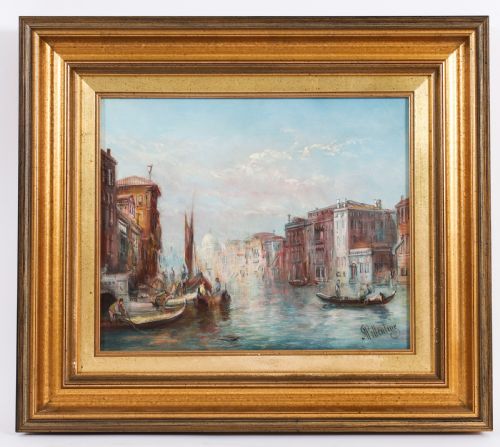
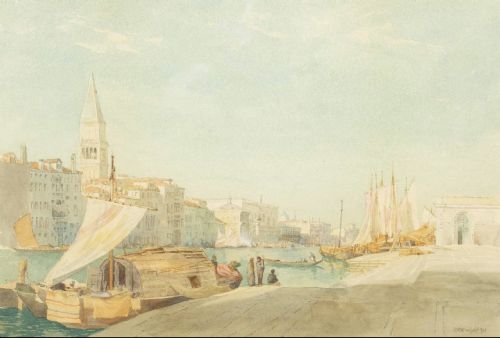
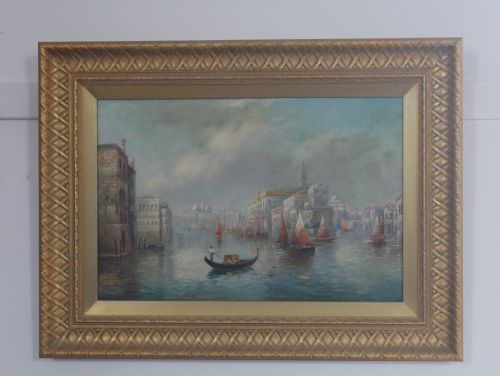
Grand canal artwork depicts the iconic waterways, palazzi, and historic landmarks of Venice, rendered primarily in oil paints and watercolours. These pieces serve as a visual record of the city's architecture and maritime life across different eras.
Buyers frequently encounter 19th-century works, including Victorian oil paintings and traditional Italian views. The selection ranges from expansive canvas townscapes to delicate paper watercolours.
Subjects often feature recognisable locations such as the Doge's Palace, the Rialto area, and Santa Maria della Salute. Artists capture these scenes under various conditions, from bright daylight to moonlight.
How grand canal artwork was made
Painters utilised oil on canvas to build rich, textured surfaces, often framing the finished works in wood or gilded wood. Giltwood frames add a traditional decorative border that complements the maritime subjects.
Watercolour and pastel on paper required swift, assured handling to capture the transient effects of light on water. Artists also incorporated gouache and ink pen drawings to add opacity and fine detail to works on paper.
Venetian gondolas appear persistently across the centuries, ferrying travellers past the Bridge of Sighs in nearly every medium.
What varies in quality in grand canal artwork
The sophistication of perspective and atmospheric light handling distinguishes the output of established artists from lesser works. Mastery over water reflections and architectural proportions elevates a composition.
The integrity of the canvas and paper support, alongside the condition of the original giltwood frame, influences the overall integrity of the piece. Subtle colour harmonies and confident brushwork mark the upper tier of the range.
Alfred Pollentine·Richard Henry Wright·Marc Aldine·Vittore Zanetti Zilla·Hercules Brabazon Brabazon·Jane Vivian
The Grand Canal Artwork Glossary
- Veduta
- A highly detailed, topographical painting or watercolour of a townscape or cityscape. These views were particularly popular with travellers in Italy.
- Gouache
- An opaque watercolour paint consisting of pigment, water, and a binding agent such as gum arabic. It allows for solid areas of colour and sharp highlights.
- Giltwood
- Wood that has been treated with a thin layer of gold leaf or gesso and gold paint. It is commonly found on traditional antique picture frames.
- Canvas
- A heavy woven fabric used as a surface for oil painting. It is typically stretched over a wooden frame before application.
- Pastel
- A dry art medium in the form of a stick, consisting of powdered pigment and a binder. It produces velvety colours that resemble chalk drawings.
Grand Canal Artwork: Frequently Asked Questions
What periods do these paintings cover?
The available selection spans from the Victorian era and the nineteenth century through to the mid-twentieth century. Works date from the eighteen-seventies up to nineteen-sixty.
Different decades bring distinct artistic interpretations, moving from nineteenth-century romanticism towards impressionist and post-impressionist approaches.
Which materials are most common?
Oil on canvas and watercolour on paper dominate the selection, often housed in period wooden or gilded frames. Some pieces also utilise pastel, gouache, and ink.
Canvas works provide rich texture and depth, whereas watercolours offer a lighter, luminous quality suited to Venetian light.
How should I display a framed watercolour?
Watercolours on paper require protection from direct sunlight to prevent fading of the pigments. Hanging them in rooms with stable humidity levels preserves both the paper and the frame.
Glass fronts protect the delicate paper surface from dust and atmospheric pollutants while allowing clear visibility of the brushwork.
How do I identify a veduta painting?
Veduta paintings focus on accurate, detailed topographical representation of urban landscapes, particularly Venetian canals and monuments. They prioritise recognisable architecture and perspective.
Artists often populated these scenes with gondolas and figures to provide a sense of scale and daily life on the water.