



Gothic Revival Brass Candelabra
Gothic revival brass candelabra bring medieval architectural weight into domestic spaces through heavy metalwork and pointed arches.
Gothic Revival Brass Candelabra
Gothic revival brass candelabra emerge primarily from the nineteenth century, drawing heavily on ecclesiastical and medieval forms for domestic and church lighting. Buyers searching this phrase encounter multi-branch table pieces, wall sconces, and hanging chandeliers created during the Victorian era and later twentieth-century revivals.
The material expression ranges from plain brass and gilt brass to ormolu, bronze, and wrought iron, often paired with marble or wood bases. These items take the form of five-branch and seven-branch candelabra alongside articulated brass designs and altar pieces.
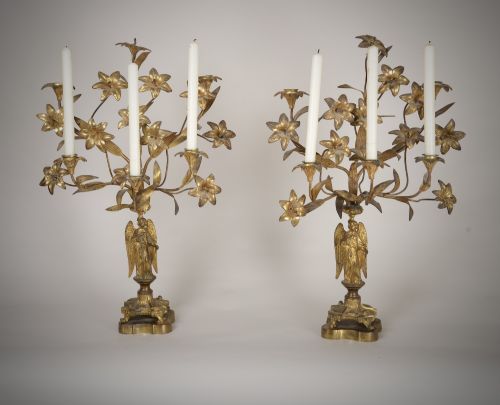
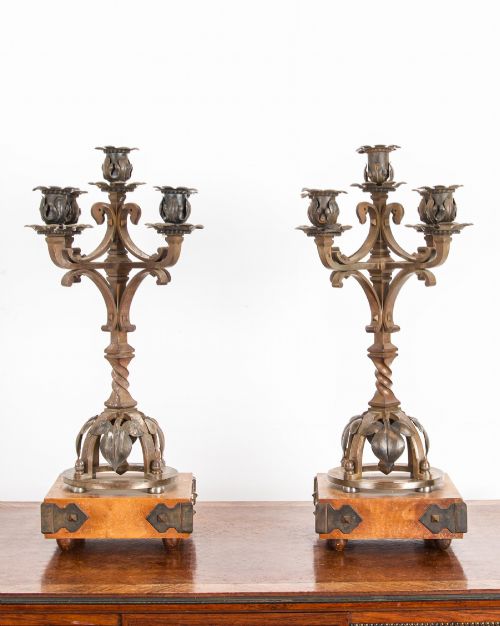
Stylistic influences span standard Victorian Gothic Revival, Renaissance Revival, and medievalist designs. The surviving pieces show a clear preference for paired items intended to balance a mantelpiece or altar.
How they were made
Makers utilised brass, gilt brass, and bronze as the primary metals, casting and shaping components to achieve sharp architectural profiles and structural durability. Gilt bronze and ormolu applications added a bright metallic finish to the heavier metal cores.
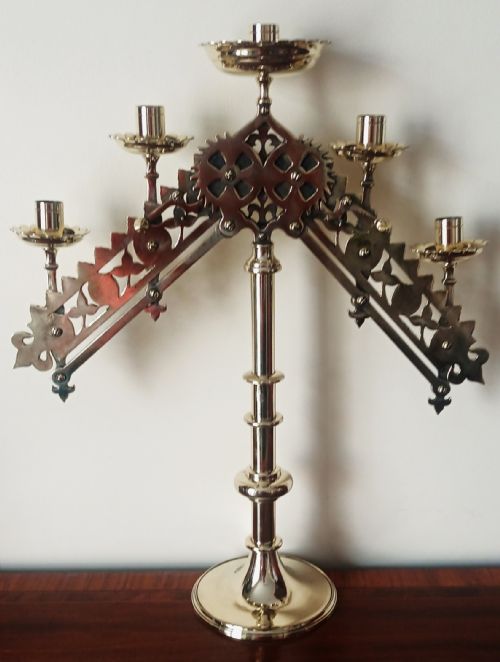
Construction techniques include articulated joints on select brass candelabra, allowing the arms to adjust, alongside fixed branch configurations for wall sconces and heavy altar pieces. Wrought iron and wood occasionally provided structural support or secondary bases for the metalwork.
Gothic Revival Brass Candelabra Retail Price Guide 2026
Typical asking prices for gothic revival brass candelabra among the pieces listed under this phrase on Sellingantiques today, from the lower quarter to the upper quarter. They describe what is for sale here now, not the wider market.
Listings feature brass, gilt brass, ormolu, bronze, and wrought iron combined with marble and wood across the nineteenth and early twentieth centuries.
What varies in quality
Quality rests in the crispness of the casting and the architectural fidelity of the Gothic motifs, separating standard production from finer workshop output. The weight of the metal and the complexity of the multi-branch assembly dictate the physical presence of the object.
Surface finish also differentiates the pieces, with original gilt brass, ormolu, and bronze patination holding visual depth compared to plain or later-cleaned brass surfaces. Articulated mechanisms and integrated wall sconce backplates demonstrate mechanical and design ambition.
Wm. Tonks & Sons
The Gothic Revival Brass Candelabra Glossary
- Gothic Revival
- An architectural and decorative style drawing on medieval forms, pointed arches, and ecclesiastical motifs. This aesthetic dominated nineteenth-century design across metalwork and furnishings.
- Ormolu
- Finely ground high-carat gold applied to a bronze or brass base through a mercury amalgamation or electroplating process. It provides a bright, durable golden finish on decorative metalwork.
- Articulated
- Built with movable joints or pivoting arms that allow the user to adjust the spread of the light sources. This mechanical feature appears on select nineteenth-century brass examples.
- Ecclesiastical
- Relating to the Christian church or clergy, describing items originally intended for chapel or altar use. These pieces often feature heavier construction and overtly religious iconography.
- Wall Sconce
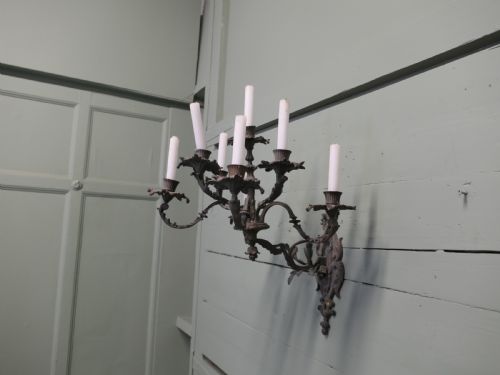
- A light fixture fixed to a wall rather than resting on a table or floor, featuring protruding arms for candles. The evidence shows these rendered in heavy bronze and brass with Gothic detailing.
Gothic Revival Brass Candelabra: Frequently Asked Questions
What periods do these candelabra date from?
The listings span the nineteenth century, including Victorian examples, alongside pieces from the early twentieth century up to nineteen thirty. The bulk of the material originates in the Victorian period.
Design influences stretch into Renaissance Revival and medievalist styles, showing how nineteenth-century makers reinterpreted older architectural traditions for contemporary interiors.
How were these metal fixtures used originally?
These pieces functioned as portable table lighting, altar furnishings, and fixed wall lighting in domestic and ecclesiastical settings. Multi-branch designs provided substantial illumination before electric lighting became standard.
Articulated brass versions allowed users to reposition the candle arms to suit different spaces, while heavy wall sconces remained stationary on interior walls.
Are these items found as pairs?
Many entries on the market appear as matching pairs, particularly the five-branch candelabra and altar pieces intended for balanced display. Single table pieces and wall sconces also occur within the wider selection.
Pairs offer symmetry for mantelpieces, sideboards, or altar tables, reflecting how nineteenth-century interiors favoured balanced decorative arrangements.
What materials are used in Gothic revival lighting?
Brass, gilt brass, bronze, and ormolu form the primary metallic elements of these objects. Secondary materials such as wrought iron, wood, and marble occasionally appear in the bases and structural supports.
Surface treatments range from natural patinated brass to gilt finishes that highlight the cast architectural details and medieval motifs.