

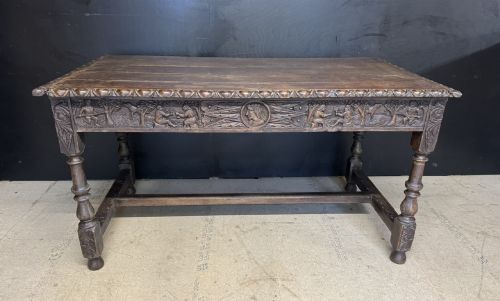


Gothic Oak Serving Table
A gothic oak serving table brings architectural presence and heavy timber character straight into a modern interior.
Gothic Oak Serving Table
A gothic oak serving table is a substantial piece of furniture designed for service and display, rooted primarily in nineteenth century revival movements. These tables appear in forms such as serving tables, sideboards, buffets, credence tables, and refectory variants.
The pieces on this page span the nineteenth century, including specific dates from eighteen seventy up to nineteen hundred, alongside items attributed more broadly to the nineteenth century. Most examples are rendered in solid oak, occasionally walnut, reflecting the architectural seriousness of Victorian and Gothic Revival design.
Makers and designers referenced in the evidence range from cabinet makers like Phillips of Bristol to stylistic inspirations such as Augustus Welby Northmore Pugin. Buyers encounter works labelled under Reformed Gothic, Neo-Gothic, and Arts and Crafts aesthetics, which utilise heavy carving and traditional joinery.
How they were made
Construction relies heavily on solid timber, with oak being the primary material supplemented by occasional walnut and brass hardware. Cabinet makers employed robust joinery techniques suitable for heavy furniture intended to withstand decades of daily use.
Decoration is achieved through deep hand carving, featuring motifs such as the Green Man and ecclesiastical tracery characteristic of the Gothic Revival style. Surfaces finished in this manner demonstrate the period preference for rich, textured woodwork over plain planes.
Gothic Oak Serving Table Retail Price Guide 2026
Typical asking prices for gothic oak serving table among the pieces listed under this phrase on Sellingantiques today, from the lower quarter to the upper quarter. They describe what is for sale here now, not the wider market.
Listings feature solid oak and walnut across the nineteenth century, including specific dates from eighteen seventy up to nineteen hundred.
What varies in quality
Quality in a gothic oak serving table rests on the depth and execution of the carved ornamentation, distinguishing ambitious workshop pieces from simpler regional carpentry. Superior examples display crisp architectural detailing and thoughtful proportions that balance heavy timber with structural elegance.
The integrity of the timber and the retention of original brass mounts or handles dictate the standing of an individual piece. Work associated with documented makers or specific design influences holds greater architectural coherence than generic nineteenth century production.
Phillips Bristol·A W N Pugin
The Gothic Oak Serving Table Glossary
- Gothic Revival
- A nineteenth century architectural and decorative style that revived medieval forms, pointed arches, and heavy timber construction. This movement inspired the dark wood and ecclesiastical motifs found on these tables.
- Credence table
- A small side table traditionally used in churches for holding sacred elements, adapted in domestic nineteenth century interiors for serving. These pieces often feature lower shelves and carved back panels.
- Refectory table
- A long, narrow dining or serving table historically used in monastic dining halls. Nineteenth century revivals of this form incorporate heavy stretchers and substantial oak legs.
- Reformed Gothic
- A late nineteenth century design approach that simplified and rationalised traditional Gothic ornament. It emphasises structural honesty and flat surface decoration rather than heavy relief carving.
- Green Man
- A sculptural motif depicting a human face carved with leaves, vines, or branches issuing from the mouth. It appears frequently in nineteenth century Gothic woodwork as a symbol of rebirth.
Gothic Oak Serving Table: Frequently Asked Questions
What is a gothic oak serving table?
A gothic oak serving table is a heavy nineteenth century furniture piece built for dining rooms and halls, influenced by medieval architecture.
These tables feature solid timber construction, dark finishes, and decorative elements like linenfold panels or pointed arches.
How were these tables used?
They served as auxiliary surfaces during large meals for holding dishes, serving food, or displaying silver and ceramics.
In modern spaces, they function effectively as sideboards, console tables, or hall tables for everyday storage.
How do I date a gothic table?
Dating relies on stylistic clues, construction methods, and materials, with most examples originating between eighteen seventy and nineteen hundred.
Later pieces often reflect Reformed Gothic or Arts and Crafts influences, while earlier Victorian pieces favour heavier ecclesiastical carving.
Will oak furniture darken over time?
Oak naturally deepens in colour as it is exposed to light and air over decades, developing a rich patina.
Nineteenth century finishers also applied dark stains to emulate much older medieval church furniture.