


Golden Satinwood Writing Cabinet
A golden satinwood writing cabinet brings sophisticated eighteenth and nineteenth-century craftsmanship into a modern interior.
Golden Satinwood Writing Cabinet
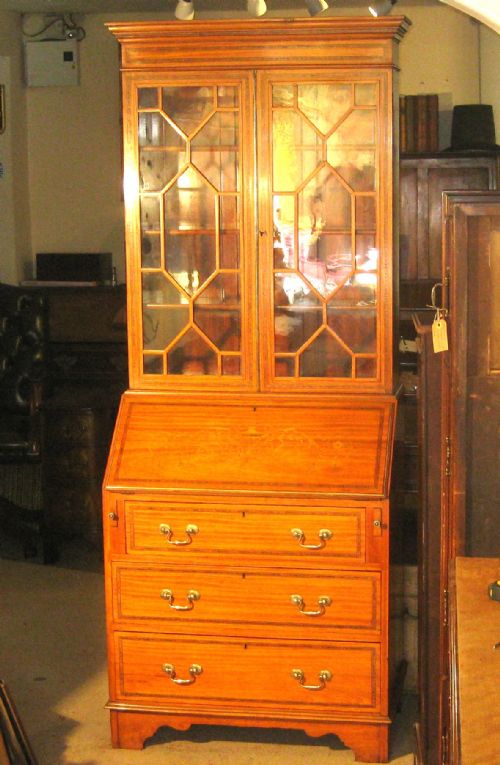
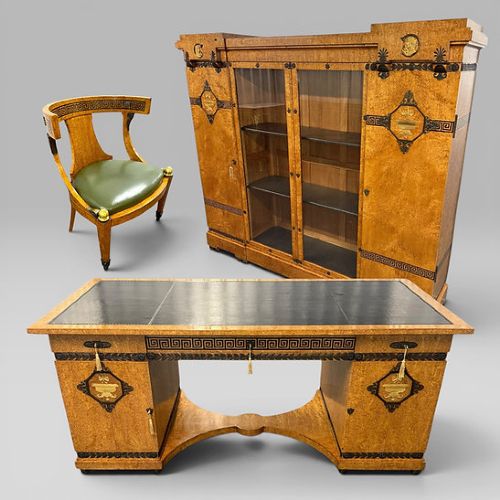
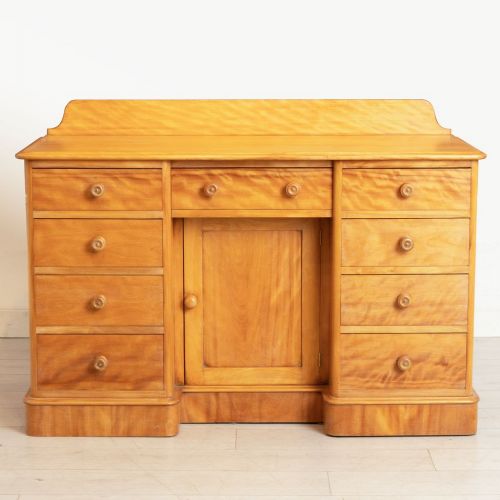
A golden satinwood writing cabinet encompasses sophisticated desk forms, elegant cylinder bookcases, and compact ladies' writing furniture designed for refined domestic spaces. The selection ranges from eighteenth-century George III masterworks to Edwardian interpretations, showcasing the enduring appeal of light-toned exotic timber.
Buyers seeking a golden satinwood writing cabinet will encounter substantial bureau bookcases, refined cylinder cabinets, and dainty bonheur du jour writing tables. These pieces integrate storage, display, and writing surfaces within highly decorative cabinetry.
Originating across Georgian, Victorian, Edwardian, and Continental workshops, these cabinets reflect evolving tastes from classical neoclassical austerity to ornate marquetry revival styles. Each piece serves as a functional workspace and a commanding focal point in a study or drawing room.
What varies in quality
The degree of figuration in the satinwood veneer dictates the visual depth and desirability of the surface, ranging from straight grain to highly mottled flame patterns. Master workshops applied marquetry with exceptional botanical precision, whilst lesser examples rely on simpler stringing and banded inlay.
The complexity of the interior mechanism, such as synchronized cylinder roll-tops and concealed secret drawers, separates standard utility furniture from exhibition-grade creations. Superior pieces exhibit seamless joinery where timber grain aligns continuously across opening doors and drawers.
Listings span the eighteenth century, Georgian period, Victorian era, and Edwardian period, utilising satinwood, mahogany, birch veneer, and brass.
Mercier Frères·Edwards & Roberts·Druce & Co, London
The Golden Satinwood Writing Cabinet Glossary
- Satinwood
- A lustrous tropical hardwood native to Ceylon and the West Indies, prized for its golden yellow colour and natural chatoyancy. It forms the primary decorative surface across late eighteenth and nineteenth-century neoclassical furniture.
- Secretaire
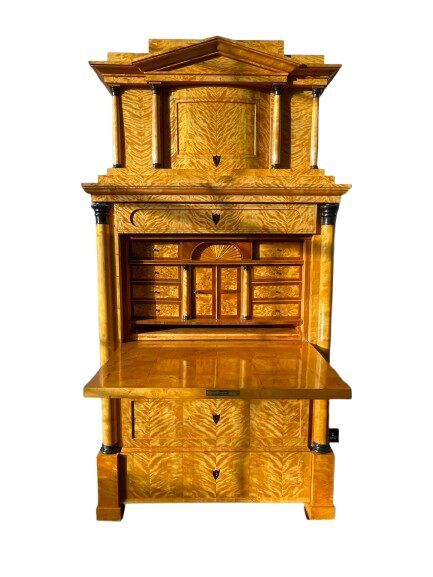
- A cabinet or desk featuring a fitted pull-down writing drawer that conceals small drawers and pigeonholes. This clever mechanism transforms a formal cabinet into an enclosed writing desk.
- Marquetry
- The art of forming decorative patterns by fitting together thin veneers of various coloured woods. Master artisans created intricate floral and neoclassical urn motifs across cabinet doors and fall-fronts.
- Bonheur du jour
- A light ladies' writing desk featuring a small tiered cabinet or superstructure with shelves and drawers above the main work surface. Introduced in France, it became immensely popular in English neoclassical design.
- Cylinder desk
- A writing desk enclosed by a quarter-circle rotating wooden cylinder that covers the desk surface and interior compartments when closed. The curved shutter slides smoothly back into the desk body when opened.
Golden Satinwood Writing Cabinet: Frequently Asked Questions
How do I care for satinwood?
Satinwood furniture requires protection from direct sunlight and excessive humidity to prevent the golden veneers from fading or lifting. Maintaining stable indoor temperatures preserves the natural oils within the timber.
Polishing should be limited to high-quality microcrystalline wax applied sparingly with a soft cloth to maintain the natural lustre.
Where were these cabinets used?
These pieces typically resided in private libraries, drawing rooms, or dedicated boudoirs as refined personal writing desks. They provided secure storage for correspondence and private journals.
Compact variations like the bonheur du jour were specifically designed for ladies to write letters and manage household accounts in comfortable reception rooms.
How do I date a satinwood cabinet?
Dating relies on examining construction techniques, secondary timbers, and stylistic markers such as neoclassical inlay or Edwardian painted details. Eighteenth-century pieces often feature hand-cut dovetails and oak drawer linings.
Later Victorian and Edwardian interpretations utilise machine-sawn components and different framing methods while mimicking earlier Georgian aesthetic styles.