
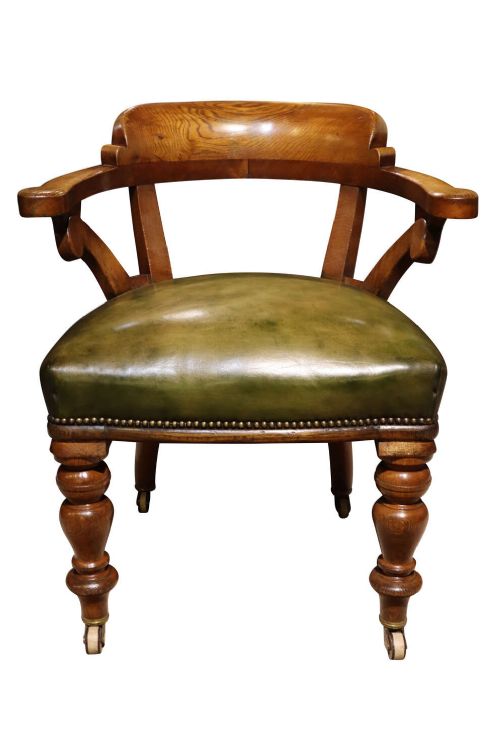
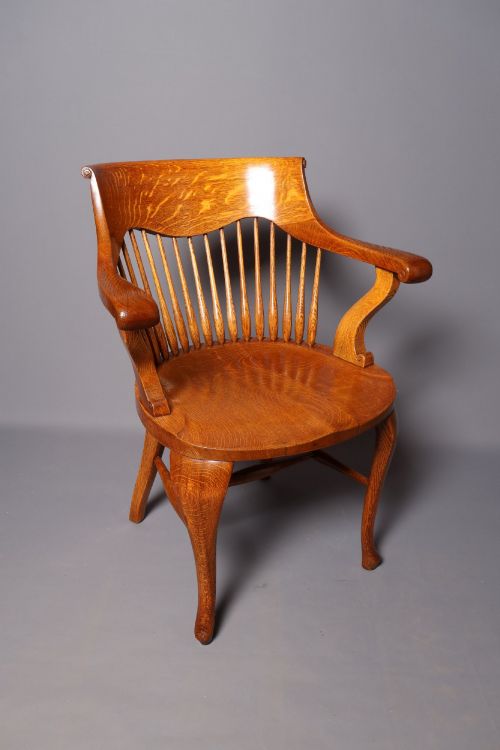

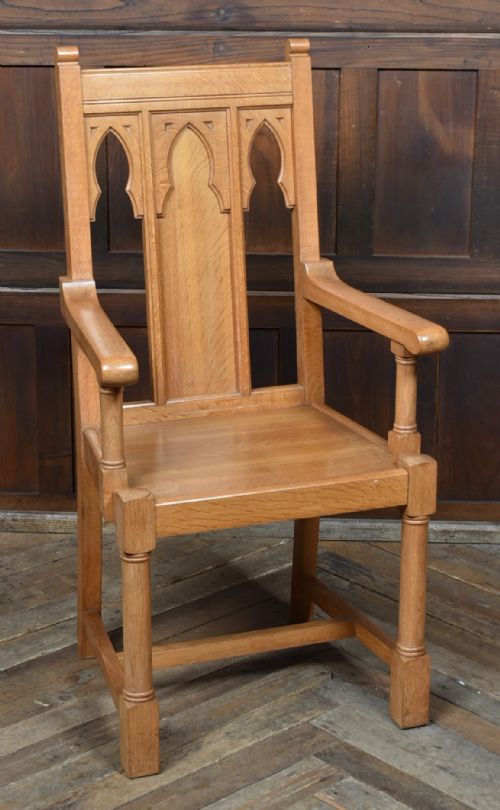


Golden Oak Armchair
A golden oak armchair brings warm timber tones and robust seating to a room, spanning Victorian Gothic and Arts and Crafts origins.
What these golden oak armchairs are
When you search for a golden oak armchair, you encounter sturdy seating created across the nineteenth and early twentieth centuries. The examples here include library chairs, desk chairs, hall chairs, and chapel thrones.
You are most likely to meet Victorian and Edwardian iterations on this page. These range from Gothic revival library chairs in green leather to Arts and Crafts armchairs originating from Masonic lodges.
The forms encompass open armchairs, tub armchairs, and carver armchairs. Many pieces reflect specific regional or institutional provenance, such as Scottish chapel seating or lodge furniture.
How they were made
The construction relies heavily on solid oak timber with distinctive golden tones. Makers utilised brass and metal fixings alongside traditional joinery to build these substantial frames.
Upholstered variations incorporate leather inserts, including button leather panels on library and desk chairs. Decorative details often follow Gothic revival or Arts and Crafts manners.
Retail Price Guide 2026
Typical UK retail prices for golden oak armchair, calculated from the Sellingantiques database of over a million retail prices indexed since 2003. This retail price guide relies exclusively on Sellingantiques data; no external sources or auction records are used, so the figures do not describe the wider market.
Listings feature periods spanning from eighteen seventy through the Edwardian era, constructed in solid oak, leather, and brass.
What varies in quality
The distinction between standard utility seating and finer library armchairs rests in the depth of the carving and the integrity of the timber. Pieces designed for institutional lodges or formal libraries display more ambitious joinery and richer material selection.
The quality of the upholstery integration, such as well-fitted leather panels and buttoning, elevates the finished form. Simpler hall chairs rely entirely on the grain and colour of the golden oak itself.
The Golden Oak Armchair Glossary
- Golden oak
- A warm, honey-toned timber finish characteristic of nineteenth and early twentieth-century furniture. It highlights the natural grain of the wood.
- Arts and Crafts
- A design movement valuing traditional craftsmanship and simple forms. Pieces from this tradition often emerge from communal or lodge commissions.
- Smokers bow
- A low-backed wooden armchair with a turned spindle gallery. This form is commonly found in offices and studies.
Frequently Asked Questions
What periods do these armchairs come from?
The listings span the nineteenth and early twentieth centuries. You will find Victorian, Edwardian, and specific dated examples from around eighteen seventy to nineteen twenty.
This timeframe encompasses both revivalist Gothic aesthetics and later Arts and Crafts movements.
Where were these chairs originally used?
Many examples served in formal libraries, offices, and studies as desk or library chairs. Others originated in institutional settings such as Masonic lodges or Scottish chapels.
Simpler forms functioned as hall chairs or occasional seating within domestic interiors.
What materials are typically used?
Solid oak forms the primary structural material across every piece. This is frequently paired with leather upholstery and brass or metal hardware.
The timber displays a natural golden hue that defines the visual character of the seating.
How do I identify a Gothic Revival armchair?
Gothic revival pieces display architectural influences drawn from medieval design. Look for pointed structural elements, heavy frames, and formal leather upholstery.
These chairs often carry a solemn, grand presence suited to libraries and institutional spaces.